Spirulina Dosage for Horses: Weight Chart, Free Calculator and Safe Feeding Guide
Written & Reviewed By: Medshorse Team
Last Updated: October 2026
The standard spirulina dosage for horses is 20 grams twice daily for a 500 kg (1,100 lb) horse. That works out to about 8 grams per 100 kg of body weight per day. Many owners drop to 10 grams twice daily once symptoms settle.
Label advice is not identical across brands. For a horse of the same size, daily amounts range from 10 grams to 80 grams depending on the product and the goal. This guide puts those numbers side by side, gives you a weight chart and a calculator, and explains what the research does and does not show.
Spirulina is a nutritional supplement, not a medicine. It will not cure heaves, sweet itch or insulin resistance, so treat the numbers below as a starting point and talk to your vet before changing the plan for a horse with a diagnosed condition.
Disclaimer: This article is for general education and is not veterinary advice. Product names mentioned, including Spirulina, belong to their respective owners, and MedsHorse is not affiliated with them. Always follow your veterinarian’s instructions and the current product label.
Spirulina dosage at a glance (500 kg horse)
Doses are based on published guidance from Mad Barn, Forageplus and Reverdy. Always follow the label of the product you buy.
Key takeaways
- Standard dose: 4 g per 100 kg for maintenance and 8 g per 100 kg for active support, split over two feeds.
- Introduce it gradually. Up to half of horses reject the smell at first, so mix it with a little oil.
- Evidence is strongest for metabolic support in a small equine study and weakest for allergies, where only case reports exist.
- Buy human grade Arthrospira platensis with batch testing. Never swap it for unidentified blue-green algae.
- Check competition rules and stop at least 72 hours before an event if your product label advises it.
- Ask your vet first if your horse has EMS, PPID, heaves or any condition under treatment.
What Is Spirulina and What Does It Do for Horses?
Spirulina is a dried blue-green alga, technically a cyanobacterium, made mainly from Arthrospira platensis. It is sold as a fine green powder that you stir into the bucket feed.
Equine vet Dr. Eleanor Kellon describes it as a dense powder with antihistamine, anti-inflammatory and immune moderating effects documented in laboratory work.
Owners feed it for three main reasons: respiratory support during dusty or pollen heavy seasons, relief from seasonal itching such as midge hypersensitivity, and metabolic support for horses with equine metabolic syndrome (EMS). Protein supply is a fourth reason, but it is not spirulina’s strongest use.
What Is Inside Spirulina Powder?
Spirulina nutrition and what it means for your horse
| Component | Amount or detail | Why it matters |
|---|---|---|
| Crude protein | About 60% on the Reverdy label, up to 70% reported | A complete protein, but low in lysine and methionine |
| Phycocyanin | The blue pigment protein | Antioxidant and anti-inflammatory. A mouse study found it raised protective IgA and lowered allergy linked IgE |
| Beta-carotene, vitamins C and E | Present in meaningful amounts | Antioxidants that protect cells from free radical damage |
| Gamma linolenic acid (GLA) | An omega-6 fatty acid | Behaves as an anti-inflammatory fatty acid |
| Thiamine (vitamin B1) | High | Supports carbohydrate metabolism and nerve signalling |
| Iron | About 28 mg per 100 g | 40 g a day supplies roughly 11 mg, against a 400 mg daily need for a 500 kg horse |
Sources: Mad Barn, Forageplus Talk, Reverdy product sheet and Nemoto-Kawamura et al., 2004.
Because it is low in lysine and methionine, spirulina should not be your main protein plan. If you feed it mainly for muscle, add those two amino acids to balance the ration.
Spirulina Dosage for Horses by Weight (Chart)
Feed 4 grams per 100 kg of body weight daily for maintenance and 8 grams per 100 kg daily for the standard dose. A 500 kg horse therefore gets 20 g (maintenance) or 40 g (standard) a day, divided between two feeds.
Spirulina dosage chart for horses by body weight
| Horse type | Body weight | Maintenance per day | Standard per day | Per feeding (twice daily) | Standard amount |
|---|---|---|---|---|---|
| Mini or small pony | 150 kg (330 lb) | 6 g | 12 g | 6 g | |
| Pony | 300 kg (660 lb) | 12 g | 24 g | 12 g | |
| Small horse | 400 kg (880 lb) | 16 g | 32 g | 16 g | |
| Average horse | 500 kg (1,100 lb) | 20 g | 40 g | 20 g | |
| Large horse | 600 kg (1,320 lb) | 24 g | 48 g | 24 g | |
| Warmblood or cob | 700 kg (1,540 lb) | 28 g | 56 g | 28 g | |
| Draft horse | 800 kg (1,760 lb) | 32 g | 64 g | 32 g |
Maintenance is 4 g per 100 kg and standard is 8 g per 100 kg of body weight. Divide the daily total into two feeds.
How This Chart Was Built
The standard column scales the 20 g twice daily rate that Mad Barn and Forageplus publish for a 500 kg horse. It also sits at the top of Reverdy’s range of 2 to 8 g per 100 kg. Maintenance follows Mad Barn’s 10 g twice daily step down. Use a weight tape or scale for a better figure than guessing by eye.
How to Measure Spirulina Accurately
- A 25 ml scoop holds about 20 g according to Forageplus.
- A PharmaHorse scoop is about 10 g, so always check which scoop came with your tub.
- A level tablespoon is roughly 7.5 g, based on a Canadian equine label that lists 2 tablespoons as 15 g.
- Weigh your own scoop once on a kitchen scale, because powder density varies between products.
Free Spirulina Dosage Calculator for Horses
Enter your horse’s weight, pick a goal and the calculator returns a daily total, a per feeding amount and an approximate scoop count.
Spirulina Dosage Calculator for Horses
Enter your horse’s weight, choose kg or lb, and select a dose rate to calculate the estimated spirulina powder amount.
Calculated Spirulina Dose
Horse Weight
0.0 kg / 0.0 lb
Dose Per Feeding
0.0 g
Feedings Per Day
2
Total Daily Dose
0.0 g/day
Selected Reference Dose Rate
The result is estimated by scaling the selected reference dose proportionally to the entered weight. Introduce spirulina gradually and consult your veterinarian before changing your horse’s diet.
Spirulina Dosage by Goal: Allergies, Respiratory Support, EMS and More
The right amount depends on why you are feeding it. This decision guide shows the typical daily amount for a 500 kg horse in each situation.
Which spirulina dose fits your horse?
Spirulina for Horses With Allergies and Respiratory Problems
For seasonal allergies, heaves or inflammatory airway disease, the usual spirulina dose is 20 g twice daily for a 500 kg horse. Dr. Kellon suggests starting 4 to 6 weeks before allergens appear so the supplement is already on board.
The best known data are case reports from the 2006 European Equine Health and Nutrition Congress. An 8 year old Warmblood eventer was fed 20 g of spirulina with 2,000 mg of jiaogulan twice daily. Her post exercise recovery normalised within two days and her cough stopped within a week.
A Standardbred with inflammatory airway disease only partly improved on half that dose, then stopped headshaking and sneezing once the dose doubled. For jiaogulan amounts, see our guide to jiaogulan dosage for horses.
There are no placebo controlled trials in horses, so treat these results as encouraging rather than proven. Spirulina is a support tool. If your vet has prescribed bronchodilators or steroids, do not stop them on your own.
You can compare the usual medication doses in our guides to Ventipulmin dosage for horses, dexamethasone dosage for horses and cetirizine dosage for horses.
Management matters just as much. Soak or steam hay, choose low dust bedding and turn out when you can. Feeding spirulina to a horse eating dusty hay in a closed stable is like mopping while the tap runs.
Spirulina for Sweet Itch and Insect Hypersensitivity
For sweet itch, Mad Barn pairs 20 g of spirulina twice daily with 6 to 8 oz of ground flax and 5,000 mg of chondroitin sulphate twice daily. Spirulina on its own is described as helpful for mild tail and mane rubbing, with the best results seen when chondroitin is added.
The evidence here is anecdotal and based on how spirulina moderates antibody responses, shifting them toward protective IgA and IgG and away from IgE.
Owner reviews on retailer sites report less itching, but they are not controlled data and a change of season can look like a treatment effect. Fly sheets, masks and midge control still do the heavy lifting.
Spirulina for Horses With EMS or Insulin Resistance
Mad Barn lists 20 g twice daily as a dose that can be used in horses with EMS, with veterinary approval first. This is the area with the most solid research, covered in detail below.
Spirulina does not replace diet control, exercise or prescribed treatment. If your vet uses medication, such as the options in our metformin dosage for horses guide, keep that plan in place and ask whether spirulina fits alongside it.
Spirulina for Competition Horses
Mad Barn notes that spirulina was not on the current FEI Equine Prohibited Substances List when its article was updated, but rules change, so confirm with your governing body.
Reverdy goes further and advises stopping at least 72 hours before any sporting event unless you can document that the product is free of prohibited substances. Choose a batch tested product and keep the batch number.
Spirulina as a Protein Source
Spirulina is a concentrated and digestible protein, but Forageplus does not recommend it as the best protein supplement because pea protein has more protein and a better amino acid profile. Spirulina earns its place when you want skin and lung support, with protein as a bonus.
How to Start Feeding Spirulina Step by Step
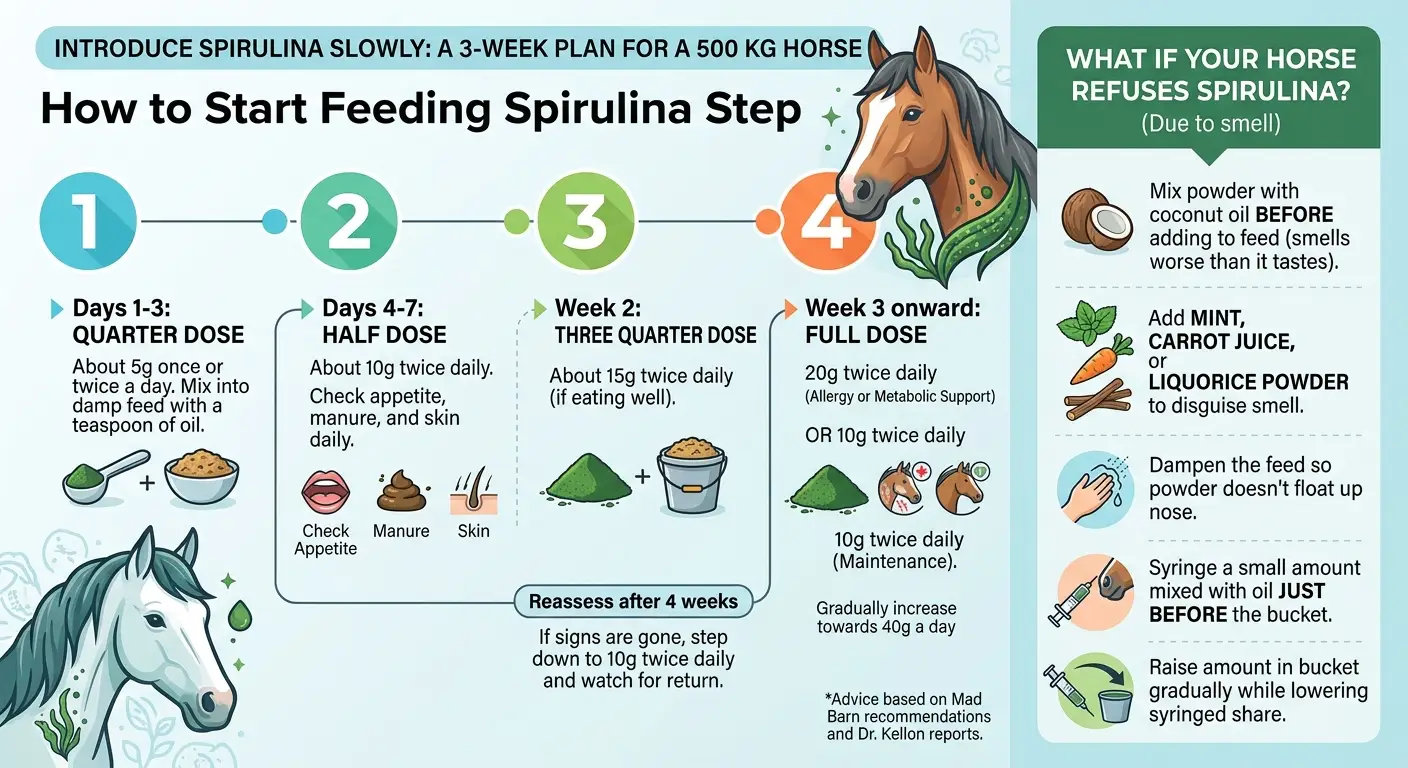
Introduce spirulina slowly over about three weeks. Mad Barn advises increasing the rate gradually toward 40 g a day, and many horses dislike the smell at first. This ramp is a practical way to follow that advice rather than a published protocol.
Suggested introduction plan for a 500 kg horse
About 5 g once or twice a day, mixed into a damp feed with a teaspoon of oil.
About 10 g twice daily. Check appetite, manure and skin each day.
About 15 g twice daily if your horse is eating it without fuss.
20 g twice daily for allergy or metabolic support, or 10 g twice daily for maintenance.
Reassess after 4 weeks. If the signs have gone, step down to 10 g twice daily and watch for a return.
What If Your Horse Refuses Spirulina?
Dr. Kellon reports that up to 50% of horses reject spirulina in a bucket feed, mostly because of the smell. Try these fixes in order:
- Mix the powder with coconut oil before it goes in the feed, since it smells worse than it tastes.
- Add mint, carrot juice or liquorice powder to disguise the smell.
- Dampen the feed so the powder does not float up the nose.
- Syringe a small amount mixed with oil just before the bucket, so the taste is familiar when the feed arrives.
- Raise the amount in the bucket gradually while lowering the syringed share.
What the Research Says About Spirulina in Horses
Published horse research on spirulina is thin. The best controlled data come from one small Polish study, and the respiratory claims rest on case reports. Here is what each shows.
EMS horses fed spirulina for 3 months (Nawrocka et al., 2017)
Six EMS horses received spirulina, six EMS horses received pelleted hay and six healthy horses acted as controls. The EMS control group showed no change in weight or condition score.
What this means: after three months, spirulina fed horses lost weight, lowered fasting insulin and improved insulin sensitivity. Their insulin was still well above the healthy average, so spirulina helped but did not normalise everything.
Limits to keep in mind: only six horses received spirulina, the study ran for three months, and the feeding level was reported as 500 g per day of pelleted product, which is far above the 20 to 80 g a day on retail labels.
We do not know that the home doses in this guide produce the same result. Nobody has published a dose response study in horses.
The respiratory case reports came from Dr. Kellon in 2006 and had no control group. Phycocyanin’s effect on IgE and IgA comes from a mouse study. Taken together, the science supports using spirulina as a low risk support supplement while you manage the underlying cause. It does not support using it as a stand alone treatment.
Is Spirulina Safe for Horses? Risks and Side Effects
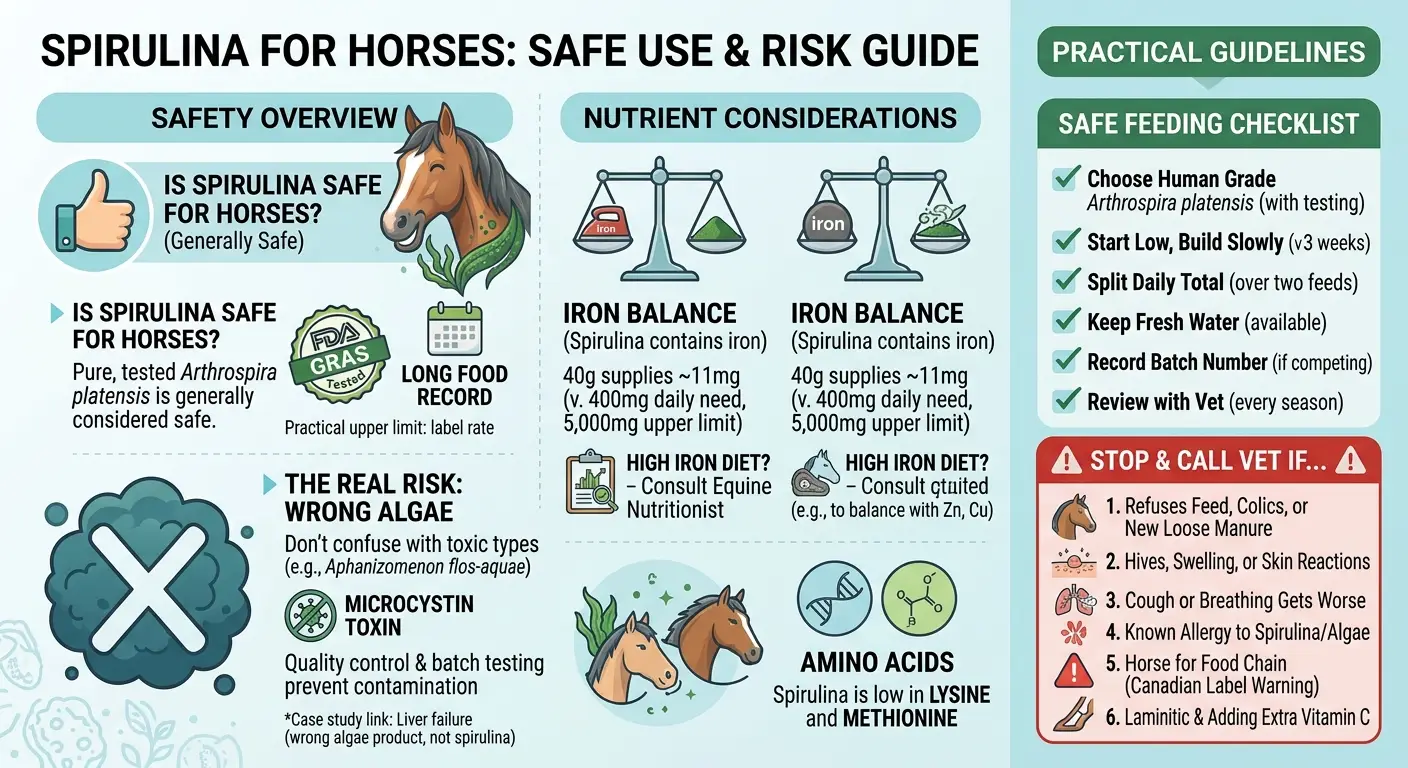
Pure, tested spirulina is generally considered safe for horses. Mad Barn notes it is Generally Recognized as Safe by the US FDA for human use, and Dr. Kellon points to its long record as a food supplement. I could not find an official upper limit for horses, so the practical ceiling is the label rate of your product.
The Real Risk Is the Wrong Algae or a Poor Batch
Not all blue-green algae are equal. A 2016 case report described a Holsteiner gelding that developed liver failure and encephalopathy linked to microcystin toxin in a blue-green algae product, and the animal was euthanised.
That product was Aphanizomenon flos-aquae, not spirulina. Mad Barn cites a 2017 study of algae supplements to explain why spirulina carries lower microcystin levels, but contamination is still a quality control issue, which is why batch testing matters.
Iron and Amino Acid Balance
Spirulina contains iron, but 40 g supplies only about 11 mg against a 400 mg daily need and a 5,000 mg upper tolerable limit for a 500 kg horse. If your horse is already on a high iron diet, balance iron, zinc and copper with an equine nutritionist. Remember too that spirulina is low in lysine and methionine.
Safe feeding checklist
- Choose human grade Arthrospira platensis with batch testing.
- Start low and build up over about three weeks.
- Split the daily total over two feeds.
- Keep fresh water available at all times.
- Record the batch number if you compete.
- Review the plan with your vet every season.
Stop and call your vet if
- Your horse refuses feed, colics or has new loose manure.
- Hives, swelling or other skin reactions appear.
- Cough or breathing gets worse instead of better.
- Your horse is allergic to spirulina or algae.
- The horse will enter the food chain. A Canadian label warns against use in horses intended for food.
- Your horse is laminitic and you plan to add extra vitamin C alongside it.
How to Choose a Quality Spirulina Supplement for Horses
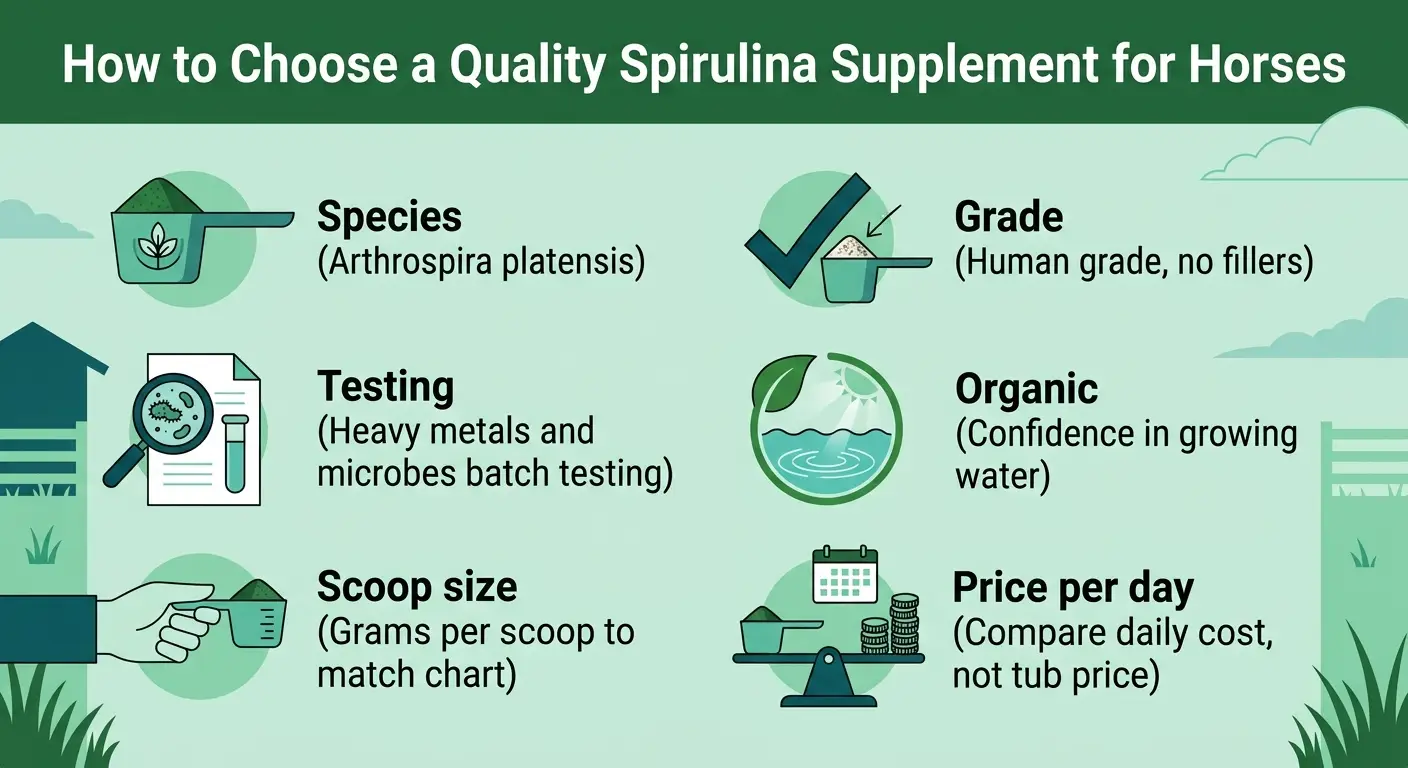
- Species: the label should say Arthrospira platensis or Spirulina platensis, not a vague blue-green algae blend.
- Grade: look for human grade powder with no fillers, sugars or flavourings.
- Testing: prefer brands that screen each batch for heavy metals and microbes. Forageplus and Reverdy both state that they do.
- Organic: optional, but organic sourcing can add confidence about the growing water.
- Scoop size: check the grams per scoop so you can match the chart.
- Price per day: compare cost at your horse’s dose, not the price per tub.
Approximate cost per day for a 500 kg horse
| Product | Listed price | At 20 g per day | At 40 g per day |
|---|---|---|---|
| Reverdy Spirulina 1 kg | EUR 26.50 | EUR 0.53 | EUR 1.06 |
| Forageplus Organic Spirulina (about 25 days at 40 g) | GBP 27.99 | GBP 0.56 | GBP 1.12 |
| PharmaHorse Spirulina (1 kg bucket shown) | From EUR 34.95 | EUR 0.70 | EUR 1.40 |
Prices were seen on the brand websites in October 2026 and change often. Cost per day is calculated from the listed price and an assumed 1 kg pack where not stated.
Spirulina vs Other Supplements
Spirulina compared with common alternatives
| Supplement | Best use | Strength | Watch out for |
|---|---|---|---|
| Spirulina | Skin, lung and metabolic support | Complete protein plus antioxidants and immune modulating compounds | Smell, low lysine and methionine, quality control |
| Pea protein | Muscle and topline | Higher protein and a better amino acid profile, per Forageplus | Does not offer spirulina’s antihistamine effects |
| Chlorella | General nutrition | Safe and nutritious | Lacks the high protein and immune effects of spirulina, per Dr. Kellon |
| Aphanizomenon flos-aquae blends | None recommended | Marketed as blue-green algae | Linked to a microcystin toxicity case in a horse |
| Seaweed or kelp | Iodine and trace minerals | Mineral dense | Different purpose and iodine load. See our guide to kelp dosage for horses |
Spirulina also pairs well with other supplements. Mad Barn lists MSM, flaxseed meal, jiaogulan and vitamin C as safe combinations, though Dr. Kellon cautions against extra vitamin C for laminitic horses.
If your horse’s minerals are unbalanced, review your forage first, including the magnesium dosage for horses if magnesium is a concern.
Pros and Cons of Feeding Spirulina to Horses
Pros
- Complete protein with antioxidants in one powder
- May moderate allergic responses
- Small controlled study showed benefits in EMS
- Generally recognised as safe when pure
- Easy to combine with other supplements
Cons
- Strong smell and frequent refusal
- Little horse specific research
- Quality varies between brands
- Low in lysine and methionine
- Daily cost adds up for large horses
Common Spirulina Feeding Mistakes
- Starting at the full dose. A sudden switch is the quickest way to cause refusal.
- Using it instead of treatment. Spirulina supports a plan, it does not replace medication or management.
- Guessing the scoop size. A 10 g scoop and a 20 g scoop give very different doses.
- Buying unidentified blue-green algae. Check the species on the label.
- Starting after symptoms appear. For seasonal allergies, begin 4 to 6 weeks early.
- Ignoring competition rules. Check your governing body and stop before events if the label says so.
FAQs
How much spirulina should I give my horse per day?
A 500 kg horse typically gets 20 g twice daily, which is 8 g per 100 kg of body weight per day. Maintenance is half of that, at 10 g twice daily. Scale the amount to your horse and follow the label of your product.
What is the spirulina dosage for a 500 kg horse?
The common dose for a 500 kg horse is 20 g twice daily, or 40 g per day in total. After signs settle, many owners reduce to 10 g twice daily as a maintenance dose.
Can I give a horse too much spirulina?
Pure spirulina has a wide safety margin and Dr. Kellon states that feeding too much is not a problem. I could not find an official upper limit for horses, so stay within your label rate, watch the cost and ask your vet before going higher.
Should I give spirulina once or twice a day?
Most guidance splits the daily amount over two feeds, which Forageplus calls best practice. A Canadian equine label lists once daily dosing, so follow the directions on your product.
How long does spirulina take to work in horses?
Case reports describe improved respiratory recovery within two days and a stopped cough within a week. The EMS study measured changes after three months. Results vary and many reports are anecdotal.
When should I start spirulina for seasonal allergies?
Dr. Kellon suggests starting 4 to 6 weeks before allergies usually begin. Forageplus suggests beginning in February or March in the UK to cover the summer months.
Can spirulina help horses with heaves or equine asthma?
Spirulina may support breathing by moderating allergic responses, and case reports show improvement alongside jiaogulan. There are no placebo controlled trials, so use it alongside dust control and your vet’s plan, not instead of it.
Is spirulina safe for horses with EMS or insulin resistance?
A small study of six EMS horses found lower fasting insulin, weight loss and better insulin sensitivity after three months. Mad Barn lists 20 g twice daily as usable in EMS horses, but check with your vet first and keep up diet and exercise.
Can spirulina help sweet itch?
Evidence is mostly anecdotal. Mad Barn pairs 20 g of spirulina twice daily with ground flax and chondroitin sulphate for horses with sweet itch, alongside fly protection and midge control.
Is spirulina safe for competition horses?
Mad Barn reported that spirulina was not on the current FEI prohibited list, but rules change. Reverdy advises stopping at least 72 hours before an event. Check your governing body and keep the batch number.
How do I get a picky horse to eat spirulina?
Mix it with coconut oil, dampen the feed, and add mint, carrot juice or liquorice powder. If the horse still refuses, syringe a small oil mixed dose before the bucket feed and build up gradually.
Can I mix spirulina with other supplements?
Mad Barn lists MSM, flaxseed meal, jiaogulan and vitamin C as safe combinations. Dr. Kellon advises against extra vitamin C for laminitic horses, so check with your vet first.
Is spirulina better than pea protein for building muscle?
Forageplus does not recommend spirulina as the best protein supplement because pea protein has a higher protein level and better amino acid profile. Spirulina is more useful for skin and lung support.
What type of spirulina is safe for horses?
Choose human grade Arthrospira platensis that is batch tested for heavy metals and microbes. Avoid unidentified blue-green algae products, because Aphanizomenon flos-aquae was linked to a fatal microcystin case in a horse.
Can pregnant mares, lactating mares or foals have spirulina?
I could not find a published spirulina dose for foals or broodmares. Mad Barn notes that lactating mares and growing horses need more protein, but ask your vet or an equine nutritionist before feeding it.
Final Thoughts and Next Steps
The most reliable spirulina dosage for horses is 20 grams twice daily for a 500 kg horse, stepping down to 10 grams twice daily for maintenance. Scale by body weight for ponies and draft horses, introduce it slowly and buy a batch tested, human grade product.
Here is a simple plan:
- Weigh your horse with a tape or scale and use the calculator above.
- Check your scoop size on a kitchen scale.
- Ask your vet if your horse has EMS, PPID, heaves or takes any medication.
- Start at a quarter dose and build to the full dose over about three weeks.
- Reassess after four weeks and step down if the signs have settled.
Spirulina works best as one part of a plan that also includes low dust forage, fly protection, balanced minerals and regular vet care.
This article is for education only and is not veterinary advice. Your vet knows your horse’s health history and should guide any change to diet, supplements or medication.
Sources and Further Reading
- Mad Barn: Benefits of Spirulina for Horses
- Forageplus Talk: Spirulina for Horses by Dr. Eleanor Kellon, VMD
- Nawrocka et al., Marine Drugs, 2017: Spirulina platensis and insulin sensitivity in EMS horses
- Kellon, 2006: Use of Gynostemma pentaphyllum and Spirulina platensis in horses
- Nemoto-Kawamura et al., 2004: Phycocyanin and IgA and IgE responses in mice
- Mittelman et al., 2016: Microcystin associated liver failure in a Holsteiner gelding
- Roy-Lachapelle et al., 2017: Cyanotoxins in algae dietary supplements
- Reverdy: Spirulina for horses 1 kg product sheet
- PharmaHorse: Spirulina for horses
- Forageplus: Organic Spirulina for Horses
- The Natural Way: Spirulina for horses with sweet itch
- Drugs.com: Equine Spirulina (Canada) label information