Ranitidine Dosage for Horses: Chart, Calculator & Safe Guide, Safety Tips & More
Written & Reviewed By: Medshorse Team
Last Updated: October 2026
Your vet has mentioned ranitidine for your horse’s ulcers, and now you are looking at a prescription label wondering if the numbers add up. Good instinct to double check. Ranitidine dosage for horses is based on body weight, it has to be repeated several times a day, and small mistakes in timing or math can leave a horse under-treated.
The short answer: the normal oral ranitidine dose for horses is 2.2 to 6.6 mg per kg of body weight every 6 to 8 hours, and the normal IV dose is 2 mg per kg every 6 to 8 hours, according to the Vet Drugs List. For a 500 kg (1,100 lb) horse, that is about 1,100 to 3,300 mg by mouth per dose.
The MSD Veterinary Manual lists a different schedule of 11 mg per kg every 12 hours, shown below as an alternative. This guide includes a full weight chart, a working calculator and the limits of the evidence.
Disclaimer: This article is for general education and is not veterinary advice. Product names mentioned, including Ranitidine, belong to their respective owners, and MedsHorse is not affiliated with them. Always follow your veterinarian’s instructions and the current product label.
Ranitidine for Horses at a Glance
Reference figures from veterinary sources. Your vet sets the final dose.
- Ranitidine is an H2 blocker that lowers stomach acid so ulcers can heal.
- Normal range (Vet Drugs List): 2.2 to 6.6 mg/kg by mouth or 2 mg/kg IV, every 6 to 8 hours.
- Alternative (MSD Veterinary Manual): 11 mg/kg by mouth or 1.3 mg/kg IV, every 12 hours.
- It is not FDA approved for horses and is used off label under veterinary direction.
- Omeprazole beat ranitidine in head to head racehorse studies.
- Between 60% and 100% of adult horses in training develop ulcers at some point.
What Is Ranitidine and How Does It Work in Horses?
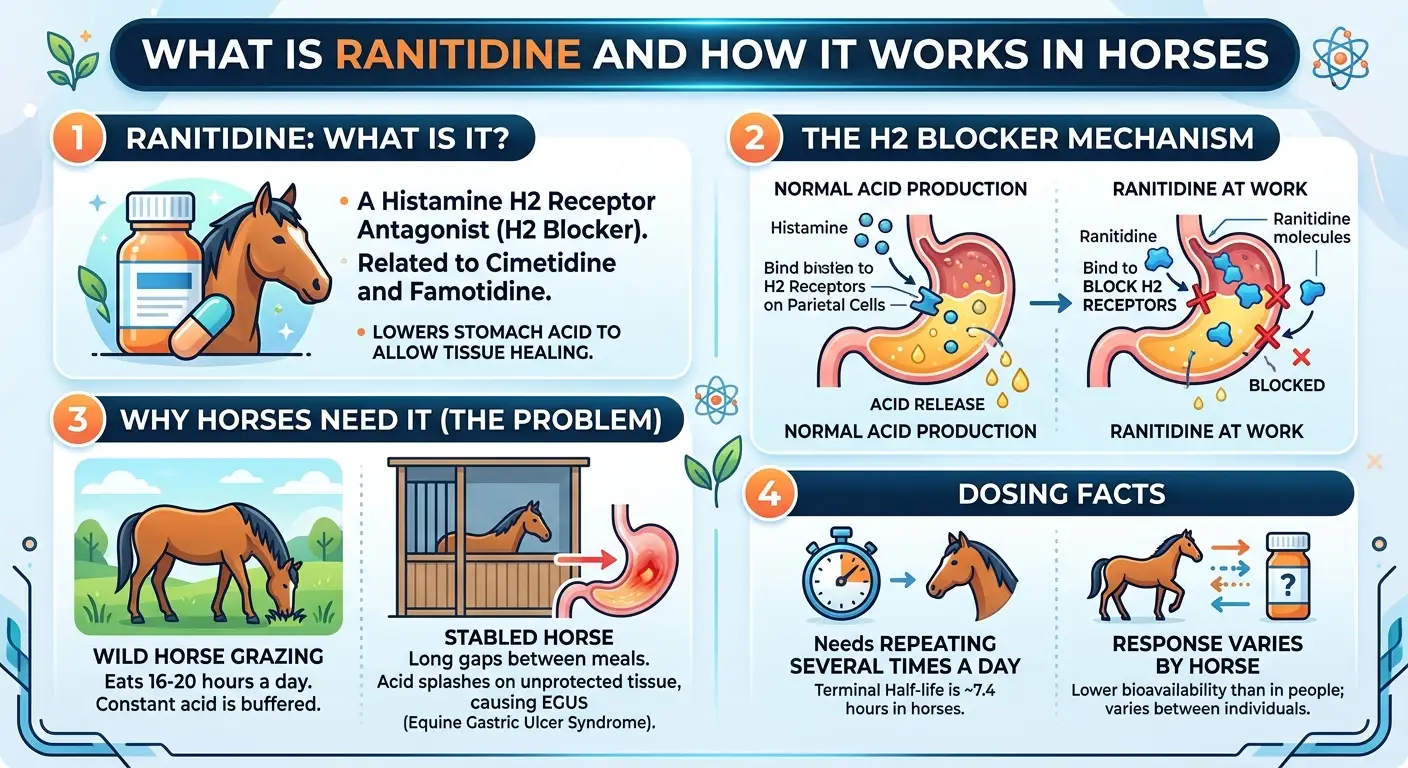
Ranitidine (the drug once sold as Zantac) is a histamine H2 receptor antagonist, usually called an H2 blocker. In plain terms, it lowers the amount of acid a horse’s stomach produces so damaged tissue gets a chance to heal.
Here is the mechanism. Histamine binds to H2 receptors on parietal cells in the stomach lining, and that signal tells the cells to make acid. Ranitidine blocks those receptors, so less acid is released. It belongs to the same family as cimetidine and famotidine.
Horses make acid around the clock, even when they are not eating. That is fine for a wild horse that grazes 16 to 20 hours a day, but a stabled horse on long gaps between meals can end up with acid splashing on unprotected tissue. That is how Equine Gastric Ulcer Syndrome (EGUS) develops.
Two facts about ranitidine in horses matter for dosing. First, the terminal half-life is about 7.4 hours, which helps explain why it needs repeating several times a day. Second, bioavailability is lower in horses than in people, and it varies from horse to horse. That variation is one reason some horses respond well and others do not.
Ranitidine Dosage for Horses: What the Sources Say
The normal range for horses is 2.2 to 6.6 mg per kg of body weight by mouth every 6 to 8 hours, or 2 mg per kg IV every 6 to 8 hours (Vet Drugs List, horse row). The MSD Veterinary Manual lists 11 mg per kg by mouth, or 1.3 mg per kg IV, every 12 hours. Treatment normally runs for at least 3 to 4 weeks.
Oral ranitidine dose for horses
The Vet Drugs List gives 2.2 to 6.6 mg per kg by mouth every 6 to 8 hours, drawing on the Papich and Plumb’s drug handbooks. Treat this as the normal range. The MSD Veterinary Manual lists 11 mg per kg by mouth every 12 hours as an alternative schedule.
Oral products come as tablets (commonly 150 mg or 300 mg), powders or compounded suspensions.
IV ranitidine dose for horses
Injectable ranitidine is typically a 25 mg/mL solution. The normal IV dose from the Vet Drugs List is 2 mg per kg every 6 to 8 hours. The MSD Veterinary Manual lists 1.3 mg per kg every 12 hours. IV use belongs in the vet’s hands. Rapid injection has caused heart rhythm changes and low blood pressure in small animals, so it is given slowly.
Why do the published doses differ?
If you compare the two sources, the numbers look far apart: a lower dose given three or four times a day against a higher dose given twice a day. Horses differ in how much ranitidine they absorb, which is one reason references do not agree on a single schedule. The table below shows exactly what each source lists.
Ranitidine Doses for Horses by Source
Figures are as published. They are not a recommendation for your horse.
| Source | Oral dose | IV dose |
|---|---|---|
| Vet Drugs List (normal range) | 2.2 to 6.6 mg/kg every 6 to 8 hours | 2 mg/kg every 6 to 8 hours |
| MSD Veterinary Manual (alternative) | 11 mg/kg every 12 hours | 1.3 mg/kg every 12 hours |
Dose sources: Vet Drugs List ranitidine page and MSD Veterinary Manual antiulcerative drugs table. The charts and calculator below use these doses.
Ranitidine Dosage Chart for Horses by Weight
Use these charts to see the math behind a prescription. They show the normal range from the Vet Drugs List first, with the MSD rate as an alternative. Tablet counts, shown in brackets, assume plain 300 mg tablets, and IV volumes assume a 25 mg/mL solution.
Compounded products have their own concentrations, so always follow your pharmacy label.
Oral Ranitidine Dosage Chart for Horses
Dose per administration in mg, with the number of 300 mg tablets in brackets. For 150 mg tablets, double the numbers in brackets.
| Horse weight | Normal range, 2.2 to 6.6 mg/kg every 6 to 8 hrs | Alternative, 11 mg/kg every 12 hrs |
|---|---|---|
| 200 kg (441 lb) | 440 to 1,320 mg (1.5 to 4.4) | 2,200 mg (7.3) |
| 300 kg (661 lb) | 660 to 1,980 mg (2.2 to 6.6) | 3,300 mg (11) |
| 400 kg (882 lb) | 880 to 2,640 mg (2.9 to 8.8) | 4,400 mg (14.7) |
| 500 kg (1,102 lb) | 1,100 to 3,300 mg (3.7 to 11) | 5,500 mg (18.3) |
| 600 kg (1,323 lb) | 1,320 to 3,960 mg (4.4 to 13.2) | 6,600 mg (22) |
| 700 kg (1,543 lb) | 1,540 to 4,620 mg (5.1 to 15.4) | 7,700 mg (25.7) |
| 800 kg (1,764 lb) | 1,760 to 5,280 mg (5.9 to 17.6) | 8,800 mg (29.3) |
| 900 kg (1,984 lb) | 1,980 to 5,940 mg (6.6 to 19.8) | 9,900 mg (33) |
| 1000 kg (2,205 lb) | 2,200 to 6,600 mg (7.3 to 22) | 11,000 mg (36.7) |
Sources: normal range from the Vet Drugs List, alternative from the MSD Veterinary Manual.
IV Ranitidine Dosage Chart for Horses
Dose in mg, with volume of 25 mg/mL solution in brackets. For reference only. IV ranitidine is given slowly by a veterinarian.
| Horse weight | Normal, 2 mg/kg every 6 to 8 hrs | Alternative, 1.3 mg/kg every 12 hrs |
|---|---|---|
| 200 kg (441 lb) | 400 mg (16 mL) | 260 mg (10.4 mL) |
| 300 kg (661 lb) | 600 mg (24 mL) | 390 mg (15.6 mL) |
| 400 kg (882 lb) | 800 mg (32 mL) | 520 mg (20.8 mL) |
| 500 kg (1,102 lb) | 1,000 mg (40 mL) | 650 mg (26 mL) |
| 600 kg (1,323 lb) | 1,200 mg (48 mL) | 780 mg (31.2 mL) |
| 700 kg (1,543 lb) | 1,400 mg (56 mL) | 910 mg (36.4 mL) |
| 800 kg (1,764 lb) | 1,600 mg (64 mL) | 1,040 mg (41.6 mL) |
| 900 kg (1,984 lb) | 1,800 mg (72 mL) | 1,170 mg (46.8 mL) |
| 1000 kg (2,205 lb) | 2,000 mg (80 mL) | 1,300 mg (52 mL) |
Sources: normal dose from the Vet Drugs List, alternative from the MSD Veterinary Manual. Conversion used: 1 kg equals 2.2046 lb.
Quick example: a 1,000 lb horse weighs about 454 kg. At the normal range of 2.2 to 6.6 mg per kg, that is about 1,000 to 3,000 mg per oral dose (up to ten 300 mg tablets) every 6 to 8 hours. At the MSD rate of 11 mg per kg every 12 hours it is about 5,000 mg per dose.
Weight matters more than most owners expect. A weight tape is only an estimate, and a livestock scale is better. If you are guessing your horse’s weight, you are guessing the dose.
Ranitidine Dosage Calculator for Horses
Enter your horse’s weight, pick the rate that matches your vet’s instructions and see the numbers. Both sources’ oral and IV rates are included. The calculator is built to check your math, not to replace your vet.
© medshorse.com
How to Give Ranitidine to a Horse Safely
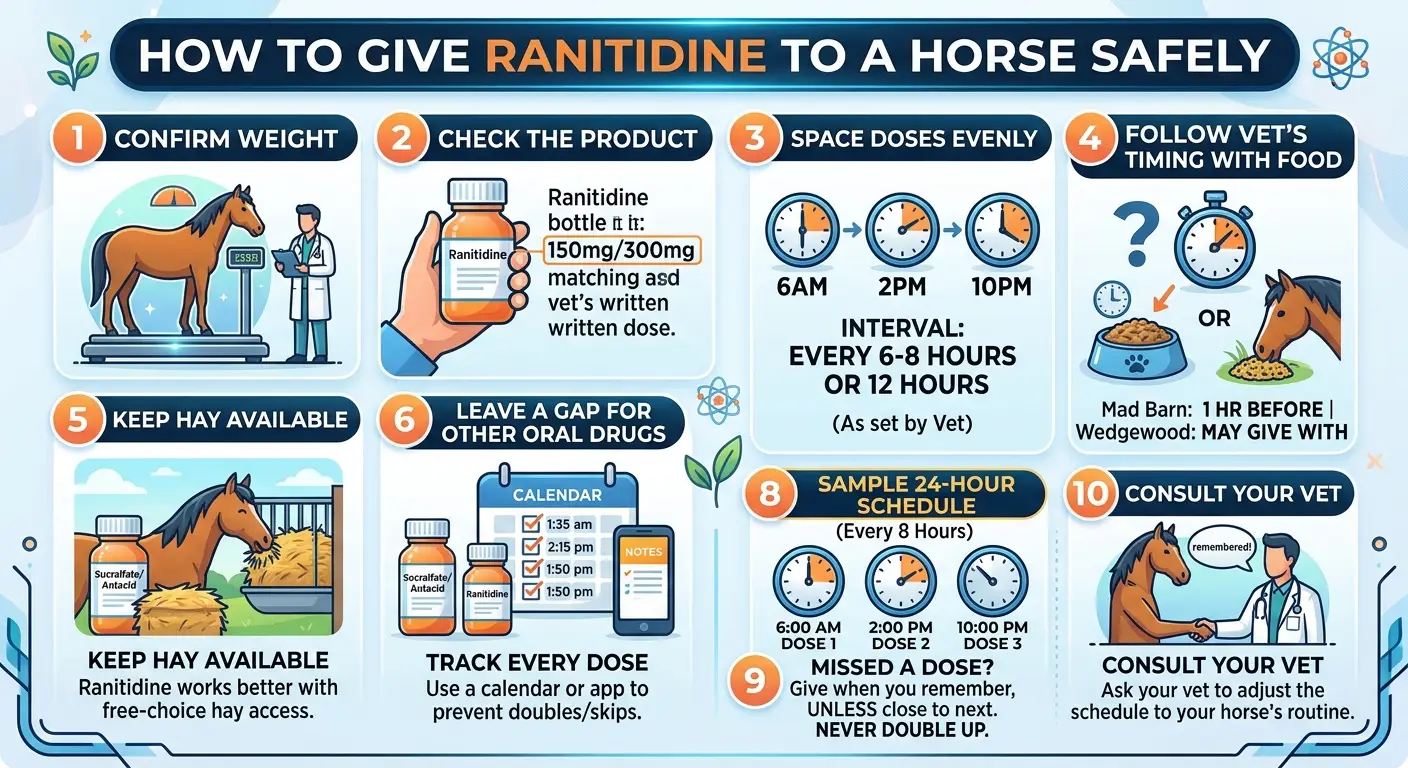
Giving a drug two to four times a day is where most owners slip. A simple routine keeps blood levels steady and protects the stomach lining overnight too.
- Confirm the weight. Use a scale if you can, and give your vet the current figure.
- Check the product. Match the strength on the label (for example 150 mg or 300 mg tablets, or a compounded concentration) to the amount you were told to give.
- Space doses evenly. Follow the interval your vet sets. The references list every 6 to 8 hours or every 12 hours, so build the times around that.
- Follow your vet’s timing with food. Mad Barn’s review advises about one hour before a meal, while Wedgewood’s owner guidance says it may be given with food.
- Keep hay available. A study of five adult horses found ranitidine lowered gastric acidity better with free access to hay than in unfed horses.
- Leave a gap around other oral drugs. Allow about 2 hours around antacids, sucralfate and similar products.
- Track every dose. Write each dose on a calendar or in a notes app so nothing is doubled or skipped.
Sample 24 Hour Ranitidine Schedule
An example for an every 8 hour schedule. Every 6 hour and every 12 hour plans are spaced the same way. Ask your vet to adjust it to your horse’s routine.
Dose 1
About one hour before morning feed
Dose 2
Eight hours after dose 1
Dose 3
Covers the long overnight stretch
Missed a dose? Give it when you remember unless the next dose is close. Never double up.
How Long Does a Horse Stay on Ranitidine?
Most vets treat for a minimum of 3 to 4 weeks, and longer if the ulcers are numerous or severe. Do not stop early because your horse looks better. Signs do not always match severity, so a horse with few signs can still have serious lesions.
A follow-up gastroscopy tells you whether the ulcers have healed. It is also worth asking your vet how to wind treatment down. Studies in people show rebound acid hypersecretion after ranitidine, and whether that happens in horses has not been studied yet.
Does Ranitidine Work for Horse Ulcers? The Evidence
Yes, ranitidine can lower stomach acidity in horses, but it is less reliable than omeprazole. Studies show some benefit, mostly for squamous ulcers, with lots of variation between individual horses.
What the Key Studies Found
Summaries based on published abstracts and Mad Barn’s research reviews.
Murray and Schusser, 1993. Five adult horses. Ranitidine reduced gastric acidity when horses had free access to hay, with less effect in unfed horses.
Murray and colleagues, 1996. Eight horses put through intermittent feed deprivation developed squamous ulceration. Those given ranitidine had significantly fewer ulcerated areas.
Lester and colleagues, 2005. Sixty racing Thoroughbreds with squamous ulcers. Omeprazole was more effective than ranitidine at healing them.
Hwang and colleagues, 2022. Forty-nine Korean Thoroughbred racehorses. Omeprazole again outperformed ranitidine.
Some treatment failures may come down to dosing. One reference points to incorrect doses and the difficulty of giving several doses a day as likely reasons ranitidine fails in practice. If you want a stronger option, see our guide to omeprazole dosage for horses.
Ranitidine vs Omeprazole for Horses: Which Is Better?
Omeprazole is better for most ulcer cases. It is a proton pump inhibitor that blocks acid at the last step of production, and GastroGard is the FDA approved treatment for equine gastric ulcers. Ranitidine’s case rests on lower cost and a long track record.
Ranitidine vs Omeprazole for Horses
Side by side comparison from veterinary references.
| Feature | Ranitidine | Omeprazole |
|---|---|---|
| Drug class | H2 blocker | Proton pump inhibitor |
| Typical oral dose | 2.2 to 6.6 mg/kg every 6 to 8 hours, or 11 mg/kg every 12 hours | 4 mg/kg once daily for treatment, 2 mg/kg once daily to prevent recurrence (MSD) |
| Doses per day | 2 to 4 | 1 |
| FDA approved for horses | No | Yes (GastroGard) |
| Head to head racehorse trials | Less effective | More effective |
| Availability | Limited, often compounded | Widely available |
| Cost | Lower | Higher |
Cost Comparison Reported by Mad Barn
Prices change, and ranitidine supply varies by region.
Other ulcer medications compared
Ranitidine is only one tool. Omeprazole suppresses acid most strongly. Cimetidine and famotidine are other H2 blockers. Sucralfate coats ulcerated tissue and is often paired with acid reducers (see sucralfate dosage for horses). Misoprostol, a prostaglandin analog, is typically used for glandular ulcers (see misoprostol dosage for horses with glandular ulcers).
Squamous and glandular ulcers behave differently. Squamous ulcers sit in the upper part of the stomach, which lacks a protective mucus layer, and respond well to acid suppression. Glandular ulcers sit in the lower part of the stomach and often need a different combination, so a gastroscopy helps your vet choose.
Ranitidine Side Effects and Safety in Horses
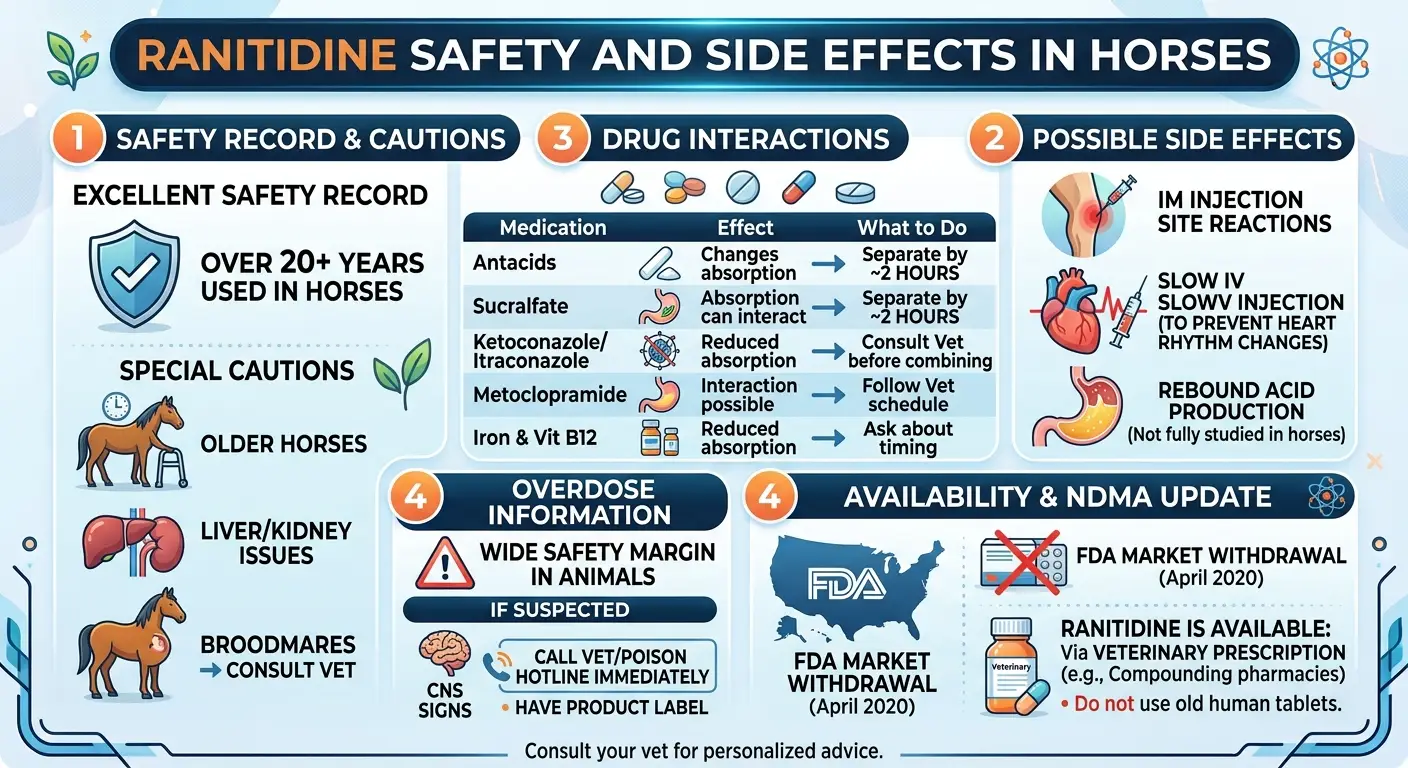
Ranitidine has an excellent safety record. Wedgewood Pharmacy’s monograph calls H2 blockers very safe drugs with few side effects, and notes ranitidine has been used in horses for more than 20 years. It also states that no specific side effect information for horses was found.
Possible side effects and cautions
- Injection site reactions can occur with intramuscular injection.
- Rapid IV injection has caused vomiting and transient heart rhythm changes in dogs and cats, which is why IV doses are given slowly.
- Older horses and horses with reduced liver or kidney function may need a lower dose.
- One reference advises avoiding ranitidine in pregnant or lactating animals, so raise this with your vet if you have a broodmare.
- Rebound acid production after stopping treatment is documented in people but has not been studied in horses.
Ranitidine drug interactions
Common Interactions to Discuss With Your Vet
| Medication or product | What can happen | What to do |
|---|---|---|
| Antacids | Can change ranitidine absorption | Separate oral doses by about 2 hours |
| Sucralfate | Often prescribed together, absorption can interact | Allow about 2 hours between oral doses |
| Metoclopramide | Some vets advise spacing the doses | Follow your vet’s schedule |
| Ketoconazole and itraconazole | Absorption may drop when stomach acid falls | Ask your vet before combining |
| Iron supplements and vitamin B12 | Absorption may be reduced | Ask about timing and need |
What if a horse gets too much ranitidine?
H2 blockers have a wide margin of safety in laboratory animals. No overdose information was found for horses, and one reference notes central nervous system signs at high doses. Call your vet or an animal poison hotline right away, and have the product label and the amount given ready.
Availability and the NDMA issue
In April 2020 the FDA ordered all ranitidine products off the US market after some were found to contain NDMA, a probable carcinogen. Ranitidine is still used in other countries, and compounding pharmacies such as Wedgewood prepare veterinary versions with a prescription.
Read the FDA’s NDMA update on ranitidine for background. Do not use old human tablets from the medicine cabinet.
Competition rules
Ranitidine is a Class 5 substance in the ARCI Uniform Classification Guidelines, which covers drugs with localized actions. Penalties and withdrawal times depend on your sport, so check your governing body’s current rules before competing.
Ranitidine for Horses: Pros and Cons
Pros
- Lower cost than omeprazole
- Decades of use in horses
- Few reported side effects
- Available as oral and injectable forms
- Can be combined with sucralfate
Cons
- Needs two to four doses a day
- Variable absorption between horses
- Less effective than omeprazole in trials
- Not FDA approved for horses
- Hard to find in the US without compounding
Signs Your Horse May Have Ulcers
Ulcer signs are easy to miss, and they do not track with severity. Watch for girth sensitivity, reduced appetite, weight loss, a rough coat, chronic diarrhea, cribbing, behavior changes, reduced performance and colic. A gastroscopy is the only definitive diagnosis, and it shows whether the ulcers are squamous, glandular or both.
If your horse is on NSAIDs, the stomach can be at extra risk. Ask your vet about protection when using drugs such as bute dosage for horses, Banamine dosage for horses or Previcox dosage for horses.
Managing Ulcers Beyond Medication
Drugs treat the lesions, but management stops them from returning. Recurrence is common once treatment ends, so the daily routine matters as much as the prescription.
- Feed a forage based diet with near constant access to hay or pasture.
- Limit starchy grain meals, which raise ulcer risk.
- Avoid hard exercise on an empty stomach.
- Reduce stress from sudden changes in routine, housing or herd mates.
- Ask your vet about gut support such as glutamine dosage for horses with ulcers during recovery.
Common Ranitidine Dosing Mistakes
- Guessing body weight instead of measuring it.
- Skipping the midday dose because it is inconvenient.
- Stopping treatment when the horse seems better.
- Giving antacids or sucralfate at the same moment as ranitidine.
- Using leftover human tablets without veterinary advice.
- Treating the drug as a cure and not changing feed or turnout.
- Forgetting to check competition rules before a show.
Checklist Before You Give the First Dose
- My vet has confirmed ranitidine is right for my horse.
- I know my horse’s current weight.
- I checked the strength and concentration on the label.
- I wrote down the dose in mg and the times to give it.
- I know the 2 hour gap needed around antacids and sucralfate.
- I know how long the course should last and when the follow up is booked.
- I checked competition rules if my horse will be tested.
FAQs
What is the ranitidine dosage for horses?
The normal oral range is 2.2 to 6.6 mg per kg of body weight every 6 to 8 hours, according to the Vet Drugs List. For a 500 kg horse that is about 1,100 to 3,300 mg per dose. The MSD Veterinary Manual lists a different schedule of 11 mg per kg every 12 hours. Your veterinarian sets the final dose.
How much ranitidine can I give a 1,000 lb horse?
A 1,000 lb horse weighs about 454 kg. At the normal range of 2.2 to 6.6 mg per kg, one oral dose is about 1,000 to 3,000 mg, or up to ten 300 mg tablets, every 6 to 8 hours. The MSD rate of 11 mg per kg every 12 hours works out to about 5,000 mg per dose. Confirm the amount and product strength with your vet.
What is the IV dose of ranitidine for horses?
The normal IV dose from the Vet Drugs List is 2 mg per kg every 6 to 8 hours. The MSD Veterinary Manual lists 1.3 mg per kg every 12 hours. A 500 kg horse would get 1,000 mg (40 mL of a 25 mg/mL solution) on the first schedule or 650 mg (26 mL) on the second. IV ranitidine should only be given slowly by a veterinarian.
How often should a horse get ranitidine?
The normal interval is every 6 to 8 hours, which is three to four doses a day (Vet Drugs List). The MSD Veterinary Manual lists every 12 hours, which is two doses a day. The terminal half-life is about 7.4 hours. Follow the interval your vet sets and keep doses evenly spaced.
How long does ranitidine take to heal ulcers in horses?
Veterinarians usually treat for a minimum of 3 to 4 weeks. The exact time depends on the number and severity of the ulcers. A follow-up gastroscopy is the only way to confirm that the lesions have fully healed before treatment is stopped.
Is ranitidine better than omeprazole for horses?
No. Head-to-head studies in racing Thoroughbreds found omeprazole healed squamous ulcers more effectively than ranitidine. Omeprazole is also given once a day, while ranitidine needs two to four doses. Ranitidine’s main advantages are lower cost and a long history of use.
Is ranitidine safe for horses?
Ranitidine is generally considered safe, with few reported side effects, and it has been used in horses for more than 20 years. Use extra caution in older horses and in horses with reduced liver or kidney function, where a lower dose may be needed.
What are the side effects of ranitidine in horses?
No specific side effects have been well documented in horses. Injection site reactions can occur with intramuscular use. Rapid intravenous injection has caused heart rhythm changes in dogs and cats, so IV doses are given slowly. Acid rebound after stopping has been seen in people but is not yet studied in horses.
Can I buy ranitidine for horses over the counter?
In the United States, no. The FDA ordered all ranitidine products off the market in April 2020 over NDMA concerns. Ranitidine is not FDA approved for horses, and compounding pharmacies can prepare it with a veterinarian’s prescription. Availability differs in other countries.
Can horses take human ranitidine tablets such as Zantac?
Do not use leftover human tablets on your own. Human ranitidine products were withdrawn in the US because some contained NDMA, a probable carcinogen. If your vet recommends ranitidine, ask for a compounded or properly sourced product and follow the label.
Should ranitidine be given before or with food?
One major reference advises giving the oral dose about one hour before a meal. Another monograph says it may be given with food. Research shows ranitidine lowers acidity best when horses have free access to hay, so keep forage available and follow your vet’s timing advice.
Can ranitidine be given with sucralfate?
Yes, vets often prescribe them together. Because antacids and sucralfate can change how ranitidine is absorbed, allow about 2 hours between oral doses. Your veterinarian can build a schedule that fits both medications and your horse’s feeding routine.
What should I do if I miss a dose of ranitidine?
Give the missed dose as soon as you remember. If the next dose is almost due, skip the missed one and return to the normal schedule. Never double up to catch up. Try to keep doses evenly spaced.
Can ranitidine prevent ulcers in horses on NSAIDs?
Veterinarians sometimes prescribe H2 blockers such as ranitidine as a precaution when a horse takes NSAIDs or corticosteroids. Evidence in horses is limited, and omeprazole is more commonly used. Ask your vet whether protection is needed for your horse’s drug plan.
Is ranitidine allowed in horse competition?
Ranitidine is listed as a Class 5 drug in the ARCI Uniform Classification Guidelines, which covers drugs with localized actions. Rules and withdrawal times differ between racing and sport federations, so check your governing body’s current list before competing.
What are alternatives to ranitidine for horses?
Omeprazole is the most common choice and GastroGard is FDA approved for equine ulcers. Other options include famotidine, cimetidine, sucralfate and misoprostol. Which one fits depends on whether the ulcers are squamous or glandular, so work with your vet.
Can foals take ranitidine?
Foals are a high risk group for ulcers, and H2 blockers show individual variation in absorption. The references reviewed here do not give a foal dose, so foal dosing must come from your veterinarian. Never scale an adult dose down on your own.
How do I know if my horse has ulcers?
Common signs include girth sensitivity, poor appetite, weight loss, a rough coat, behavior changes, reduced performance and colic. Signs do not always match severity, so only a gastroscopy gives a firm diagnosis and shows where the ulcers are.
Final Thoughts and Next Steps
Ranitidine dosage for horses comes down to three things: weight, schedule and supervision. The normal oral range is 2.2 to 6.6 mg per kg every 6 to 8 hours, with the MSD Veterinary Manual listing 11 mg per kg every 12 hours as an alternative, but the evidence says omeprazole usually heals ulcers more reliably. Ranitidine still has a place as a lower cost option or part of a combination plan.
Your next step is simple. Weigh your horse, take the chart to your vet, and ask whether ranitidine, omeprazole or a combination fits the ulcer type. Then pair the plan with better feeding habits so the ulcers do not come back.
Sources and further reading
- MSD Veterinary Manual: Antiulcerative Drugs table
- Mad Barn: Ranitidine for Equine Gastric Ulcer Treatment
- Wedgewood Pharmacy: Ranitidine for Veterinary Use
- Vet Drugs List: Ranitidine (horse dose row)
- Vetscraft: Ranitidine for Animals (pregnancy and high dose cautions)
- EquiMed: Ranitidine (spacing from other oral drugs)
- ECEIM consensus statement on Equine Gastric Ulcer Syndrome in adult horses (J Vet Intern Med, 2015)
- Lester et al. 2005: Omeprazole or ranitidine for squamous ulceration in racing Thoroughbreds
- Murray and Schusser 1993: 24 hour gastric pH in horses treated with ranitidine
- Hwang et al. 2022: Gastric ulcers in Korean Thoroughbred racehorses