Milk Thistle Dosage for Horses: Weight Chart, Free Calculator and the Safety Facts Most Guides Skip
Written & Reviewed By: Medshorse Team
Last Updated: October 2026
Getting the milk thistle dosage for horses right sounds simple until you read a few product labels. One says 4 grams a day for a 500 kg horse. Another says 25 grams. A German herb guide goes as high as 50 grams. Same plant, wildly different numbers.
So who is right? Honestly, nobody has a veterinary-approved answer yet, and that is exactly why a clear, honest guide is useful. Below you will find a weight-based dosage chart, a free calculator, a plain-English summary of what horse studies actually show, and the safety rules worth knowing before the first scoop goes into the bucket.
Disclaimer: This article is for general education and is not veterinary advice. Product names mentioned, including Milk Thistle, belong to their respective owners, and MedsHorse is not affiliated with them. Always follow your veterinarian’s instructions and the current product label.
- For a 500 kg horse, published labels range from about 4 g to 25 g of ground milk thistle seed per day. Leaf based herb products are dosed higher still, up to 50 g in one German guide.
- A cautious starting point is 0.8 g per 100 kg of body weight, which is 4 g for a 500 kg horse.
- Horses absorb silibinin poorly. Bioavailability was only 0.6% when fed in one study, so the form and dose both matter.
- A silibinin extract caused no dose-limiting toxicity in healthy horses at up to 26 mg per kg twice daily for a week. That is an extract, not a licence to feed unlimited powder.
- Milk thistle is a supplement, not a treatment for liver disease. A sick horse needs a vet first.
- Check with your vet before feeding it to pregnant or nursing mares, foals, or horses on medication.
What Is Milk Thistle and Why Do Horse Owners Feed It?
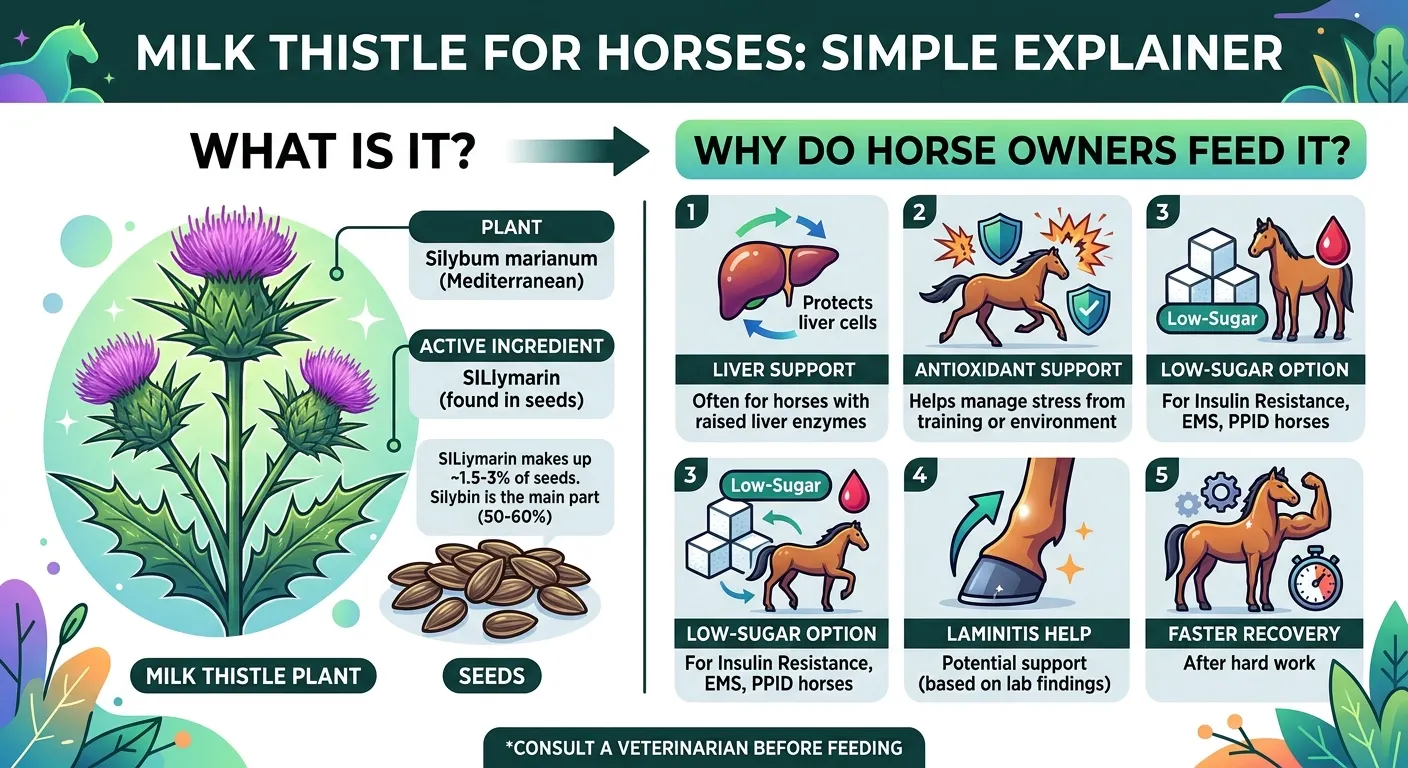
Milk thistle (Silybum marianum), also called St. Mary’s thistle, is a Mediterranean plant with purple flowers and spiny leaves. Its seeds contain silymarin, a mixture of compounds called flavonolignans. The main ones are silybin (also written silibinin), isosilybin, silychristin and silydianin.
A 2021 digestibility study from Mendel University in Brno reports that silymarin makes up roughly 1.5 to 3 percent of the dry seed. Silybin is the biggest share of that, at about 50 to 60 percent.
Silymarin is the reason horse owners reach for this herb. It works as an antioxidant, and lab research suggests it protects liver cells. People feed it to horses for five main reasons:
- Liver support, usually after a vet has noticed raised liver enzymes
- General antioxidant support for horses under training or environmental stress
- A low-sugar herb for insulin resistant, EMS or PPID horses
- Laminitis-prone horses, based mostly on lab findings
- Faster recovery after hard work
How well horse research backs each of those is a separate question, and we cover it honestly below.
Seed, Leaf, Oil or Extract: Which Form Are You Buying?
Here is why the form matters. The dose that suits one product can be badly wrong for another.
| Form | What it is | What to know |
|---|---|---|
| Ground seed powder | Whole seeds milled to a fine powder | The form most single-ingredient supplements and dosing charts refer to. Contains the silymarin complex. |
| Seed cake (expeller) | Seed residue left after oil pressing | Still contains flavonolignans. Used at hundreds of grams per day in Czech feeding trials. |
| Dried leaf or herb | Leaves and aerial parts | Not the main silymarin source. Contains compounds such as apigenin and luteolin. Often dosed at tens of grams. |
| Cold-pressed oil | Oil from the seeds | Dosed by volume in millilitres, so it cannot be compared with powder grams. |
| Standardized extract | Concentrated silybin, sometimes bound to phospholipid | Used in research. Poorly absorbed by the horse even when concentrated. |
How Much Milk Thistle Should You Give a Horse?
For a 500 kg horse, product labels range from about 4 to 25 grams of milk thistle seed powder a day. No official veterinary dose exists, so start at the low end, weigh the powder on a scale, and ask your vet first if your horse has a health condition.
Practical tip: Always check whether the product is seed or leaf before you copy a dose from any chart, including this one. This guide’s numbers apply to pure ground seed powder only.
Milk Thistle Dosage Chart by Body Weight
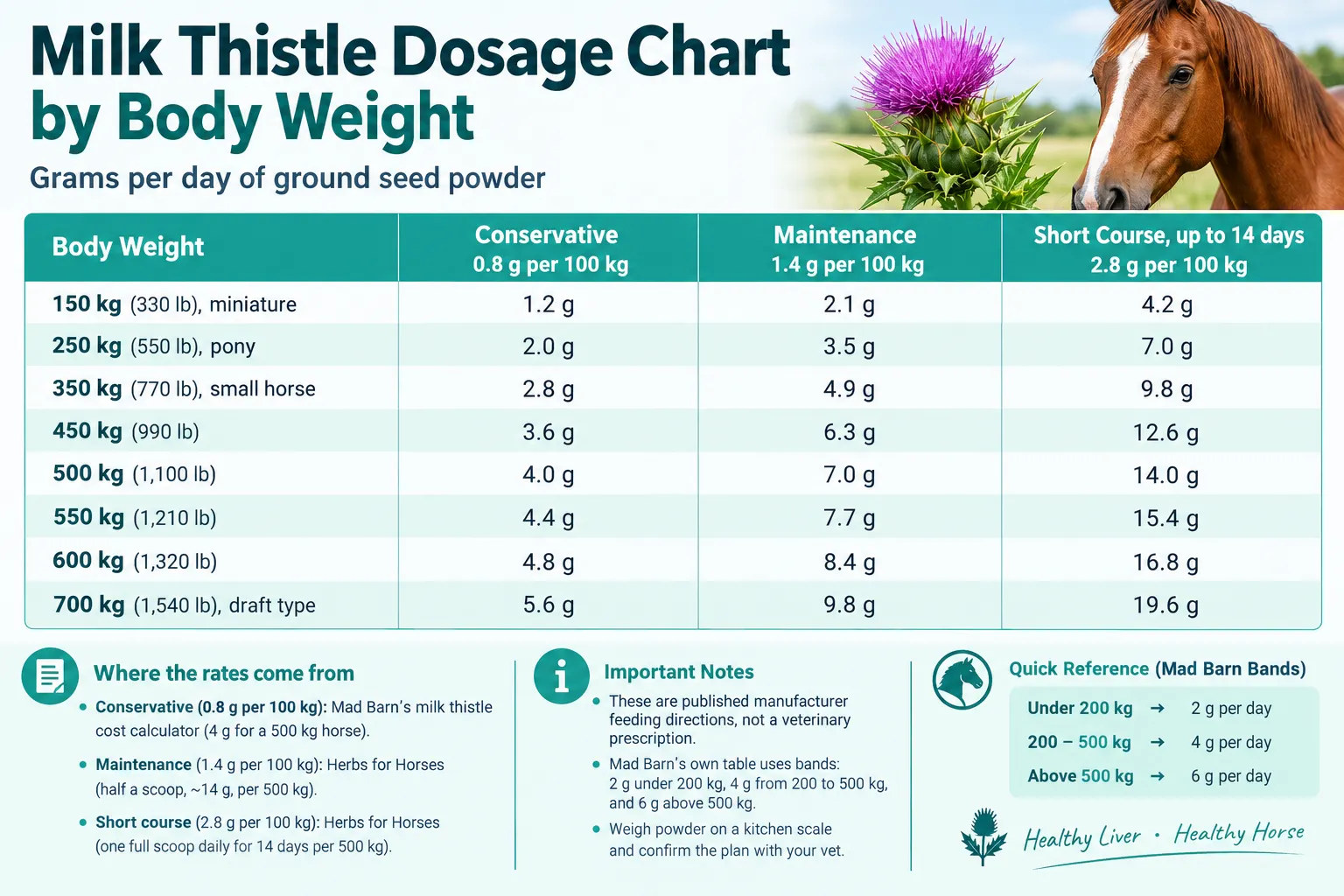
The chart below turns published feeding directions into a simple per-weight table. It uses three rates, each taken from a real supplier’s instructions.
| Body weight | Conservative0.8 g per 100 kg | Maintenance1.4 g per 100 kg | Short course, up to 14 days2.8 g per 100 kg |
|---|---|---|---|
| 150 kg (330 lb), miniature | 1.2 g | 2.1 g | 4.2 g |
| 250 kg (550 lb), pony | 2.0 g | 3.5 g | 7.0 g |
| 350 kg (770 lb), small horse | 2.8 g | 4.9 g | 9.8 g |
| 450 kg (990 lb) | 3.6 g | 6.3 g | 12.6 g |
| 500 kg (1,100 lb) | 4.0 g | 7.0 g | 14.0 g |
| 550 kg (1,210 lb) | 4.4 g | 7.7 g | 15.4 g |
| 600 kg (1,320 lb) | 4.8 g | 8.4 g | 16.8 g |
| 700 kg (1,540 lb), draft type | 5.6 g | 9.8 g | 19.6 g |
Rates come from published manufacturer feeding directions, not from a veterinary prescription. Mad Barn’s own table uses bands instead: 2 g under 200 kg, 4 g from 200 to 500 kg and 6 g above 500 kg. Weigh powder on a kitchen scale and confirm the plan with your vet.
Here is where each column comes from:
- Conservative, 0.8 g per 100 kg: the serving rate in Mad Barn’s milk thistle cost calculator, which works out to 4 g for a 500 kg horse.
- Maintenance, 1.4 g per 100 kg: Herbs for Horses suggests half a scoop (their scoop is about 14 g) per 500 kg for maintenance.
- Short course, 2.8 g per 100 kg: the same brand suggests one full scoop daily for 14 days per 500 kg.
Free Milk Thistle Dosage Calculator
Enter your horse’s weight, pick a plan, and the tool does the maths.
Milk Thistle Dosage Calculator for Horses
For pure ground milk thistle seed powder only. Not for leaf products, oils, extracts or blends. Weigh powder on a kitchen scale and confirm the plan with your vet.
© medshorse.com
Why Do Milk Thistle Label Doses Vary So Much?
Here is what a 500 kg horse would receive on six different published labels.
Four things explain the spread:
- Different plant parts. Silymarin sits in the seed coat, not the leaf. A dried herb product and a seed powder are not interchangeable gram for gram.
- No standard silymarin content. The Mendel researchers note that the exact makeup of the silymarin complex varies with growing conditions and processing.
- Different goals. Some labels describe a short course, others daily maintenance.
- Low absorption. In a 2013 pharmacokinetic study, silibinin bioavailability was just 0.6% when fed and 2.9% by stomach tube. With numbers that low, nobody can say a given label is the “correct” one.
Milk Thistle Dosage for Ponies, Minis, Seniors and Foals
Dose by body weight, not by species. At the conservative rate, a 250 kg pony gets about 2 g a day and a 150 kg miniature about 1.2 g. PharmaHorse and the Pferdegold guide both halve the horse dose for ponies.
Senior horses follow the same weight-based maths. Add a vet check if your senior has PPID or takes regular medication.
Foals and weanlings are different. One supplier says there is no age restriction when fed appropriately, but it still advises asking a vet or nutritionist. With so little research in young horses, get vet approval first.
How to Measure Milk Thistle Powder: Grams, Scoops and Teaspoons
Scoop sizes differ by brand, which causes real dosing errors. Published scoop sizes include:
- Mad Barn: 1 scoop is 9 cc, or 4 g
- NAF Equine: 1 level 15 ml scoop is about 6 g
- PharmaHorse: 1 scoop is about 8.5 g
- Herbs for Horses: 1 scoop is about 14 g
Based on those figures, one level teaspoon of fine powder weighs roughly 2 g. A kitchen scale beats any scoop, and Mad Barn itself advises using a scale for accurate dosing.
What Does Research Say About Milk Thistle Dosage in Horses?
The horse research is small but useful. Four studies matter most.
The Digestibility Study: Does a Bigger Dose Absorb Better?
In the Mendel University study, five Czech Warmblood mares averaging 480 kg ate milk thistle seed cake mixed into barley granules. Doses stepped up through 100, 200, 400 and 700 g a day, with each level lasting 21 days.
Digestibility rose with dose up to 400 g a day, then leveled off. The authors suggested 400 g of seed cake daily as the most suitable level from a digestibility standpoint. Blood values stayed in the normal range, and flavonolignans in plasma were below the detection limit.
Treat these numbers with caution:
- Only five healthy horses took part.
- Doses ran back to back with no washout period, which peer reviewers pointed out.
- Seed cake is a feed ingredient, not a supplement powder. 400 g of cake is nowhere near a supplement scoop.
Bioavailability and Safety
The 2013 Colorado State study gave nine healthy horses silibinin bound to phospholipid. Five horses then ate increasing doses of 0, 6.5, 13 and 26 mg per kg twice daily, each for seven days. Silibinin did not accumulate and no dose-limiting toxicity appeared.
The authors concluded it was safe but poorly bioavailable, and called for studies in horses with liver disease. Remember this was a concentrated extract, so it says little about megadosing raw powder.
Performance Horses: Cortisol and Energy Metabolism
In a 56-day trial in 12 driving horses, seed cake of up to 400 g daily was fed before heavy exercise. Significant differences showed up mainly in cortisol and NEFA (a fat energy marker).
A Kentucky Equine Research summary notes the milk thistle horses had a smaller cortisol rise after exercise, with no change in liver or kidney function.
A 2022 review in Planta Medica found that none of the animal studies reported problems linked to milk thistle.
The Laminitis Lab Study
A 2014 study on hoof tissue found that milk thistle extract and silymarin reduced lamellar separation triggered by bacterial toxins in a dish. That is a promising lab result. It does not prove that feeding milk thistle prevents laminitis in a live horse.
What the Research Cannot Tell Us Yet
Be wary of any guide that promises more than this. In the sources reviewed, there is no established dose for horses with liver disease, no long-term safety data, and no head-to-head comparison of seed, leaf and extract forms. That is why the safest approach is a conservative dose with vet oversight.
Is Milk Thistle Worth Feeding? Evidence by Situation
| Situation | What horse research shows | Our reading |
|---|---|---|
| Healthy horse, no concern | Safe in feeding trials. Blood markers stayed normal, and no clear benefit appeared in healthy mares. | Optional, not essential |
| Raised liver enzymes | Authors of the main safety study called for more work in horses with liver disease. | Use only alongside a vet diagnosis and repeat bloodwork |
| Insulin resistant, EMS or PPID | Suppliers describe the pure powder as free of sugar and starch. Little horse outcome data exists. | A reasonable low-sugar option to discuss with your vet |
| Laminitis prone | Lab study on hoof tissue showed protection against toxin-driven lamellar separation. | Promising, but not proven in live horses |
| Performance horse | Small Czech trials showed a smaller post-exercise cortisol rise and NEFA differences. | Early signals only |
If your vet has diagnosed insulin resistance and is discussing medication, our guide to metformin dosage for horses explains how that dosing works. Milk thistle does not replace it.
Owners managing laminitis risk also look at other herbs, such as the one covered in our jiaogulan dosage for horses guide. For joint comfort rather than liver support, see devils claw dosage for horses.
How to Feed Milk Thistle to Your Horse Step by Step
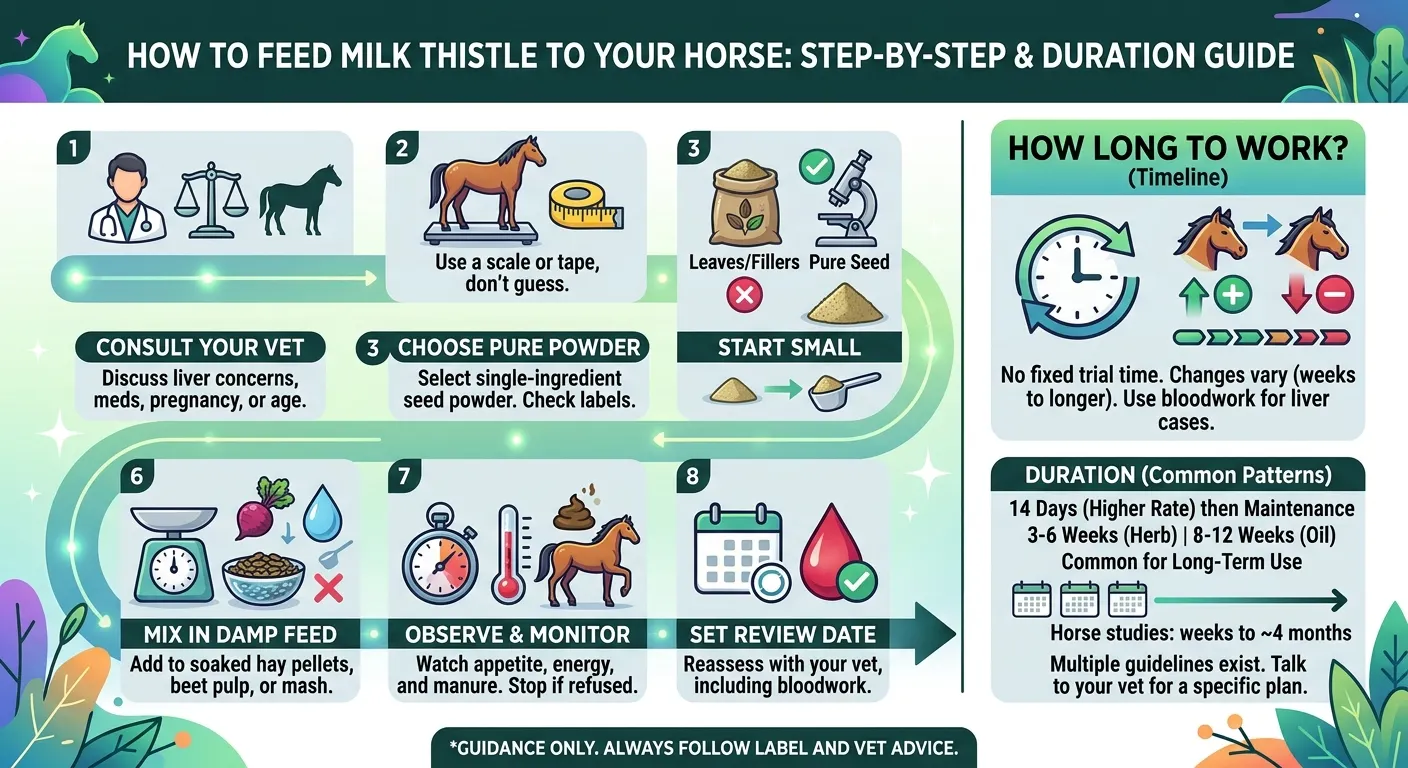
- Talk to your vet first if your horse has liver concerns, takes medication, is pregnant or nursing, or is a youngster.
- Get an accurate weight. Use a scale or weigh tape instead of guessing.
- Choose a single-ingredient seed powder. Check the label for seed rather than leaf, and for no added sugars or fillers.
- Start small. Mad Barn suggests beginning with a smaller amount and building up over several weeks to reduce the chance of refusal.
- Weigh every serving. Use a kitchen scale, not a scoop from a different brand.
- Mix it into damp feed. Soaked hay pellets, beet pulp or a mash work well. If you already feed fiber supplements, add one new product at a time. Our psyllium husk dosage for horses guide covers that routine.
- Watch your horse. Note appetite, manure consistency and energy, and stop if your horse refuses the feed or the manure loosens.
- Set a review date. Decide when you and your vet will reassess, and recheck bloodwork if you started it for a liver concern.
How Long Does Milk Thistle Take to Work in Horses?
No horse trial gives a firm answer. Mad Barn says some horses show changes within a few weeks while others take longer. If you feed it for a liver concern, bloodwork is a far better measure than how your horse looks.
How Long Should You Feed It?
Feeding guides mention several patterns. Herbs for Horses suggests 14 days at the higher rate before dropping to maintenance. The Pferdegold guide suggests three to six weeks for herb and eight to twelve weeks for oil. Mad Barn describes long-term use as common. The horse studies themselves lasted weeks to about four months.
Milk Thistle Side Effects, Risks and When to Avoid It
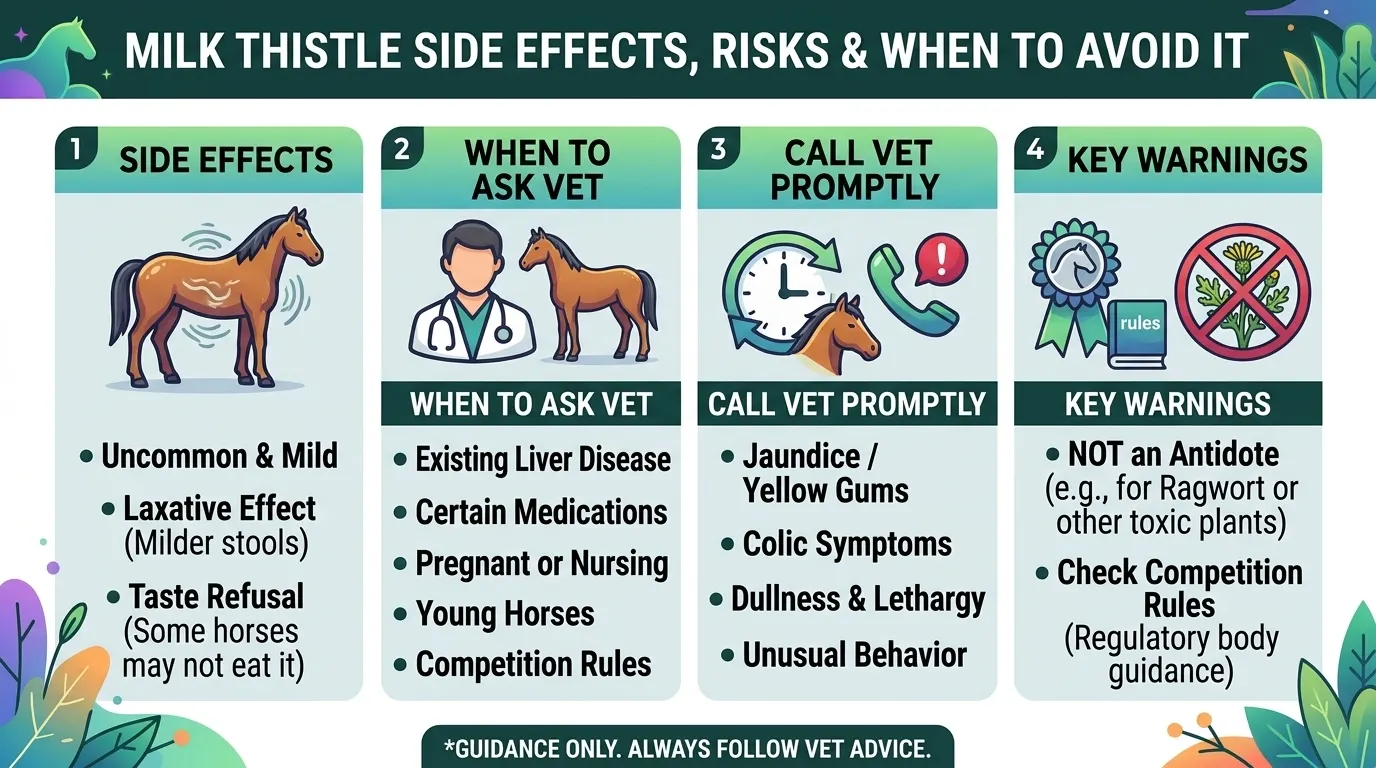
Milk thistle is generally well tolerated, and suppliers describe side effects as uncommon. The two reported issues are reduced feed acceptance because of the herbal taste (Mad Barn) and a possible mild laxative effect (Pferdegold).
Ask your vet before feeding if your horse:
- has known or suspected liver disease or abnormal bloodwork
- takes prescription medication, especially drugs cleared by the liver
- is pregnant or nursing
- is a foal, weanling or yearling
- competes under rules that test for prohibited substances
Call your vet promptly if you notice:
- yellow gums or eyes (jaundice)
- weight loss, poor appetite or dullness
- signs of colic
- sores on pale, sun-exposed skin
- unusual behavior, wandering or head pressing
A few points deserve more detail:
- Pregnancy and nursing. There is limited research in breeding mares, so Mad Barn advises against it unless a vet recommends it.
- Medications. Milk thistle is processed by the liver, and one supplier warns it may influence how some drugs are handled. If your horse is on long-term pain relief, such as the drug covered in our bute dosage for horses guide, tell your vet about every supplement.
- Liver disease. Several supplier pages claim there are no contraindications. That overstates what we know. A horse with true liver disease needs a diagnosis, not self-treatment.
- Toxic plants. No study we reviewed shows milk thistle reverses poisoning from plants such as ragwort. Some herbs carry liver risks themselves, which is why our comfrey dosage for horses guide opens with safety.
- Competition. Mad Barn says its plain powder complies with current FEI rules, and NAF states compliance with the BETA NOPS code in the UK. Rules change, so confirm with your governing body.
Common Milk Thistle Mistakes
- Comparing grams across seed, leaf, oil and extract
- Using scoops from one brand to dose another
- Skipping the vet when liver values are high
- Treating milk thistle as a replacement for removing the cause, such as a toxin, a medication issue or a diet problem
- Starting at the full dose on day one
- Never rechecking bloodwork after starting for a liver concern
- Assuming natural means no interaction
How Much Does Milk Thistle Cost Per Day?
Prices below were checked in October 2026 and will change.
| Product (seed powder) | Price when checked | Daily amount | Approximate cost per day |
|---|---|---|---|
| Mad Barn, 1 kg | $37.04 on subscription ($38.99 one time) | 4 g | about $0.15 |
| Herbs for Horses, 1 kg | C$44.00 | 7 g maintenance | about C$0.30 |
| NAF Equine, 1 kg (UK) | £17.99 | 12 to 18 g | about £0.22 to £0.32 |
Cheaper per kilo is not always cheaper per day, because the recommended dose differs by brand.
What to Look for on a Milk Thistle Label
- Seed named as the ingredient, not just “milk thistle herb”
- A single ingredient with no sweeteners, molasses or fillers
- Grams per serving stated clearly, not only scoops
- Batch testing and a stated shelf life (Mad Barn guarantees two years)
- Storage guidance: cool, dry and sealed, away from light and moisture
- A statement on competition rules if you compete
FAQs
How much milk thistle should I give my horse per day?
For a 500 kg horse, product labels range from about 4 g to 25 g of ground milk thistle seed per day, and leaf based herb products go higher. A cautious starting point is 0.8 g per 100 kg of body weight, which is 4 g for a 500 kg horse. There is no official veterinary dose, so confirm the amount with your vet.
Can you give a horse too much milk thistle?
In one study, healthy horses tolerated a concentrated silibinin extract at up to 26 mg per kg twice daily for a week with no dose-limiting toxicity. That does not make unlimited powder safe. Very large amounts may reduce palatability or loosen manure, and long-term high intakes have not been studied, so stay within the label and your vet’s advice.
How long does milk thistle take to work in horses?
No horse study gives a firm answer. Suppliers say some horses show changes in appetite or condition within a few weeks, while others take longer. Feeding guides mention courses from 14 days to 12 weeks, and long-term use is common. If you are feeding it for a liver concern, ask your vet to recheck bloodwork rather than judging by appearance.
Is milk thistle safe for horses with insulin resistance, Cushing’s or laminitis?
One major supplier states its pure milk thistle powder contains no sugar or starch and can be fed to metabolic and laminitic horses. Research on metabolic outcomes in live horses is limited, and a lab study on hoof tissue does not prove it prevents laminitis. Check the label for added sugars, and treat milk thistle as an extra, not a replacement for diet control, exercise and veterinary care.
Can pregnant or lactating mares have milk thistle?
Research in breeding mares is limited, and at least one supplier advises against milk thistle for pregnant or lactating mares unless a vet recommends it. Until better data exist, keep it out of the diet of mares in foal or nursing unless your vet specifically approves it.
Should I feed milk thistle seeds, powder, pellets or oil?
For dosing by weight, single ingredient ground seed powder is the easiest form to measure and compare. Pellets and blends vary in silymarin content, oil is dosed by volume (15 to 60 ml in one German guide), and leaf products are not a concentrated silymarin source. Whatever you choose, read the grams per serving on the label.
Does milk thistle help a horse with liver disease?
Milk thistle may support liver health, but it is not a proven treatment for liver disease in horses. A 2013 horse study called for more research in horses with liver disease. A sick horse needs a diagnosis, bloodwork and veterinary care first, and milk thistle can only be discussed as an add-on, never as a substitute.
What is the right milk thistle dose for a pony or miniature horse?
Dose by body weight, not by species. At the conservative rate of 0.8 g per 100 kg, a 250 kg pony would get about 2 g a day and a 150 kg miniature about 1.2 g. Some European suppliers halve the horse dose for ponies. Use a kitchen scale, because a small scoop error matters more at low doses.
What is the difference between milk thistle seed and leaf for horses?
Silymarin, the group of active compounds, is found in the seed, specifically the fruit coat, while the leaf and herb contain other plant compounds such as apigenin and luteolin. Seed products are the form most horse studies and dosing charts refer to, so do not swap leaf and seed gram for gram.
How do I get a picky horse to eat milk thistle?
Milk thistle is a fine powder with a mild herbal taste. Start with a small amount and increase gradually over several weeks, then mix it into soaked hay pellets, beet pulp or a damp mash. If your horse still refuses it, stop and ask your vet or nutritionist about alternatives.
Is milk thistle allowed in competition?
Some suppliers state their plain milk thistle is compliant with FEI rules and the BETA NOPS code in the UK, but rules change. Check with your governing body before competing. Choose a single ingredient product from a supplier that tests batches, because contamination in poorly made supplements is a risk.
How long can a horse stay on milk thistle?
Suppliers describe long-term use as common, but the horse studies reviewed ran for weeks to about four months, not years. A sensible approach is to set a clear purpose, review it with your vet every few months, and stop if the reason for using it goes away. Horses with liver concerns should have repeat bloodwork.
Does milk thistle interact with medications in horses?
Possibly. Milk thistle is processed by the liver, and one supplier warns it may influence how some medications are handled. Tell your vet about every supplement before starting, especially if your horse takes prescription medication or drugs cleared by the liver.
How many grams are in a teaspoon of milk thistle powder?
As a rough guide, one level teaspoon of fine milk thistle powder weighs about 2 g, based on scoop sizes published by suppliers. Scoops differ between brands, from about 4 g to 14 g, so a kitchen scale is more reliable than any scoop or spoon.
Can foals or young horses have milk thistle?
One supplier says there is no age restriction when fed appropriately but advises asking a vet or nutritionist about young horses. Because foals have different growth needs and very little research exists on this herb in youngsters, ask your vet before giving milk thistle to a foal or weanling.
Final Thoughts and Next Steps
The honest answer on milk thistle dosage for horses is that nobody has an official dose. This guide compares feeding directions from several suppliers with the best available horse research.
A conservative starting point of 0.8 g per 100 kg of pure seed powder is easy to defend. Your next steps:
- Weigh your horse and use the calculator above.
- Confirm the plan with your vet, especially if there is a liver, metabolic or medication question.
- Introduce it gradually, weigh every serving, and set a review date.
Sources and Further Reading
- Dockalova et al., 2021. Dose effect of milk thistle seed cakes on digestibility of nutrients and silymarin in horses (Animals)
- Hackett et al., 2013. Pharmacokinetics and safety of silibinin in horses (American Journal of Veterinary Research)
- Dockalova et al., 2021. Milk thistle seed cakes and equine plasma biochemistry under physical exertion (Animals)
- Dockalova et al., 2022. Effect of milk thistle seed cakes in horses subjected to physical exertion (Journal of Equine Veterinary Science)
- Reisinger et al., 2014. Milk thistle extract and silymarin inhibit LPS-induced lamellar separation of hoof explants (Toxins)
- Guerrini and Tedesco, 2022. Use of milk thistle in farm and companion animals (Planta Medica)
- Kentucky Equine Research: Milk thistle use explored in performance horses
- Supplier feeding directions: Mad Barn, Herbs for Horses, NAF Equine, PharmaHorse, Pferdegold