Kelp Dosage for Horses: Dosage Chart, Calculator & Safety Guide for Safe Daily Feeding
Written & Reviewed By: Medshorse Team
Last Updated: October 2026
Kelp is easy to overfeed because a few grams can carry a lot of iodine. Too little leaves a horse short on a mineral the thyroid needs. Too much can cause problems of its own.
This guide gives you the typical kelp dosage for horses, a weight-based chart, a simple iodine calculator and the safety rules that matter most.
Quick answer: Most horses are fed kelp meal at about 5–20 grams per day, depending on the product’s iodine content. Always follow the label, weigh the dose on a gram scale, and check your horse’s total iodine intake first.
Disclaimer: This article is for education only and does not replace veterinary advice. Consult your vet before adding kelp to your horse’s diet.
How Much Kelp Should You Feed a Horse Per Day?
A mature horse typically gets 5–20 grams of kelp meal daily. That is roughly 0.2 to 0.7 ounces. The right amount depends on how much iodine your product contains, your horse’s size, and what else is in the diet.
Here is why the range is so wide. Iodine in Laminaria kelp varied from 796 to 2,984 mg per kg across seven samples in one study. That is nearly a fourfold gap. Two scoops of two different products can deliver very different iodine doses.
A 5 g serving of kelp meal can provide roughly 3.5 to 15 mg of iodine. For comparison, the minimum iodine requirement for a mature horse at maintenance is about 3.5 to 4 mg per day.
The rule of thumb: start at the low end of the label range, and never stack kelp on top of other iodine-rich products without doing the math.
Kelp Dosage Chart for Horses by Body Weight
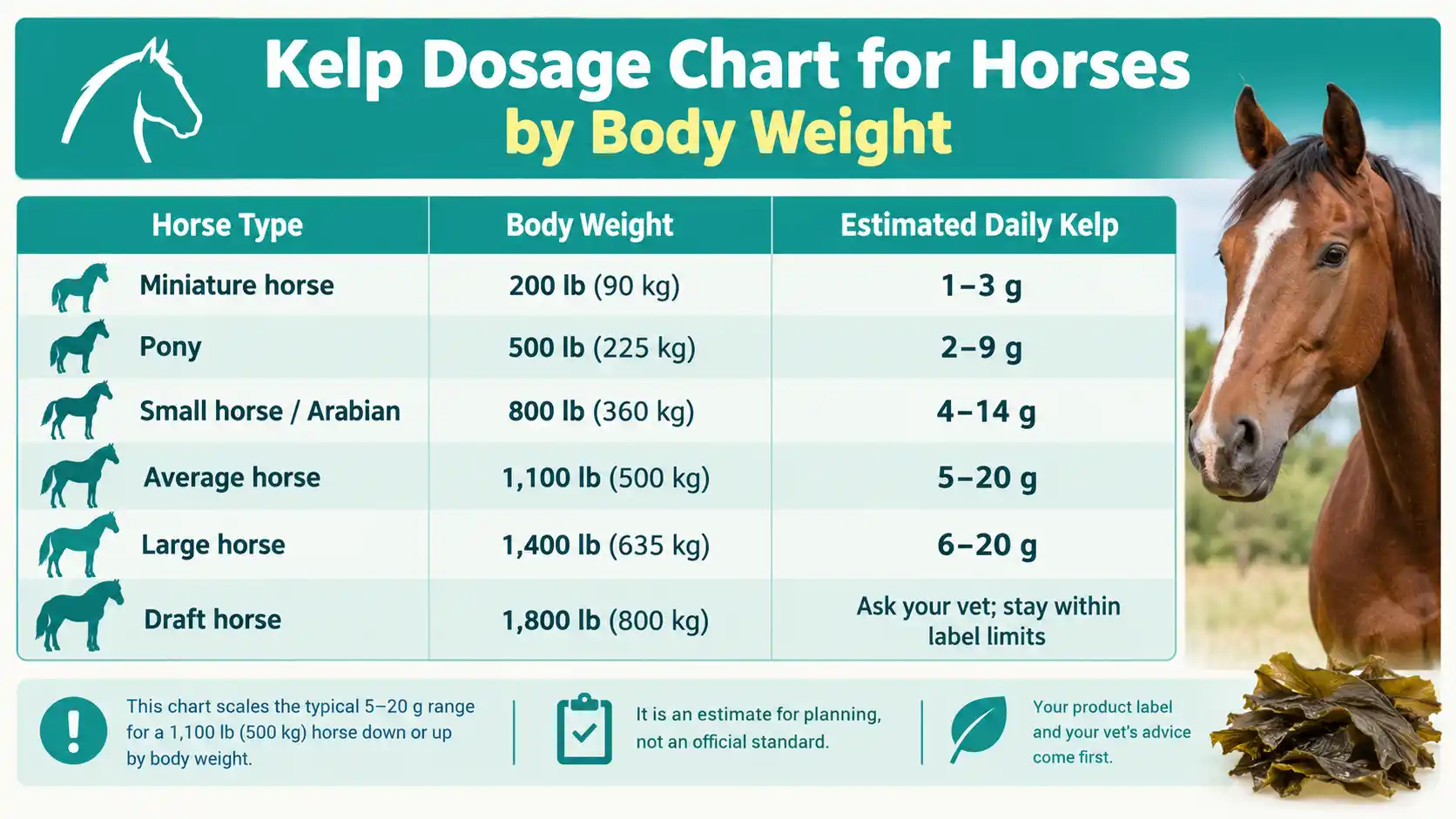
This chart scales the typical 5–20 g range for a 1,100 lb (500 kg) horse down or up by body weight. It is an estimate for planning, not an official standard. Your product label and your vet’s advice come first.
| Horse Type | Body Weight | Estimated Daily Kelp |
|---|---|---|
| Miniature horse | 200 lb (90 kg) | 1–3 g |
| Pony | 500 lb (225 kg) | 2–9 g |
| Small horse / Arabian | 800 lb (360 kg) | 4–14 g |
| Average horse | 1,100 lb (500 kg) | 5–20 g |
| Large horse | 1,400 lb (635 kg) | 6–20 g |
| Draft horse | 1,800 lb (800 kg) | Ask your vet; stay within label limits |
Important: The top of the range can overshoot safe iodine levels. At 20 g, a kelp with 2,984 mg/kg iodine delivers nearly 60 mg. That is above the safe ceiling for a 500 kg horse (explained below). This is why the label’s iodine number matters more than the chart.
Kelp Dosage Calculator: Work Out Your Horse’s Iodine Intake
You do not need to guess. If your product label lists iodine in mg/kg (ppm), the math is simple:
Iodine from kelp (mg) = grams fed × iodine content (mg/kg) ÷ 1,000
Example: 5 g of kelp with 1,000 mg/kg iodine gives 5 × 1,000 ÷ 1,000 = 5 mg of iodine.
Use the calculator below. It shows the iodine from kelp and compares it with the upper safety limit for your horse’s size.
© medshorse.com
What Is the Safe Upper Limit for Iodine in Horses?
The NRC (2007) lists a maximum tolerable iodine level of 5 mg per kg of dry diet. A 500 kg horse eats about 10 kg of dry matter a day (roughly 2% of body weight). That works out to a ceiling of about 50 mg of iodine per day from all sources.
“All sources” matters. Iodine also comes from:
- Fortified feed (often as calcium iodate or EDDI)
- Mineral blocks and vitamin-mineral supplements
- Other seaweed or kelp products
- Some hays and water
The kelp scoop is rarely the only source. Add everything up before you feed.
What Does Kelp Do for Horses?
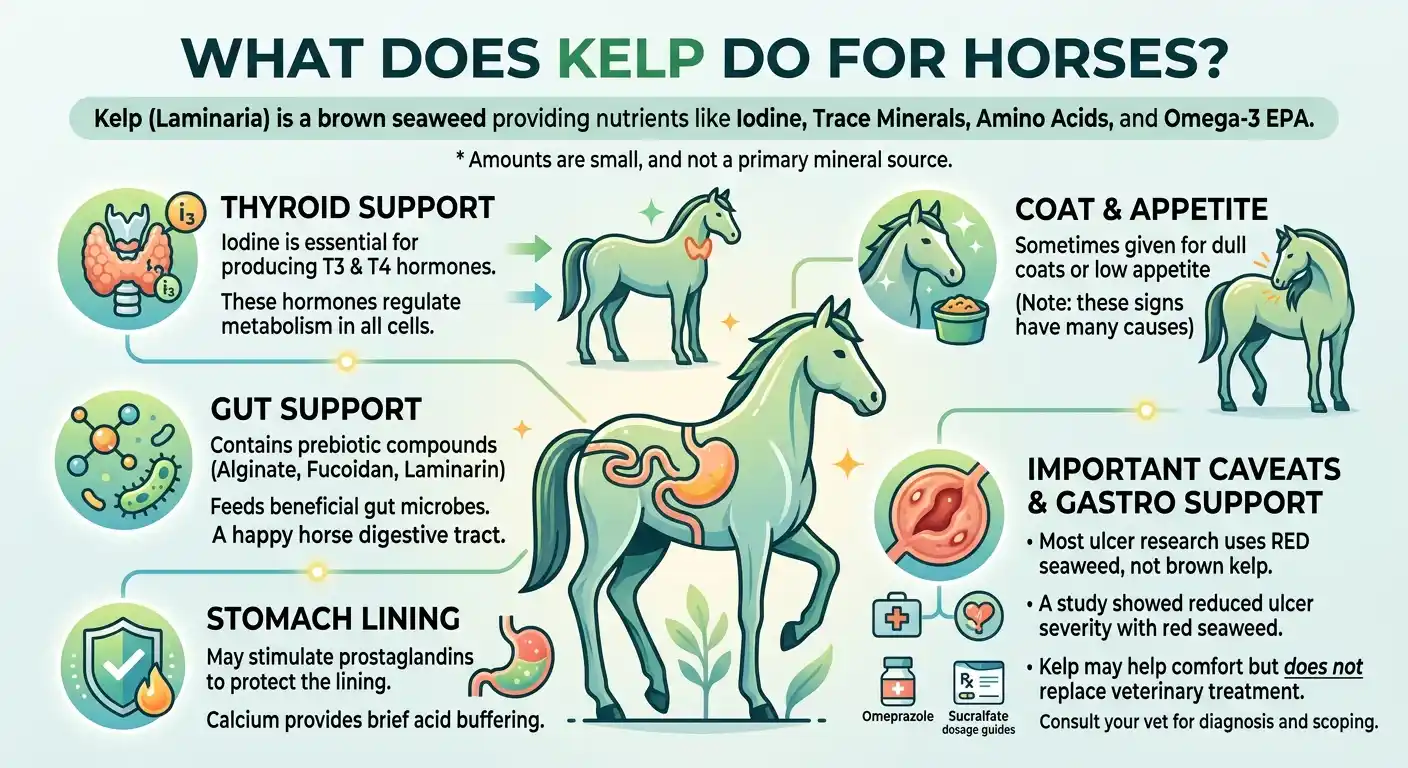
Kelp is a brown seaweed in the Laminaria genus. It is a concentrated source of iodine and also supplies trace minerals, some amino acids (including lysine and methionine) and the omega-3 fat EPA. Amounts are small, so it will not meet a horse’s mineral needs on its own.
Here is what owners and researchers look at:
- Thyroid support. Iodine is needed to make thyroid hormones T3 and T4. These regulate metabolism in every cell.
- Gut support. Kelp contains prebiotic compounds such as alginate, fucoidan and laminarin. These feed beneficial gut microbes.
- Stomach lining. Kelp may stimulate prostaglandins, which help protect the stomach lining. Its calcium may also briefly buffer acid.
- Coat and appetite. Horses with a dull, dry coat or low appetite are sometimes given kelp, though these signs have many causes.
One honest caveat: much of the ulcer research uses red seaweed, not brown kelp. A small study fed 10 horses 40 g of red seaweed daily for 30 days and saw lower ulcer severity. Kelp may help gut comfort, but it does not replace veterinary treatment.
If you suspect ulcers, see our omeprazole dosage guide and sucralfate dosage guide, and talk to your vet about scoping.
How to Feed Kelp to Your Horse Safely: Step by Step
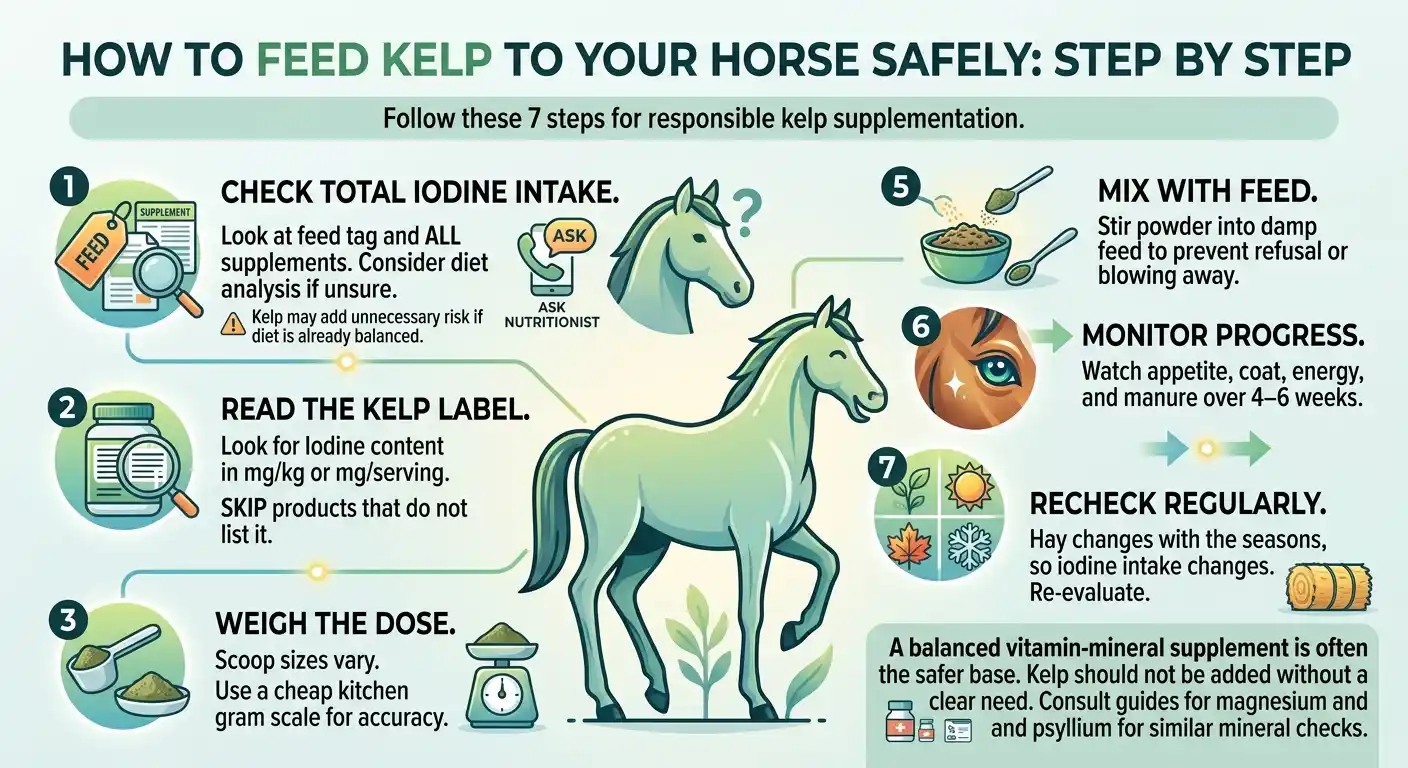
- Check your horse’s current iodine intake. Look at the feed tag and every supplement label. Submit a diet analysis or ask an equine nutritionist if you are unsure.
- Read the kelp label. Look for iodine in mg/kg or mg per serving. Skip products that do not list it.
- Weigh the dose. Scoop sizes vary. A cheap kitchen gram scale is more accurate.
- Start low. Begin at the low end of the label range, or about half, for the first week.
- Mix with feed. Stir powder into a small damp feed so it does not blow away or get refused.
- Monitor. Watch appetite, coat, energy and manure over 4–6 weeks.
- Recheck every season. Hay changes, so iodine intake changes too.
If your horse’s diet is already well balanced and fortified, kelp may add nothing but risk. A balanced vitamin-mineral supplement is often the safer base. Our magnesium dosage guide shows how to check another mineral the same way, and the psyllium husk dosage guide covers another gut-support feed.
Signs of Too Much Kelp (Iodine Toxicity) in Horses
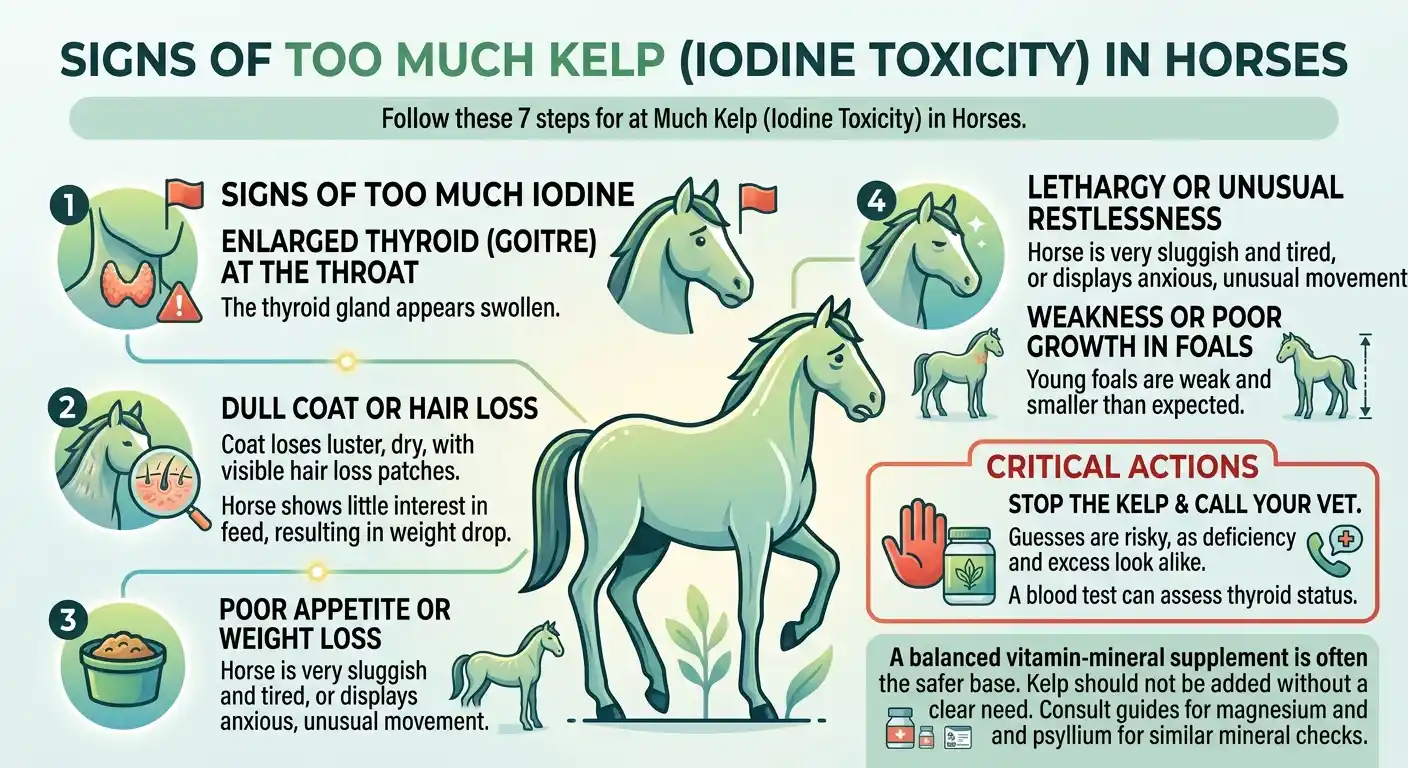
Iodine excess and iodine deficiency can look alike. Both can enlarge the thyroid, which is why guessing is risky. Watch for:
- Enlarged thyroid (goitre) at the throat
- Dull coat or hair loss
- Poor appetite or weight loss
- Lethargy or unusual restlessness
- Weakness or poor growth in foals
If you notice these signs, stop the kelp and call your vet. A thyroid blood test can help assess iodine status.
Is Kelp Safe for Pregnant and Lactating Mares?
Not without veterinary guidance. Iodine crosses the placenta and passes into milk, and foals are very sensitive to it.
In a published case report, mares fed 50 mg of iodine daily during pregnancy had foals with severe iodine toxicity. Those foals showed goitre, leg weakness and poor skeletal and muscle development.
Deficiency is also a risk. Low iodine in pregnancy is linked to fertility problems, stillbirths, goitre, contracted tendons and foals unable to stand.
Bottom line: Only add kelp for a pregnant or nursing mare if your vet has diagnosed iodine deficiency.
Common Mistakes When Feeding Kelp
- Stacking iodine sources. Fortified feed plus a mineral supplement plus kelp adds up fast.
- Using scoops instead of grams. One scoop can differ by several grams between products.
- Assuming “natural” means safe. Natural products can still contain too much iodine.
- Switching brands without rechecking. A new brand can have double the iodine.
- Feeding to “fix” a dull coat without a diagnosis. Poor coat can signal Cushing’s disease, parasites or poor nutrition.
- Giving kelp to foals or mares on a hunch.
Choosing a Good Kelp Supplement for Horses
Look for:
- Iodine guaranteed per serving, not just “contains iodine”
- Lab testing. Seaweed absorbs minerals from seawater, so reputable makers test for quality and contaminants
- A clear species name (Laminaria or similar)
- A batch or lot number
- A manufacturer who answers questions. Call them if the label is vague
Many nutritionists prefer kelp built into a finished, balanced supplement. Iodine per serving is then standardized and easier to track.
| Form | Pros | Cons |
|---|---|---|
| Plain kelp powder/meal | Flexible, often cheaper | Iodine varies, easy to overfeed |
| Kelp in a balanced supplement | Standardized iodine | Less control over kelp amount |
| Kelp pellets/treats | Palatable | Often low-dose, check the label |
When to Talk to Your Vet or Nutritionist
Call before feeding kelp if your horse:
- Is pregnant, nursing or a foal
- Has a known thyroid problem
- Has Cushing’s disease (PPID), is insulin resistant, or has laminitis
- Already eats a fortified feed plus supplements
- Shows an enlarged throat area, weight change or coat loss
Frequently Asked Questions
How much kelp should I give my horse per day?
Most horses are fed about 5 to 20 grams of kelp meal per day, depending on the iodine content of the product. Follow the label, start at the low end and weigh the dose on a gram scale.
Is kelp safe for horses?
Kelp is generally safe when fed at label rates. The main risk is too much iodine, which can affect thyroid function, so measure carefully and count all iodine sources in the diet.
Can a horse have too much kelp?
Yes. Kelp is a concentrated source of iodine, and the NRC lists a maximum tolerable level of 5 mg of iodine per kg of dry diet. Overfeeding can cause goitre, a dull coat and appetite loss.
How much iodine does a horse need each day?
A mature horse at maintenance needs roughly 3.5 to 4 mg of iodine per day. Pregnant, lactating and growing horses may need more, so ask your vet or nutritionist for individual advice.
What is the best kelp dosage for a pony?
A 500 lb pony would typically get about 2 to 9 grams per day if scaled from the standard horse range, but the label and your vet take priority. Ponies are easy to overfeed, so start low.
Can pregnant or lactating mares eat kelp?
Only if your vet has diagnosed iodine deficiency. Iodine crosses the placenta and enters milk, and excess iodine has caused serious problems in foals.
Does kelp help horses with ulcers?
Kelp may support the stomach lining, but the best evidence in horses comes from red seaweed, not brown kelp. It does not replace veterinary diagnosis or treatment.
How long does kelp take to work in horses?
There is no fixed timeline. Many owners watch coat, appetite and manure over four to six weeks. If you see no change, review the whole diet with a nutritionist rather than raising the dose.
Can I feed kelp with other supplements?
Yes, but add up the iodine from every product first. Fortified feeds and mineral supplements often contain iodine already, so kelp may not be needed.
Is kelp better than iodized salt for horses?
Neither is automatically better. Kelp iodine varies widely, while iodized salt is more standardized. Choose the source that lets you measure iodine most accurately.
What are the signs of iodine deficiency in horses?
Signs can include an enlarged thyroid, poor coat, low energy and, in foals, weakness and contracted tendons. Because excess iodine can look similar, get a vet exam and thyroid blood test before changing the diet.
Should I weigh kelp or use a scoop?
Weigh it. Scoop sizes and powder density vary between products, so a gram scale gives a more accurate dose.