Cetirizine Dosage For Horses: Calculator, Chart & Safe Guide
If your horse is dealing with hives, itching, or another allergic flare-up, your Horse vet may have mentioned cetirizine Dosage – the same active ingredient in human Zyrtec®. Before you reach for a pill bottle, it helps to know exactly how equine cetirizine dosing works, because horses need far more than a human dose.
This guide provides detailed information about the actual research that informed cetirizine Dosage For horses, provides a weight based cetirizine dosage chart and calculator, and offers knowledge of when cetirizine is useful… and when it isn’t.
This article is intended for educational purposes only, and should not be used to substitute for the advice of a licensed veterinarian. Do not start, stop or change medication for your horse without guidance from a professional.
Cetirizine Dosage Calculator for Horses
Based on published equine pharmacokinetic dosing data
Recommended Dosage
© medshorse.com
Key Takeaways
- A published study of oral cetirizine for horses has indicated that 0.2–0.4 mg/kg body weight, given every 12 hours.
- For a typical 1,100 lb (500 kg) horse, the dosage range is about 100–200 mg twice a day — but your veterinarian will determine the exact dosage for your horse.
- Cetirizine medication is effective against conditions where histamine is a large factor such as hives (dermatographism) and eosinophilic keratitis, but is not a reliable treatment alone for sweet itch (insect bite hypersensitivity) and headshaking.
- Side effects are rare and mild (drowsiness, mild GI upset).
- Giving Ivermectin 12 hours prior to giving Cetirizine will have a significant effect on the amount of Cetirizine in the blood, which is essential for both safety and for competition withdrawal time.
- Cetirizine is a regulated therapeutic drug with specific withdrawal periods (according to the competition rules: USEF, FEI, Equestrian Canada, RMTC/ARCI).
What Is Cetirizine, and Why Is It Given to Horses?
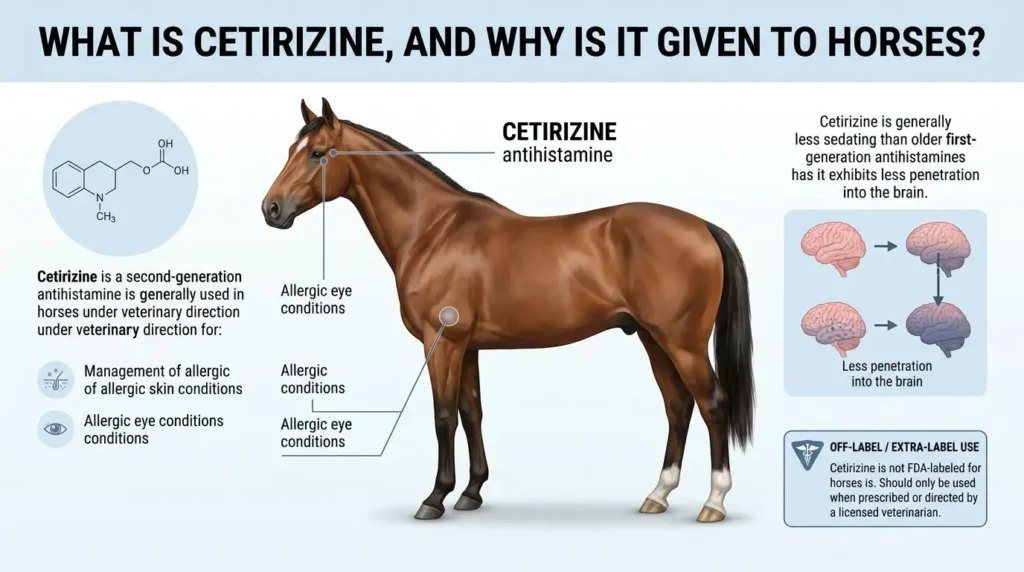
Cetirizine dosage is a second-generation antihistamine, which is the same type of medication as loratadine and fexofenadine. In human medicine, it is marketed as an over-the-counter medication, such as Zyrtec® and Reactine®.
Cetirizine is an off-label (also known as "extra-label") medication used in the management of allergic skin and eye disease in the horse. Off-label does not imply unsafe or improper, rather it is a drug that is not FDA labelled for use in horses, but that a licensed vet has knowledge through published research and their clinical experience, has a valid vet-client-patient relationship, and prescribes and doses accordingly.
Older antihistamines, such as hydroxyzine and diphenhydramine, are also effective in the treatment of allergies but do readily cross into the brain and have a demonstrable sedative effect. Cetirizine was developed to avoid that problem.
How Cetirizine Works in the Body
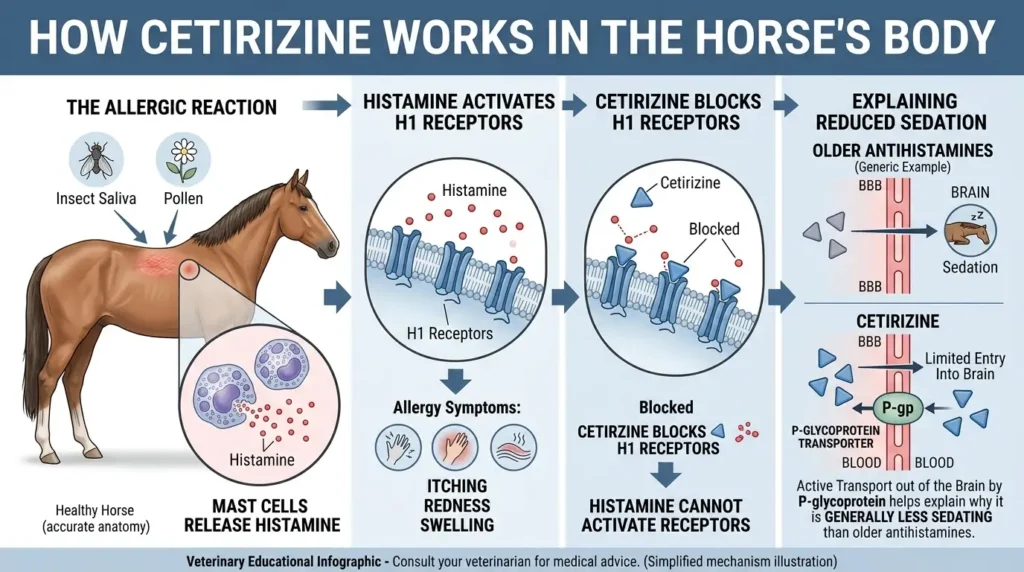
In an allergic reaction the immune system of the horse responds to an allergen (bug saliva, pollen, or something else) by releasing histamine from mast cells. Histamine acts on H1 receptors which produce the classic allergy symptoms of swelling, redness and intense itching.
Cetirizine medication acts by binding to those H1 receptors before histamine is able to bind to them. Chemically it is termed as a zwitterion, a molecule that contains both positive and negative charge centers. That structure prevents the passage of the drug into the brain, and the little that does enter is now actively extruded by a transport protein known as P-glycoprotein. This is the primary reason why cetirizine is not as sedating as the older antihistamines.
Cetirizine vs. Hydroxyzine
You should remember that cetirizine is a metabolite of hydroxyzine – that is, a horse taking hydroxyzine breaks it down to cetirizine in the liver anyway. Direct administration of cetirizine is just another method to achieve anti-allergy effect with minimal sedative effect of hydroxyzine.
Cetirizine Dosage for Horses: The Research-Backed Numbers
The Core Equine Dosing Study
The most pertinent published information regarding dosing of cetirizine in horses is a controlled pharmacokinetic and pharmacodynamic study in six healthy horses (Olsén et al., The Veterinary Journal, 2008). The researchers administered oral cetirizine to the horses every 12 hours and monitored blood levels and skin-response (wheal) inhibition:
- 0.2 mg/kg 3 times / 12 hours: average trough blood concentration 16 ng/mL, ~ 45% inhibition of histamine induced wheal formation.
- 4 mg/kg every 12 hours for four additional doses: average trough concentration was 48 ng/mL, and there was approximately 68% inhibition of wheal formation.
- The maximum possible inhibition modeled was approximately 95% with no apparent side effects at either dose.
- The terminal half-life during this repeated-dosing protocol was about 5.8 hours.
Another single dose pharmacokinetic study performed by the same research group (Olsén et al., Journal of Veterinary Pharmacology and Therapeutics, 2007) showed a shorter terminal half-life of approximately 3.4 hours following a single 0.2 mg/kg oral dose and a peak blood concentration was achieved within 1 hour.
These two half-life values are not the result of a difference in the data but rather a difference in the design of the studies (single dose vs repeated dosing), which is why decisions on dosing should not be made based on one half-life from one study.
The upshot of the research: orally administered cetirizine at 0.2–0.4 mg/kg every 12 hours appears to be well tolerated and effective in horses. Most equine veterinarians refer to this range when prescribing this, but your veterinarian may recommend a different level, depending on the specific situation, how your horse reacts to the drug, kidney function, and other drugs being given.
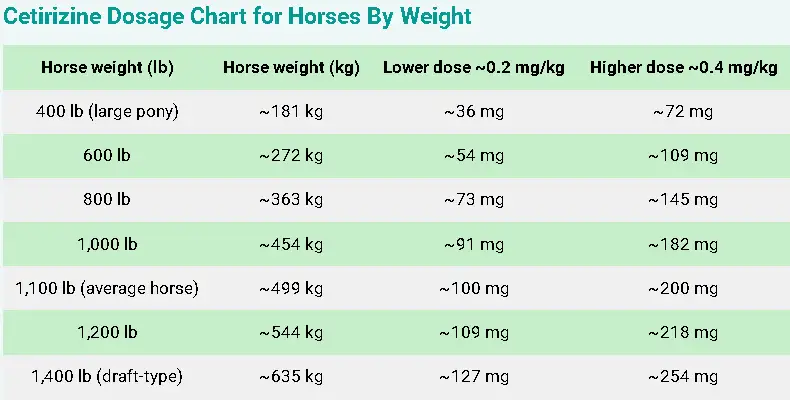
Cetirizine Dosage Chart for Horses By Weight
This chart was used to determine the two dose levels (0.2 mg/kg and 0.4 mg/kg) studied on the commonly encountered horse weights. A quick reference only — always double check with your vet for exact doses, frequency, and use the interactive calculator below for exact weight-specific doses.
| Horse weight (lb) | Horse weight (kg) | Lower dose ~0.2 mg/kg | Higher dose ~0.4 mg/kg |
| 400 lb (large pony) | ~181 kg | ~36 mg | ~72 mg |
| 600 lb | ~272 kg | ~54 mg | ~109 mg |
| 800 lb | ~363 kg | ~73 mg | ~145 mg |
| 1,000 lb | ~454 kg | ~91 mg | ~182 mg |
| 1,100 lb (average horse) | ~499 kg | ~100 mg | ~200 mg |
| 1,200 lb | ~544 kg | ~109 mg | ~218 mg |
| 1,400 lb (draft-type) | ~635 kg | ~127 mg | ~254 mg |
All doses in this chart are administered every 12 hours (twice a day) and are the same dose interval as that used in the study in horses above.
Fun fact: Horses metabolise oral drugs extensively by their liver and hind gut, meaning that they require a higher proportion of the drug of cetirizine compared to humans or dogs, to achieve an effective blood level.
How Cetirizine Is Given (Forms & Administration)
Cetirizine for horses can be administered orally. There is no FDA approved product for horses – it comes from human formulations or a compounding pharmacy:
- Human tablets (usually 5mg or 10mg): the most common treatment, but a full horse does may require a lot of tablets to be crushed and administered, usually in water, by oral dose syringe.
- Human liquid syrup (usually 1 mg/mL, formulated for children) is technically acceptable but will generally not be a feasible volume to administer to an adult horse. Sometimes it is more feasible for foals or miniature horses.
- Compounded formulations: veterinary compounding pharmacies can create flavored pastes, suspensions or concentrated powders especially formulated to fit a horse's dosage, which many owners find more convenient to accurately administer.
Cetirizine dosage for horses may be administered on or off feed, generally. Administered with a small portion of feed, it might slightly delay absorption, and decrease the peak blood level, but the total amount absorbed remains fairly constant, making it a reasonable method of easing administration without compromising efficacy.
Storage: These are usually kept at room temperature (20-25°C / 68-77°F). Depending on the product label, certain liquid formulations might require refrigeration, and liquid cetirizine should not be frozen; follow storage directions on the product label or your prescription.
What Is Cetirizine Used for in Horses?
Conditions Where Cetirizine Helps
- Dermatographism ("skin writing"): Type of hives that is caused by light pressure or rubbing and causes rapid, local swelling. This factor is dealt with rather directly through Cetirizine's histamine blocking activity.
- Eosinophilic keratitis is an immune-mediated eye disease that is painful. Systemic cetirizine has been added to standard topical treatment with clinical benefit in published case series.
- General allergic hives (urticaria): When there is a clear histamine component to the hives, in addition to other therapies, cetirizine is often used.
- Equine asthma (recurrent airway obstruction / RAO, or “heaves”): sometimes used as an adjunct (not a first-choice) treatment. Laboratory research indicated that it can suppress some inflammatory activity in airway cells; some good in-the-field trials are still lacking.
Conditions Where Cetirizine Usually Doesn't Help
That is something that many articles neglect to mention, but it is important to have realistic expectations:
- Insect bite hypersensitivity (sweet itch): Although histamine is involved, controlled clinical trials have shown that cetirizine is generally ineffective as a single agent therapy in sweet itch. This is because of the other factors contributing to sweet itch: delayed immune responses, eosinophils, and other inflammatory signals beyond the scope of antihistamines. The basic principles of sweet itch control are fly control, barrier sheets and environmental management.
- Trigeminal mediated headshaking – results of a controlled clinical trial showed that cetirizine and a placebo tablet were approximately equal with respect to the number of horses that improved. Although some individuals do use Cetirizine off-label for this purpose, it has not been deemed as a reliable treatment for this condition.
If your horse has already been diagnosed with either of these disorders, it is advisable to speak with your vet about whether or not it's worth using Cetirizine, or if your time and money is better spent elsewhere.
Is Cetirizine Safe for Horses?
Cetirizine is relatively safe in horses and tolerated at the doses studied. However, "generally safe" does not mean "no monitoring necessary.
Side Effects of Cetirizine for Horses

Side effects are rare and generally mild:
- Some degree of lethargy/drowsiness — the most common side effect, but less common than with older antihistamines such as hydroxyzine.
- Gastrointestinal upset, including a little bit of inappetence, increased salivation, and/or slight changes in the consistency of the manure.
- A few horses may have paradoxical reactions: In one reported clinical trial with 45 horses, 2 had sudden worsening of their skin with the use of cetirizine, which cleared up when the drug was discontinued. This seems to be idiosyncratic and occurs rarely.
Monitor your horse closely during the first few days of the first dose of a new course of cetirizine and contact your vet if your horse gets sicker or if there are any unusual changes in its behavior.
Overdose and Toxicity Signs
A moderate accidental overdose is unlikely due to the large safety margin. But, if a large accidental dose occurs and the drug-transport system is overwhelmed, cetirizine can enter the central nervous system and cause:
- Profound depression is extreme lethargy, incoordination (ataxia), unresponsiveness or
- Paradoxical stimulation: agitation, increased heart rate, rapid breathing, dilated pupils, tremors and, in severe cases, seizures.
If your horse has swallowed a large and undetermined amount of cetirizine, or if you see any of these signs, contact your veterinarian right away.
Contraindications
Extra caution should be used with cetirizine in horses that:
- Be known to be allergic to cetirizine, hydroxyzine or to inactive ingredients in the particular product being used.
- Have severe kidney disease — cetirizine passes into the urine in a relatively unchanged form, and a decreased kidney function can result in an accumulation of the drug in the body.
- Are pregnant or lactating — this has not been studied formally in horses, and should be used only when a veterinarian considers the benefit to be greater than the unknown risk.
- Would be prescribed a pseudoephedrine containing medication (such as Zyrtec-D). These combination products are not suitable for use in horses and other animals.
Cetirizine Drug Interactions in Horses
Ivermectin (Important)
This is one of the most important interactions for horse owners to be aware of as ivermectin dewormer is used so frequently.
Ivermectin inhibits the same transport protein (P-glycoprotein) as aids in the excretion of cetirizine through the kidneys. The total blood exposure to cetirizine was increased by approximately 60%, its blood half-life was extended and peak blood concentration was enhanced when ivermectin was administered 12 hours prior to cetirizine in a controlled pharmacokinetic study.
Interestingly, the same study determined that ivermectin administered just 1.5 hours prior to administration of cetirizine did not do so — the time window between these two drugs seems to be important.
This interaction itself does not lead to toxicity at usual doses but it does mean:
- Your veterinarian may wish to separate the deworming (ivermectin) and allergen (cetirizine) administration.
- This interaction may affect the duration of cetirizine (or detectable levels) of cetirizine in the system and, therefore, the usual withdrawal-time calculations and anti-doping compliance in competition horses.
Sedatives and CNS Depressants
While cetirizine does not penetrate the brain very well alone, it may have an additive calming/depressing effect when given in combination with sedatives, tranquilizers, or anesthetics (e.g., xylazine, detomidine, acepromazine, or diazepam).
Before beginning cetirizine administration, be sure to discuss with your veterinarian any other medications or supplements your horse is on.
Cetirizine and Competition Horses: Withdrawal Times
Most equestrian governing bodies do not prohibit the use of this medication, but instead control or therapeutic substances as antihistamines can also have effects on immune response and in some cases, on behaviour. Reported classification and withdrawal directions:
| Governing body | Classification | Withdrawal guidance |
| USEF | Category II.a (Therapeutic medication) | Subject to maximum 24-hour dose limits |
| RMTC / ARCI | Class 4 therapeutic substance | ~48 hours to clear a 6.0 ng/mL plasma threshold |
| Equestrian Canada | Conditional medication | 24 hours (single dose) / 48 hours (5-day course) |
| FEI | Controlled Medication | 96-hour detection time (may need to be longer per vet) |
These guidelines differ and can be prolonged, as mentioned above, by the interaction with ivermectin. Please consult the current requirements in the sport's rulebook and your treating veterinarian before trying to compete a horse treated with cetirizine — don't just use general withdrawal times.
Cetirizine for horses is the only equine antihistamine that is used once a day, whereas others are given twice daily.
Cetirizine vs. Other Equine Antihistamines
| Antihistamine | Generation | Typical sedation | Common equine use notes |
| Cetirizine | 2nd | Low | Broad off-label use; ineffective alone for sweet itch |
| Hydroxyzine | 1st | Higher | Long-standing use; cetirizine is its active metabolite |
| Diphenhydramine | 1st | Higher | Fast-acting; more sedation, shorter duration |
| Fexofenadine | 2nd | Low | Noted to have poor oral absorption in horses |
Common Mistakes Owners Make With Cetirizine Dosing
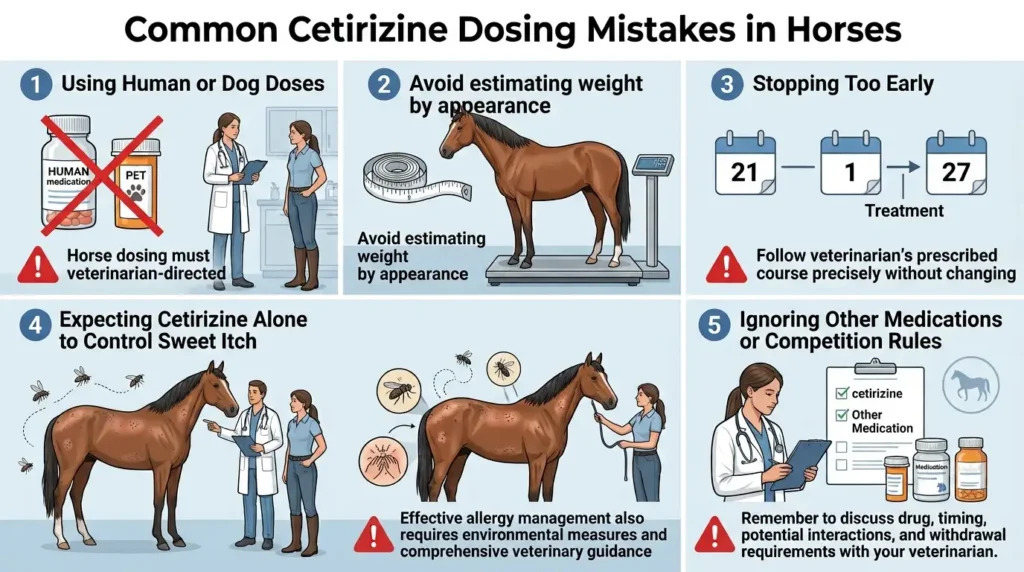
- Using a human or dog dose. Horses require significantly more than people or small animals - do not cut the number of human tablets by "feel.
- Estimation of the horse's weight. An accurate BW is required to dose accurately. A weight tape or scale is much more accurate than seeing how it looks.
- Stopping too early. It may take several days of regular treatment to see any improvement in allergic skin conditions; sudden stopping and restarting may make it more difficult to assess the effectiveness of the medication.
- Presuming it will enlarge sweet itch. As mentioned above, cetirizine alone is not a good treatment for sweet itch — and the combination of unrealistic expectations of a single medication often results in a lack of effort by the owner to invest in the environmental management measures that will help most.
- Failure to follow the ivermectin timing. When deworming and beginning cetirizine simultaneously, without taking into consideration the interaction, effect on blood levels or withdrawal calculations for competition horses may occur.
You May Also Like to Read:
- Excede Dosage For Horses: Calculator, Chart & Safe Guide
- Dexamethasone Dosage For Horses: Calculator, Chart & Safe Guide
FAQs
What are the uses of cetirizine in horse?
Cetirizine medicine is an off-label medication that is used to help control some allergic and immune-mediated diseases in horses such as hives (dermatographism) and eosinophilic keratitis; it may occasionally be used as an adjunct for other allergic skin or airway diseases.
What is the maximum amount of cetirizine that can be given to a horse?
There are published equine studies that support 0.2-0.4mg/kg body weight, administered orally every 12 hours. Your veterinarian will determine the proper dosage for your horse, depending on the weight, condition, and health history of your horse.
Can you give horses Cetirizine?
Cetirizine dose for horse used at the doses tested has demonstrated a good safety profile, with no noted side effects as part of controlled trials, but some horses may experience mild lethargy or GI upset. Still should only be used under the direction of a veterinarian.
Is it OK to give my horse human Zyrtec?
Cetirizine for horses is frequently used from human OTC preparations such as Zyrtec® and Reactine®, but the dosage, form and monitoring should only be used under veterinary supervision based on the human package leaflet.
Can horses take cetirizine everyday?
The published dosing interval is every 12 hours (twice daily), the same as all the equine studies on this drug.
Does cetirizine work for sweet itch (insect bite hypersensitivity) in horses?
Not consistently as a single treatment. Cetirizine horse dosage alone has not been shown to be effective in controlling sweet itch in clinical trials as this condition is more than a simple histamine response. Environmental and barrier management is the foremost treatment.
What are the side effects of cetirizine on horses?
Reported side effects are uncommon and usually mild — most often mild lethargy or minor gastrointestinal upset. Few instances of aggravation of skin manifestations have been reported and disappear after the discontinuation of the drug.
Will cetirizine dose interfere with other drugs that my horse is on?
Yes. The most important interaction is with ivermectin where high blood levels of cetirizine occur if it is administered 12 hours prior to ivermectin. Cetirizine can also add to the sedative effect of tranquilizers and anesthetics.
Can you give cetirizine to a horse in competition?
Most governing bodies (USEF, FEI, Equestrian Canada, RMTC/ARCI) do not ban it, but it is regulated and each has their own withdrawal time requirements. Always check with your organisation and vet for the most up-to-date regulations.
How long does it take for cetirizine to start working in a horse?
In pharmacokinetic studies, peak blood levels occur within one hour of a single oral dose; however in an allergic skin condition, clinical improvement may take longer and is best observed following repeated and regular doses.
Is it safe to use cetirizine long term in horses?
Generally used for long-term or seasonal allergy control under veterinary care, but periodic re-evaluation should be done to determine continued effectiveness and appropriateness.
Why does my vet want to discontinue cetirizine prior to an allergy skin test?
Cetirizine horse medication blocks the histamine response in the skin, which can make or make it seem like you are not reacting to the allergens you are being tested for — so it is typically stopped prior to allergy testing.
What are the differences between Cetirizine and Hydroxyzine for Horses?
In fact, cetirizine is a metabolite of hydroxyzine, meaning that your liver turns hydroxyzine into cetirizine. Administering cetirizine directly offers the same anti-allergic effects without as much drowsiness as hydroxyzine.
Is it safe to give cetirizine to miniature horses or foals?
Very small equines may need dosage of very small amounts, which will need careful calculation based on weight, and in some cases, it may be easier to give a liquid preparation rather than crushed tablets. This should always be under direct veterinary supervision.
Does the FDA have an official product approved for use of cetirizine in horses?
No, all use of cetirizine in horses is extra-label/off-label, either human-labeled drugs or veterinary compounded drugs with a veterinary practitioner's prescription.
Final Thoughts
Cetirizine Dosage For Horses has a solid published research base in horses, with a favourable safety profile (0.2–0.4 mg/kg every 12 hours), low sedation compared to older antihistamines and real clinical value for specific conditions, such as keratitis eosinophilic and hives. However, it's not a panacea for all allergies, and its limitations (sweet itch, headshaking) are equally as important as its effectiveness.
Please use the dosage chart and calculator on this page as a reference only, and not a replacement for veterinary advice. Your veterinarian will verify the correct dosage, form and monitoring schedule for your horse, and may alert you to any specific aspect of your horse's medical history, such as kidney function or current medications, that could alter the situation.
Next Step: If you're noticing signs of an allergic skin or eye condition, be sure to contact your veterinarian first to get a diagnosis, and then use the calculator above once you have a vet recommended dose level.