Thiamine Dosage for Horses: Weight Chart, Free Calculator and the Safe Way to Give Vitamin B1
Written & Reviewed By: Medshorse Team
Last Updated: November 2026
Most healthy horses need about 0.06 mg of thiamine per kg of body weight daily, or roughly 30 mg for a 500 kg (1,100 lb) horse at maintenance. Heavy work raises that to about 62.5 mg. Supplements and injections are often dosed far higher, and injectable thiamine is for veterinarians only.
This guide separates them: what a horse needs, what supplement makers suggest, and what vets use to treat deficiency. You’ll get a weight-based chart, a calculator, clear safety lines, and honest notes on where the evidence is thin.
Disclaimer: This article is for general education and is not veterinary advice. Product names mentioned, including Thiamine, belong to their respective owners, and MedsHorse is not affiliated with them. Always follow your veterinarian’s instructions and the current product label.
How Much Thiamine Does a Horse Need Per Day?
Most healthy horses need about 0.06 mg of thiamine per kg of body weight daily, or roughly 30 mg for a 500 kg (1,100 lb) horse at maintenance. Heavy work raises that to about 62.5 mg. Supplements and injections are often dosed far higher, and injectable thiamine is for veterinarians only.
Key takeaways: thiamine dosage for horses
- Baseline need: about 0.06 mg per kg of body weight per day at maintenance (30 mg for a 500 kg horse), rising to 0.125 mg per kg in heavy work.
- Supplements run higher: sources report 50 to 100 mg a day for maintenance, 200 to 500 mg for stressed or performance horses, and 1,000 mg on one New Zealand label.
- Injectable thiamine is vet-only. Labels warn of anaphylaxis, and published treatment doses vary widely.
- True deficiency is rare. Bracken fern, amprolium, long-term gut disruption and prolonged poor intake are the usual triggers.
- No oral overdose toxicity has been reported in horses, but that does not make guessing a good plan.
What Is Thiamine (Vitamin B1) in Horses?
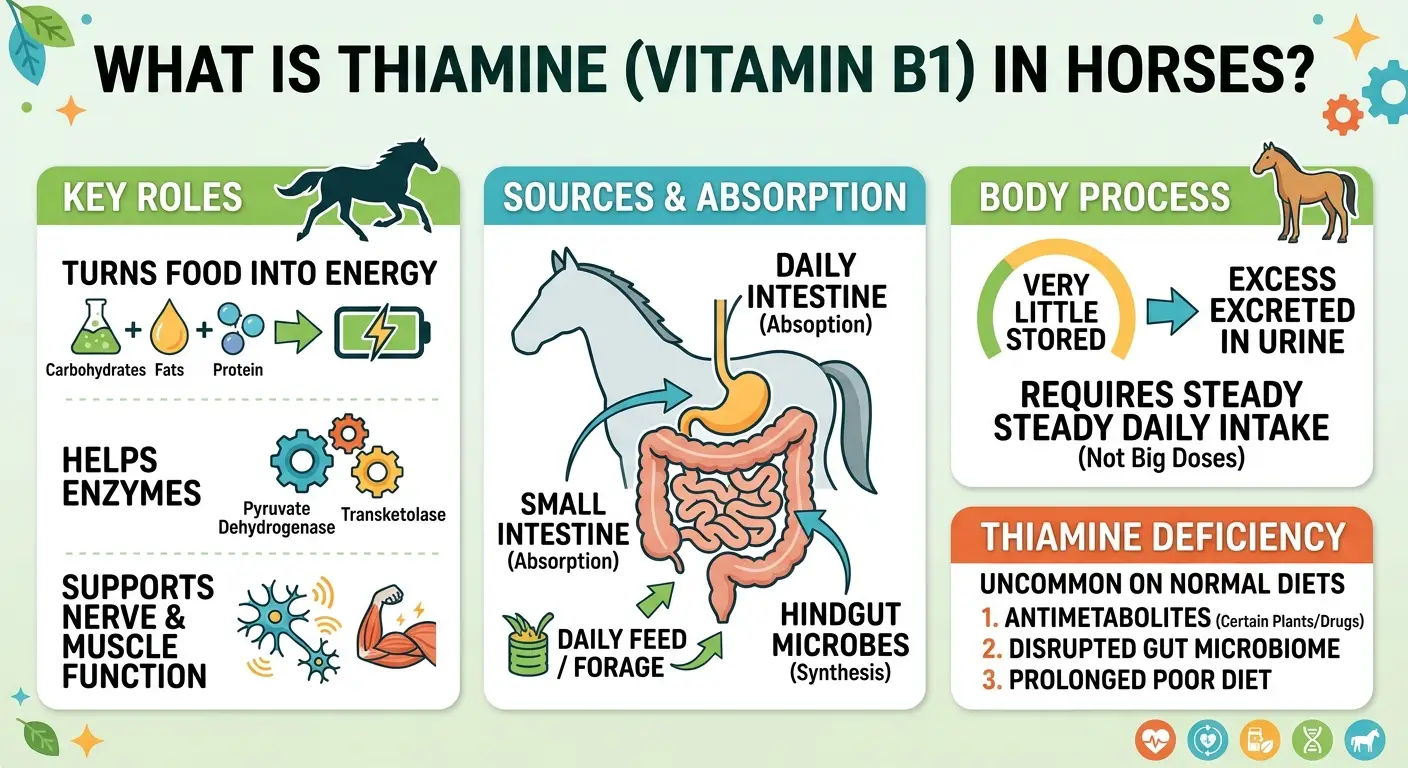
Thiamine, also called vitamin B1, is a water-soluble B vitamin that helps a horse turn carbohydrate, fat and protein into usable energy. It works as a helper for enzymes such as pyruvate dehydrogenase and transketolase, and it supports normal nerve signaling and muscle function.
Horses absorb it in the small intestine, and hindgut microbes make some of it too. The body stores very little, and any excess leaves in the urine. That is why a steady daily intake matters more than an occasional big dose.
True deficiency is uncommon on normal diets. When it happens, the usual causes are a plant or drug that breaks thiamine down, a disrupted gut, or a long stretch of poor intake.
Thiamine Dosage for Horses: Why the Numbers Don’t Match
The same word, “dosage”, covers three very different jobs. A requirement is the minimum a healthy horse needs from the whole diet. A supplement dose is an extra top-up. A treatment dose is what a vet gives to correct deficiency. Here is how the sources line up.
| Source | What it covers | Amount reported |
|---|---|---|
| NRC (2007), as summarized by Mad Barn | Requirement, maintenance | 30 mg per day for a 500 kg horse (0.06 mg per kg) |
| NRC (2007), as summarized by Mad Barn | Requirement, heavy exercise | 62.5 mg per day for a 500 kg horse (0.125 mg per kg) |
| First Choice Equine blog | Typical supplement, maintenance | About 50 to 100 mg per day (weight not stated) |
| First Choice Equine blog | Performance or stressed horses | 200 to 500 mg per day (weight not stated) |
| Vetpro (New Zealand) | Daily supplement, average horse | 1,000 mg per day for a 500 kg horse |
| Canadian vet injection label (100 mg per mL) | Treating B vitamin deficiency | 1 to 3 mL per 45 kg, IV or IM (about 2.2 to 6.7 mg per kg) |
| Covetrus label (500 mg per mL) | Supplemental thiamine injection | No fixed dose. “As determined by the veterinarian.” |
Notice the jump. A 500 kg horse’s requirement is 30 to 62.5 mg, yet one label suggests 1,000 mg of oral supplement.
That gap is not a mistake. Supplements are usually dosed well above the minimum, and no regulator sets an official oral supplement dose for horses. Treat any single number you see online as one data point, not the answer.
Thiamine Dosage Chart for Horses By Weight
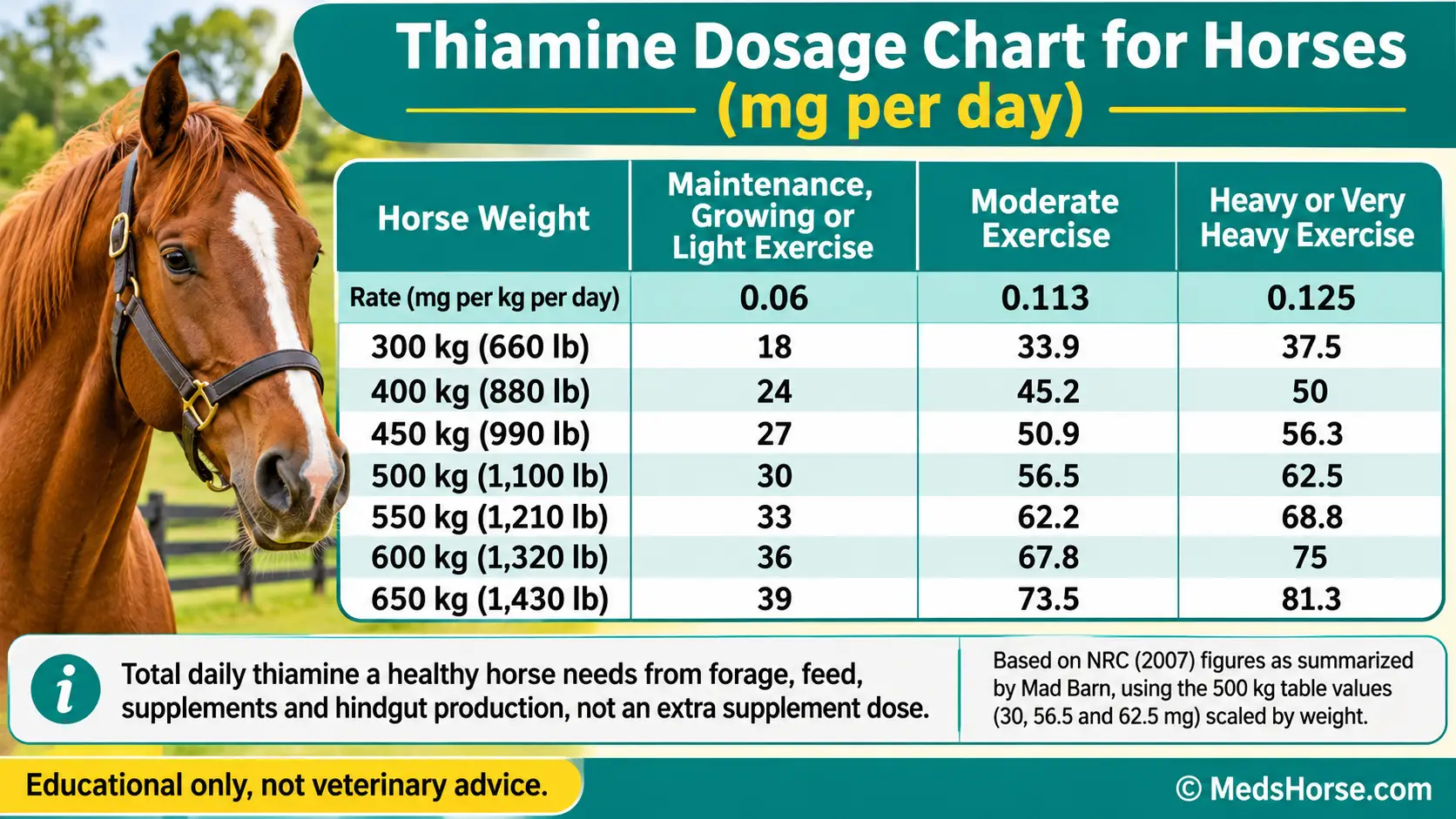
| Horse weight | Maintenance, growing or light exercise | Moderate exercise | Heavy or very heavy exercise |
|---|---|---|---|
| Rate (mg per kg per day) | 0.06 | 0.113 | 0.125 |
| 300 kg (660 lb) | 18 | 33.9 | 37.5 |
| 400 kg (880 lb) | 24 | 45.2 | 50 |
| 450 kg (990 lb) | 27 | 50.9 | 56.3 |
| 500 kg (1,100 lb) | 30 | 56.5 | 62.5 |
| 550 kg (1,210 lb) | 33 | 62.2 | 68.8 |
| 600 kg (1,320 lb) | 36 | 67.8 | 75 |
| 650 kg (1,430 lb) | 39 | 73.5 | 81.3 |
© medshorse.com
Thiamine Calculator for Horses
Enter your horse’s weight and work level to see the estimated daily requirement. It runs in your browser and nothing is stored.
© medshorse.com
Dosages Rates Used in the Calculator
| Level | Rate (mg/kg/day) | 500 kg horse |
|---|---|---|
| Maintenance | 0.06 | 30 mg |
| Growing | 0.06 | 30 mg |
| Light exercise | 0.06 | 30 mg |
| Moderate exercise | 0.113 | 56.5 mg |
| Heavy exercise | 0.125 | 62.5 mg |
| Very heavy exercise | 0.125 | 62.5 mg |
Oral Thiamine Dosing: Feed, Yeast and Supplements
What supplement makers recommend
Supplement advice is all over the map. A retailer guide suggests roughly 50 to 100 mg a day for maintenance and 200 to 500 mg for performance or stressed horses, with higher doses only under veterinary supervision.
A New Zealand veterinary supplement company recommends 1,000 mg a day for an average 500 kg horse, delivered in one level scoop of a maltodextrin-based powder.
Both groups argue that horses on hay-based or low-grass diets, or under training stress, can fall short. Those are manufacturer views. The vitamin’s safety margin is wide, but I could not find a controlled equine study that sets an ideal oral supplement dose, so staying with the label is the sensible default.
Where horses get thiamine from food
Fresh pasture is richer than dried hay. Grains, brans and yeast are richer still. The chart below shows why a hay-only ration can come up short against the 3 mg per kg maintenance level.
Thiamine in common horse feeds (mg per kg dry matter)
The dashed red line marks 3 mg per kg, the NRC maintenance level. Grains and brans clear it. Dried hay often falls below it. Grain values come from the NRC (2007) as reported by Mad Barn. Forage values come from a dairy cow thiamine review that Mad Barn cites, so treat them as estimates for horses. Grain can lose up to 50% of its thiamine in storage.
Brewer’s and baker’s yeast contain roughly 150 to 160 mg of thiamine per kg of dry matter. Do the math and 100 g of yeast supplies about 15 to 16 mg. Yeast is a useful boost, not a stand-alone fix for a 1,000 mg label target. If you’re weighing yeast, see our guide to brewers yeast dosage for horses.
How to give it
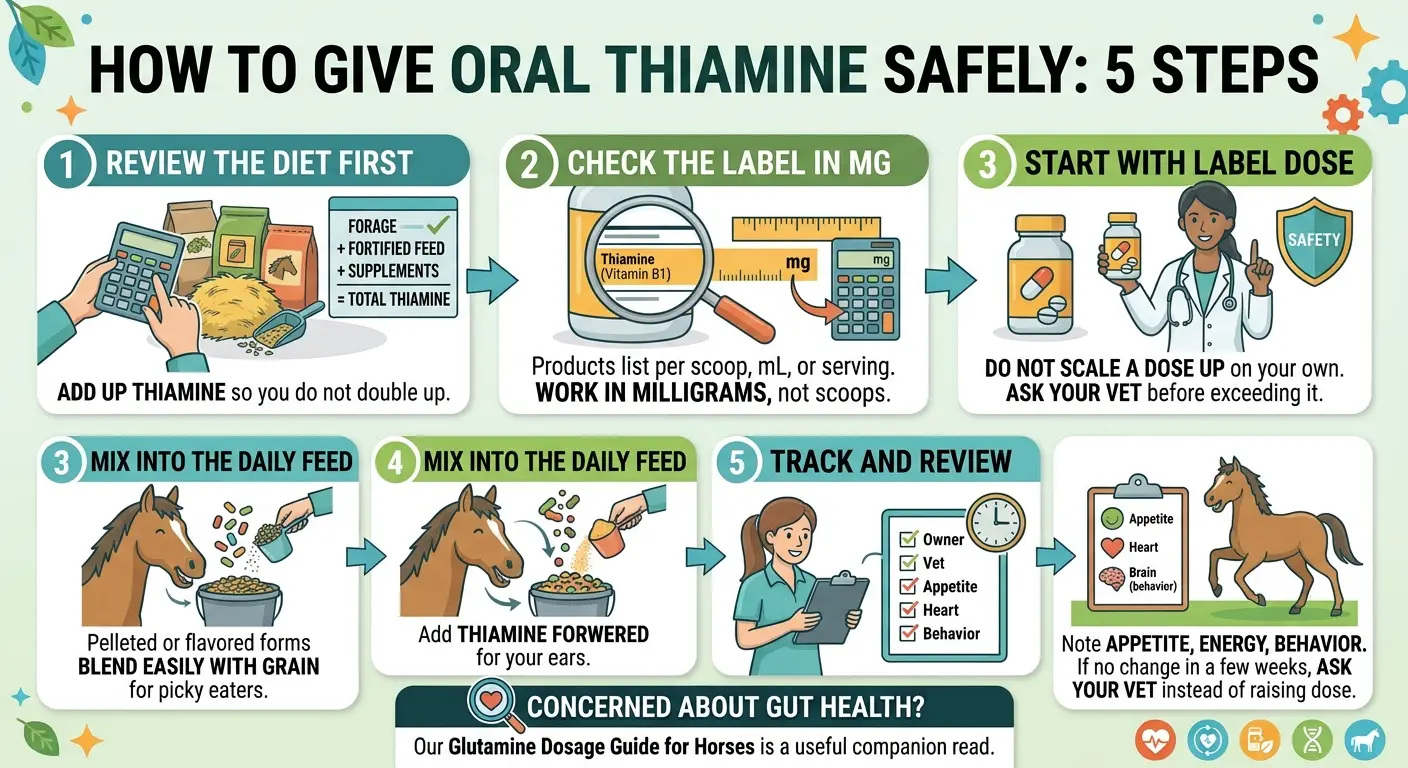
How to give oral thiamine safely: 5 steps
When Does a Horse Need More Thiamine?
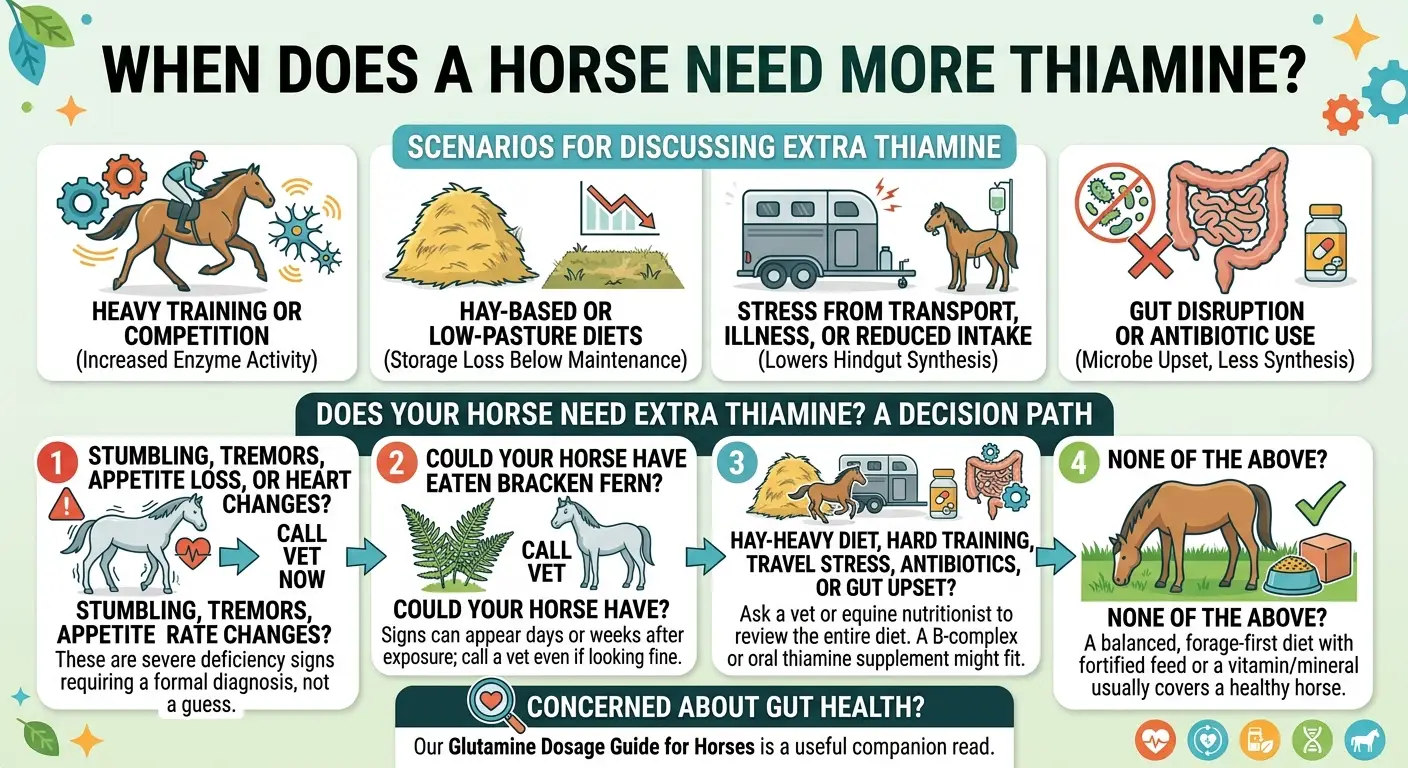
Most horses on a balanced, forage-first diet get enough. Extra thiamine or a B-complex becomes worth discussing in these situations:
- Heavy training or competition, when enzyme activity tied to thiamine rises.
- Hay-based or low-pasture diets, where stored hay can fall below the maintenance level.
- Stress from transport, illness or reduced feed intake, which can lower hindgut synthesis.
- Gut disruption or antibiotic use, which can upset the microbes that make B vitamins. If gut health is your concern, our glutamine dosage for horses guide is a useful companion read.
- Exposure to bracken fern or amprolium, both of which interfere with thiamine.
Does your horse need extra thiamine? A simple decision path
Call your vet now. These are deficiency signs and need a diagnosis, not a guess.
Call your vet, even if the horse looks fine. Signs can appear days or weeks after exposure.
Ask a vet or equine nutritionist to review the whole diet. A B-complex or oral thiamine supplement may fit.
A balanced, forage-first diet with a fortified feed or vitamin mineral supplement usually covers a healthy horse.
Signs of Thiamine Deficiency in Horses
Early signs are easy to miss: a horse that loses interest in feed or seems a little off. Later signs are neurological. The checklist below pulls together the signs reported by the sources.
Thiamine deficiency signs to watch for in horses
- Loss of appetite and weight loss
- Muscle tremors or fasciculations
- Poor coordination (ataxia), weakness or a crouched stance
- Nervousness or irritability
- Heart rate changes (slow in some reports, rapid and irregular in severe bracken cases)
- Low body temperature
What causes it
Bracken fern is the classic cause. It contains thiaminase, which breaks thiamine down, and it keeps its toxic effect even in dried hay. Amprolium, a feed additive used against coccidiosis, can also interfere with thiamine.
Mad Barn reports that horsetail has been linked to lower thiamine availability too, though horses appear less sensitive to it than some other livestock.
Does Thiamine Calm Horses?
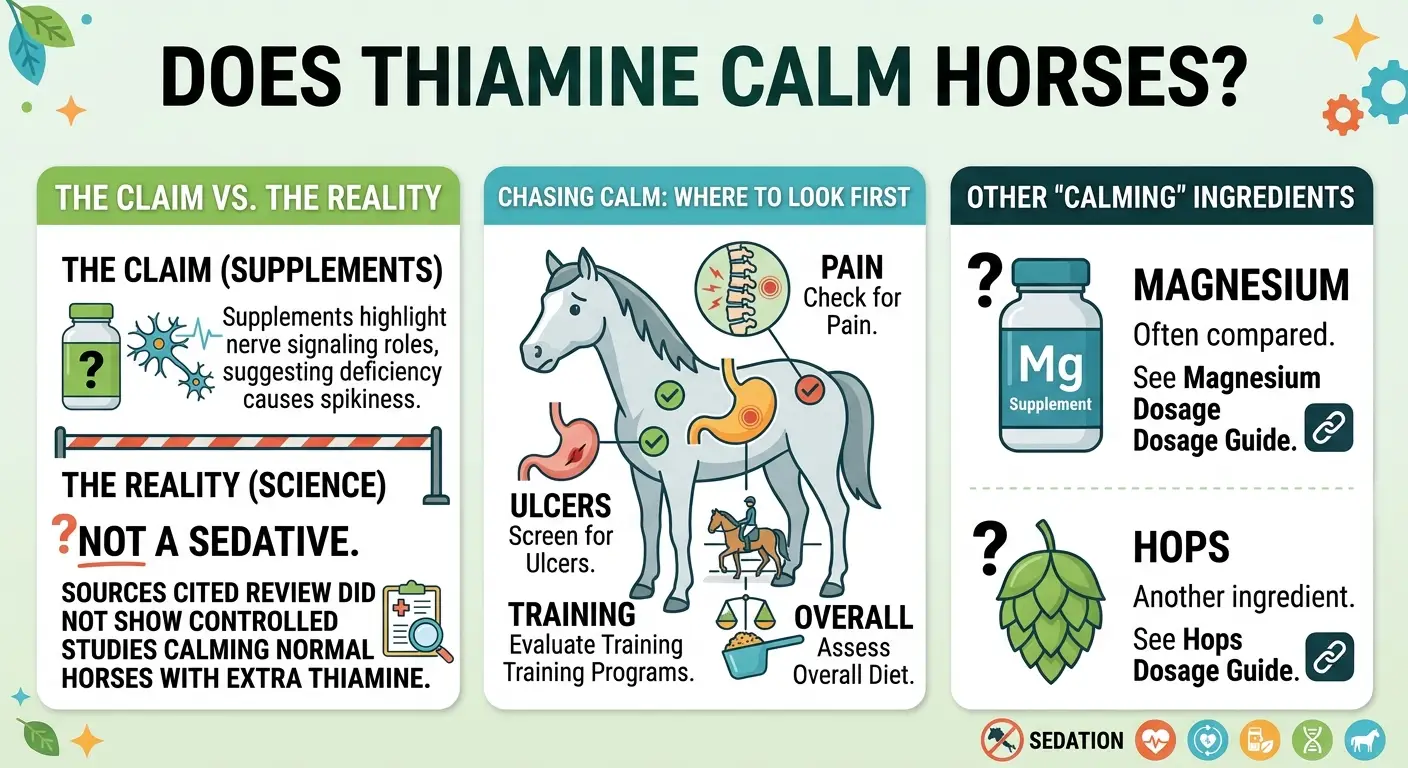
This is the most common reason owners search for thiamine, so it deserves a straight answer. Thiamine isn’t a sedative. Supplement companies point to its role in nerve signaling and say low levels can make a horse distracted, spooky or edgy.
That idea is plausible, but the sources reviewed here did not cite controlled studies showing that extra thiamine calms a normal horse.
If you’re chasing calm, it’s worth checking pain, ulcers, training and overall diet first. Related guides cover magnesium dosage for horses and hops dosage for horses, two other ingredients owners often compare with B vitamins.
Is Thiamine Safe? Can You Overdose a Horse?
Orally, thiamine has a wide margin. Mad Barn notes that toxicity from a normal diet or routine supplementation appears unlikely and hasn’t been reported in horses. Vetpro makes the same point: because the vitamin is water soluble, a horse excretes the excess.
Injections are the exception. Labels warn of anaphylaxis, and higher injected concentrations may cause problems seen in other species. In humans, very high thiamine has been linked to headaches, irritability, trembling and a rapid pulse, although equine evidence is limited. Safe in the feed bucket does not mean safe in a syringe.
Common Thiamine Mistakes to Avoid
- Mixing up units. Mg per scoop, mg per mL and mg per kg are not interchangeable.
- Copying an injection volume from a forum. Product strengths differ five-fold.
- Treating neurological signs with a supplement. Stumbling or tremors need a vet first.
- Ignoring the rest of the diet. Thiamine alone rarely fixes a ration that lacks several nutrients.
- Overlooking bracken in hay. It stays toxic when dried.
Thiamine vs Other Supplements Owners Compare
Thiamine is one piece of a bigger nutrition picture. If you’re deciding between B-vitamin options, a B-complex covers several vitamins at once, and a complete vitamin and mineral supplement balances the whole ration.
For hoof support, see biotin dosage for horses. For a vitamin and iron tonic comparison, see our Red Cell dosage for horses guide.
How Vets Test Thiamine Status
A vet can send a blood sample to a lab for transketolase activity or whole blood thiamine. Whole blood levels of roughly 5 to 23 ng per mL are associated with normal status in the reference Mad Barn cites. Testing is most useful when signs suggest deficiency or bracken exposure is possible.
FAQs
Can you overdose a horse on thiamine?
Toxicity from normal feeding or routine oral supplements has not been reported in horses, and excess thiamine is excreted in urine. Injections are different. Labels warn that anaphylaxis to injected thiamine has occurred, so injectable thiamine should only be given by or under the direction of a vet.
What are the signs of thiamine deficiency in horses?
Signs include loss of appetite, weight loss, muscle tremors, poor coordination, weakness, nervousness and heart rate changes. Severe cases linked to bracken fern can cause a crouched stance and convulsions. Any of these signs means calling a vet, not just adding a supplement.
Does thiamine calm horses?
Thiamine is not a sedative. Some supplement companies say it supports focus and a steadier temperament by supporting nerve function, but the sources reviewed for this guide did not cite controlled horse studies proving a calming effect. If your horse is spooky, check pain, diet and training first.
What foods are high in thiamine for horses?
Rice bran, wheat middlings, wheat bran, peanut meal and brewers yeast are among the richest sources, while corn, oats, wheat and barley provide moderate amounts. Fresh pasture generally supplies more than dried hay, and grain can lose up to half of its thiamine in storage.
Does bracken fern cause thiamine deficiency in horses?
Yes. Bracken fern contains thiaminase, an enzyme that breaks down thiamine, and horses are especially susceptible. It can be present in pasture or contaminated hay, and signs can appear weeks after exposure. Treatment is highly effective when started early, and it must be directed by a vet.
Is injectable thiamine safe for horses?
It is used by veterinarians, but it carries real risks. The labels warn of anaphylaxis and advise slow administration. One horse label is also listed as an unapproved animal drug, with dosing left to the veterinarian. Never inject thiamine yourself.
How long should a horse take thiamine?
There is no single duration. Situational use, such as travel or a stressful period, is usually short term. For bracken-related deficiency, the Merck Veterinary Manual describes injections for several days followed by oral supplementation for another one to two weeks. Your vet should set the plan.
Can thiamine be mixed into my horse’s feed?
Yes. Oral thiamine supplements are normally mixed into the daily feed, and pelleted or flavored forms blend easily with grain. Check the label for milligrams of thiamine per serving so you can match the amount to your plan.
What is the difference between thiamine and a B-complex for horses?
Thiamine is one of the B vitamins. A B-complex supplies several of them together, which is the more direct choice when the goal is broader B-vitamin support for horses in hard training or under stress. Adding thiamine alone does not fix other gaps in the diet.
Do horses on high-grain diets need more thiamine?
Sources disagree on emphasis. Grains supply thiamine themselves, but heavy work raises the horse’s metabolic demand for it, and stress can reduce hindgut production. A nutritionist can check the total diet instead of guessing.
How is thiamine status tested in horses?
A vet can send a blood sample to a lab to measure transketolase activity or whole blood thiamine. Whole blood levels of about 5 to 23 ng per mL are associated with normal status in the reference cited by Mad Barn.
Do foals need extra thiamine?
Growing horses need about the same as maintenance horses. One study cited by Mad Barn found young horses given 6.6 mg per kg of dry matter intake grew faster than unsupplemented peers. Ask a vet or equine nutritionist before supplementing a foal.
Expert Tips and Next Steps
- Check the label of every feed and supplement your horse already eats and add up the thiamine in milligrams.
- Use the calculator above to see your horse’s baseline, then compare it with your current intake.
- Ask your vet or an equine nutritionist before going beyond a label dose, and before giving any injectable.
- Inspect hay for bracken, especially in late summer or drought years.
- If you compete, check your governing body’s rules on injectable supplements before show day.
Sources and Further Reading
- Mad Barn: Thiamine (Vitamin B1) for Horses (summarizes NRC requirements)
- National Research Council: Nutrient Requirements of Horses, 6th revised edition (2007)
- Merck Veterinary Manual: Bracken Fern Poisoning in Animals
- USDA NRCS Illinois Grazing Manual: Bracken (Brake Fern) fact sheet
- DailyMed: Thiamine Hydrochloride 500 mg/mL label
- Drugs.com: Thiamine Hydrochloride Injection (Canada)
- Vetpro: Vitamin B1, Thiamine. What, Why, How
- First Choice Equine: Thiamine for Horses
This article is for education and is not a substitute for veterinary advice. Dosing needs vary with a horse’s weight, workload, diet and health, so confirm any supplement or injectable plan with your veterinarian. Last updated November 2026.