Regumate Dosage for Horses: Weight Chart, Free Calculator and a Safe Step-by-Step Guide for Mare Owners
Written & Reviewed By: Medshorse Team
Last Updated: November 2026
Regumate dosage for horses is 1 mL per 110 pounds (0.044 mg/kg) of body weight, given by mouth once daily for 15 consecutive days, according to the current US label.
A 1,100-lb mare gets 10 mL a day. Regumate is a prescription hormone for mares only, and the way you measure, give and handle it matters for your horse and for you.
Maybe your mare pins her ears at every gelding in the barn, swishes her tail under saddle, or turns a simple trot into a negotiation. Or maybe you are lining up a breeding date and need her to cycle on schedule. Either way, you need the right number and the right handling steps, not a vague “ask your vet.”
This guide gives you the label dose, a weight chart in pounds and kilograms, a free calculator, a step-by-step way to give it, and the safety rules most owners never hear.
Every dose and statistic comes from the FDA-approved label (revised April 2026 on DailyMed), Merck Animal Health, the UK NOAH Compendium datasheet, and a practising equine vet’s owner guide. Where the sources do not give a number, we say so.
Disclaimer: This article is for general education and is not veterinary advice. Product names mentioned, including Regumate, belong to their respective owners, and MedsHorse is not affiliated with them. Always follow your veterinarian’s instructions and the current product label.
Label dose for mares (altrenogest 2.2 mg/mL oral solution)
Sources: Regu-Mate label on DailyMed (revised April 2026); Merck Animal Health USA. Always follow the label on your own bottle and your veterinarian’s plan.
What Is Regumate (Altrenogest) and How Does It Work?
Regumate (Regu-Mate) is an oral solution of altrenogest, a synthetic progestin that suppresses heat (estrus) in mares. Each mL contains 2.2 mg of altrenogest in an oil base, and the label describes it as producing a progestational effect in mares.
In plain terms, it acts like the hormone progesterone. A mare’s cycle is driven by shifting hormones: estrogen rises as she comes into heat, and progesterone takes over after ovulation.
One vet’s owner guide explains that Regumate is a synthetic form of progesterone, which is why daily doses keep her from showing heat until you stop.
The label covers three uses: bringing mares into regular cycles as winter ends, managing prolonged heat, and scheduling breeding in the physiological breeding season. We cover each below.
Regumate Dosage Chart for Horses by Weight
The label gives one rate for every mare: 1 mL per 110 pounds once daily. The table below applies that rate to common weights. The manufacturer’s printed chart covers 770 to 1,320 lb (7 to 12 mL). Rows outside that range, shown in a lighter color, are our own calculations using the same label rate.
Regumate Dose Chart in Pounds (With Graph)
Label rate: 1 mL per 110 lb, once daily. Bar length = mL per day.
| Weight (lb) | About (kg) | Dose per day | Altrenogest per day | 15-day total |
|---|---|---|---|---|
| 440 | 200 | 4 mL | 8.8 mg | 60 mL |
| 550 | 249 | 5 mL | 11 mg | 75 mL |
| 660 | 299 | 6 mL | 13.2 mg | 90 mL |
| 770 | 349 | 7 mL | 15.4 mg | 105 mL |
| 880 | 399 | 8 mL | 17.6 mg | 120 mL |
| 990 | 449 | 9 mL | 19.8 mg | 135 mL |
| 1,100 | 499 | 10 mL | 22 mg | 150 mL |
| 1,210 | 549 | 11 mL | 24.2 mg | 165 mL |
| 1,320 | 599 | 12 mL | 26.4 mg | 180 mL |
| 1,430 | 649 | 13 mL | 28.6 mg | 195 mL |
Notice how the numbers scale evenly: every extra 110 lb adds exactly 1 mL. That makes a quick sanity check easy. If your math says a 1,000-lb mare needs 20 mL, something went wrong.
Regumate Dose Chart in Kilograms
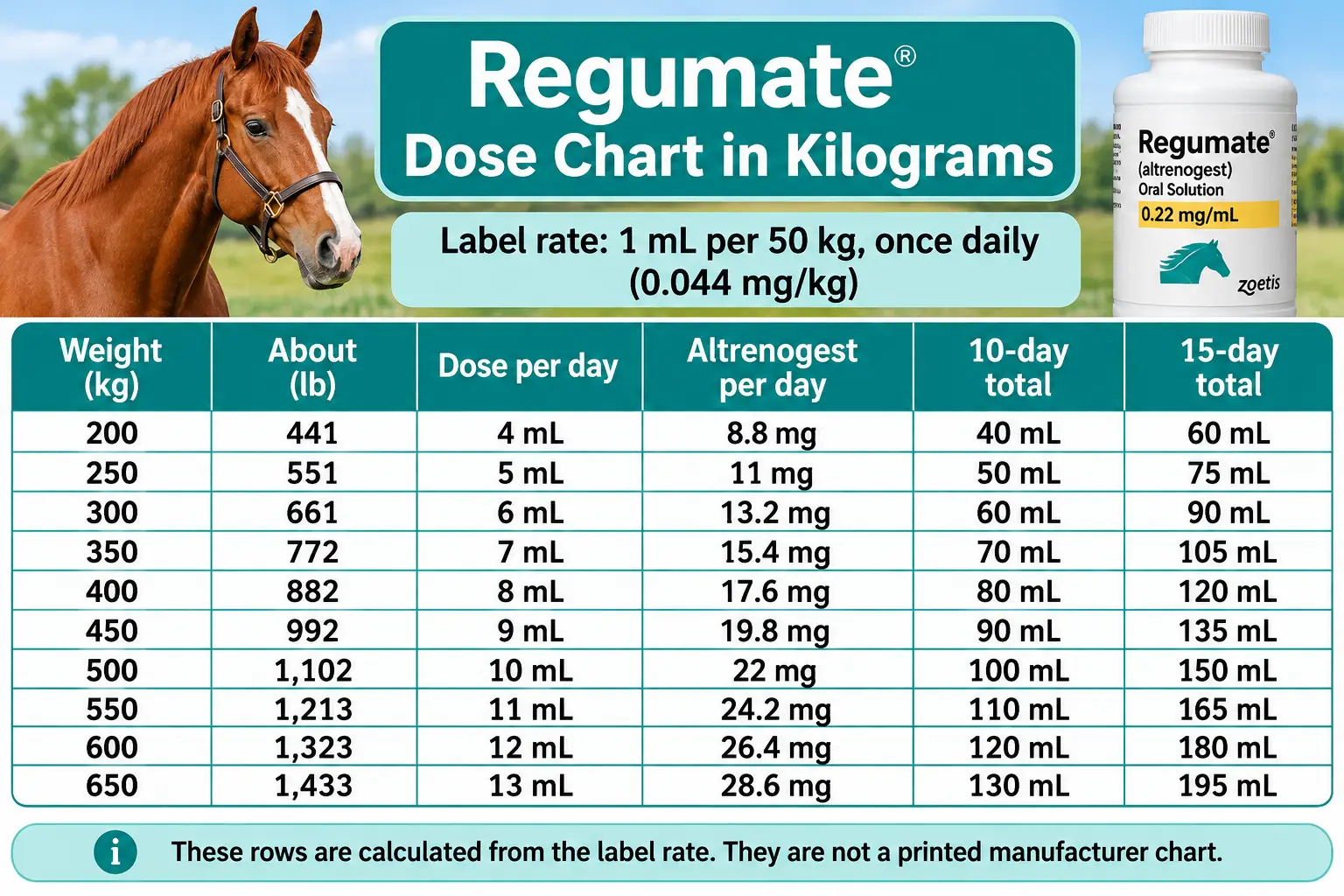
UK and metric-labelled products use 1 mL per 50 kg. This is the same rate (0.044 mg/kg), just written in metric. The table shows both the 10-day course listed on the UK datasheet and the 15-day course on the US label.
Label rate: 1 mL per 50 kg, once daily (0.044 mg/kg)
| Weight (kg) | About (lb) | Dose per day | Altrenogest per day | 10-day total | 15-day total |
|---|---|---|---|---|---|
| 200 | 441 | 4 mL | 8.8 mg | 40 mL | 60 mL |
| 250 | 551 | 5 mL | 11 mg | 50 mL | 75 mL |
| 300 | 661 | 6 mL | 13.2 mg | 60 mL | 90 mL |
| 350 | 772 | 7 mL | 15.4 mg | 70 mL | 105 mL |
| 400 | 882 | 8 mL | 17.6 mg | 80 mL | 120 mL |
| 450 | 992 | 9 mL | 19.8 mg | 90 mL | 135 mL |
| 500 | 1,102 | 10 mL | 22 mg | 100 mL | 150 mL |
| 550 | 1,213 | 11 mL | 24.2 mg | 110 mL | 165 mL |
| 600 | 1,323 | 12 mL | 26.4 mg | 120 mL | 180 mL |
| 650 | 1,433 | 13 mL | 28.6 mg | 130 mL | 195 mL |
These rows are calculated from the label rate. They are not a printed manufacturer chart.
Regumate Dose Calculator for Horses
Type in your mare’s weight to see the daily dose in mL, the total volume for the full course, and how many courses a bottle covers. The calculator applies the label rate and nothing else, so treat the result as a double-check on your vet’s instructions.
Regu-Mate Dosage Calculator for Horses
Enter the mare’s body weight to get the daily oral dose.
Mare details
For the most accurate dose, use a scale or weight tape.
Result
Enter a body weight and press Calculate Dose.
- Body weight lb / kg
- Dose rate1 mL per 110 lb (0.044 mg/kg)
- Active dose per day mg
- Total volume for 15 days mL
How to give it: Give the solution by mouth once daily for 15 consecutive days, directly on the base of the mare’s tongue or on her usual grain ration.
Safety: When handling Regu-Mate, the dosing device or syringes, always wear vinyl, neoprene or nitrile gloves. Latex gloves are not protective. Use the Regu-Mate Equine Dosing Device (recommended to reduce the risk of human exposure) or a luer lock syringe. Do not use any other dosing device.
This calculator is a guide only. Always follow the product label and your veterinarian’s instructions.
© medshorse.com
How to Calculate the Regumate Dose by Hand
To find the daily Regumate dose, divide your mare’s weight in pounds by 110. If you use kilograms, divide by 50. The answer is the number of mL to give once a day.
- Get an accurate weight. A scale is best. A weight tape is the next best option. Eyeballing is how dosing errors start.
- Divide by 110 (lb) or 50 (kg). This gives the mL per day.
- Check it against the chart. The label chart uses whole milliliters, so ask your vet how to handle weights that fall between chart lines.
- Multiply by the number of days to see how much product the full course uses.
Worked examples:
- 1,000-lb mare: 1,000 ÷ 110 = 9.1 mL per day. The chart would put her at about 9 mL.
- 1,250-lb mare: 1,250 ÷ 110 = 11.4 mL per day, between the 11 mL and 12 mL chart lines.
- 450-kg mare: 450 ÷ 50 = 9 mL per day.
- 500-kg mare: 500 ÷ 50 = 10 mL per day, or 150 mL over 15 days. One 1,000 mL bottle covers about six and a half of these courses.
How to Give Regumate to a Horse, Step by Step
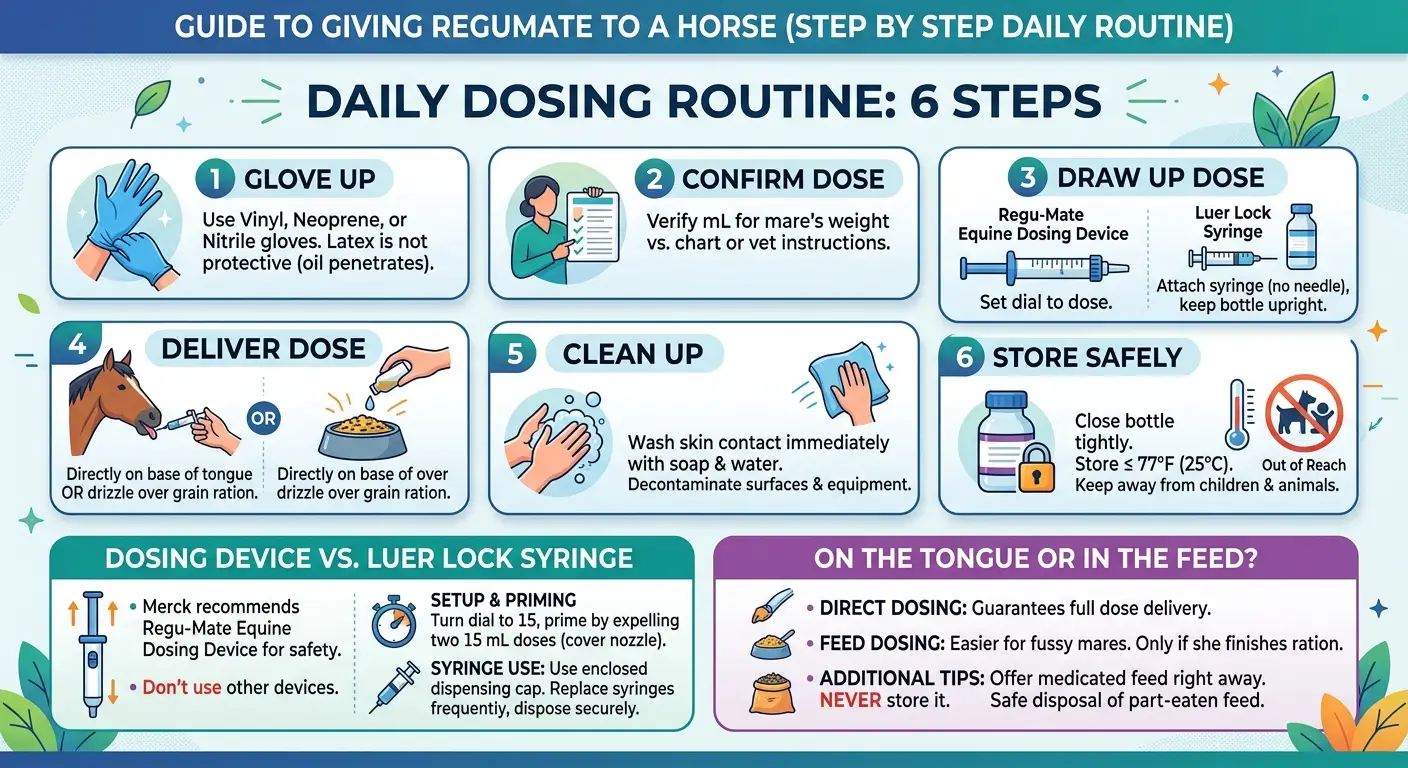
Give Regumate once a day, either squirted onto the base of the mare’s tongue or onto her usual grain ration, while wearing vinyl, neoprene or nitrile gloves. Here is the full routine, based on the manufacturer’s label.
Dosing Device vs. Luer Lock Syringe
Merck recommends the Regu-Mate Equine Dosing Device to reduce the risk of human exposure, and says not to use any other dosing device.
To set it up, you turn the dial to 15, hold the device vertically with the nozzle pointing away from anyone and covered with absorbent material, and prime it by expelling two 15 mL doses into a waste container. You re-prime if you see air in the barrel after switching bottles or during the course.
If you use a luer lock syringe instead, swap the shipping cap for the enclosed plastic dispensing cap. Replace syringes frequently and dispose of them securely.
On the Tongue or in the Feed?
Both are label-approved in the US. Direct dosing on the tongue guarantees she gets every drop. Feed dosing is easier on fussy mares, but only if she finishes her ration.
The UK datasheet adds a useful rule: offer the medicated feed right away and never store it, and destroy any part-eaten feed safely so it is not given to another animal.
How Long Does Regumate Take to Work?
Regumate suppresses heat in about 95% of mares within three days of starting treatment. The UK datasheet likewise says suppression usually happens after 1 to 3 days. After the last dose, most mares return to heat within 4 to 5 days.
What to expect from the first dose to ovulation
- Day 1: first doseDaily dosing begins. Mares should have been examined first to check ovarian activity.
- Days 1 to 3: heat is suppressedAbout 95% of mares stop showing heat within three days.
- Days 4 to 14: ongoing daily dosingSame dose, same time, every day. Do not skip or stop early.
- Day 15: last doseTreatment ends after 15 consecutive days.
- Roughly days 19 to 20: return to heatMares that were cycling normally come back into estrus 4 to 5 days after treatment ends.
- Roughly days 24 to 27: ovulationOvulation follows 5 to 7 days after the onset of heat, as in untreated mares. These day numbers are our calculation from the label timings.
UK datasheet figures differ in format: about 90% of mares show heat within 5 days of the end of treatment, and 60% ovulate between days 11 and 14 after treatment ends. Source: DailyMed label; NOAH Compendium.
What Is Regumate Used For in Mares?
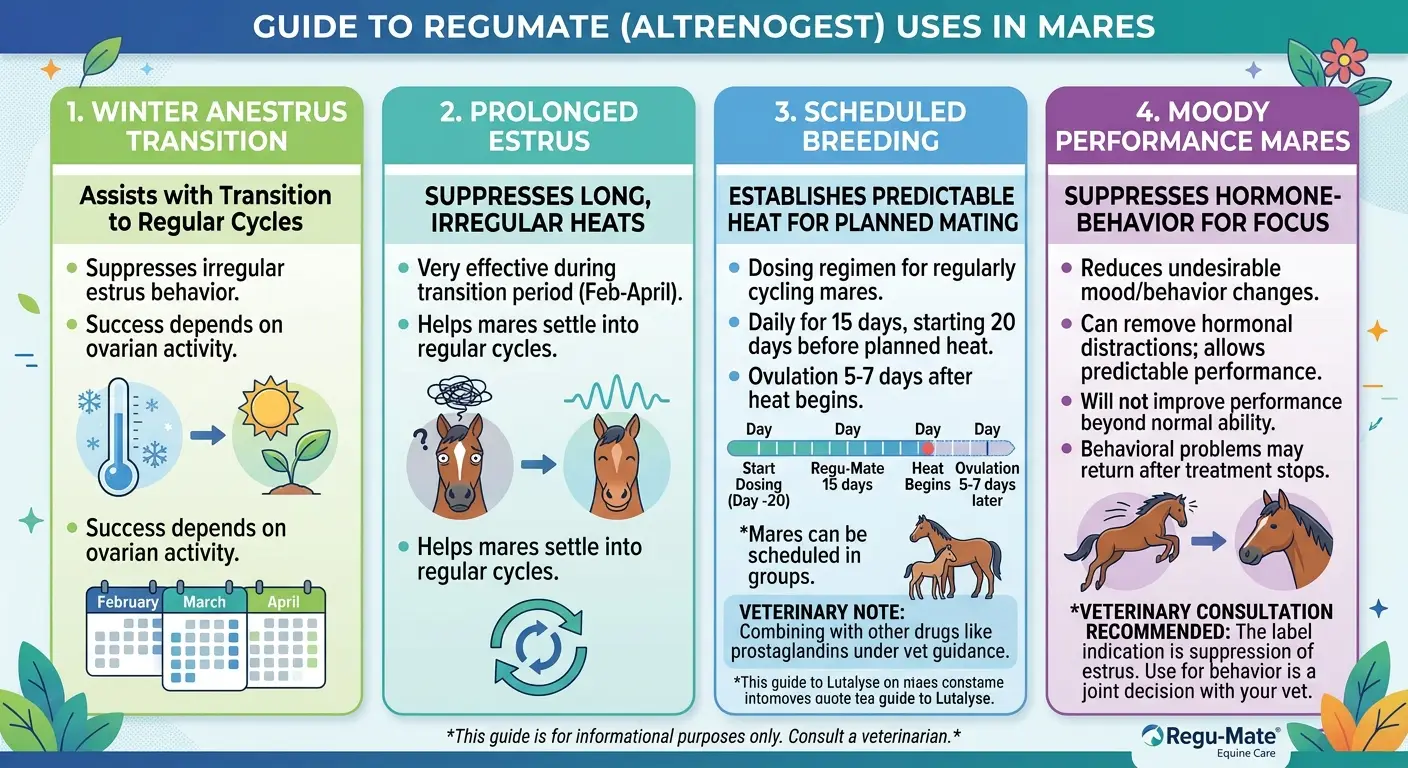
Regumate is used to suppress estrus so that a mare’s heat becomes predictable. The label lists three uses, and owners add a fourth in practice.
Winter Anestrus to Breeding Season Transition
Mares drift out of winter anestrus slowly, and the transition can be messy. The label says suppressing estrus helps mares reach regular cycles during this window. Success depends on ovarian activity, which we cover in the next section.
Prolonged Estrus
During the transition period (February, March and April, according to the label), mares can show long, irregular heats. The label calls Regumate very effective for suppressing this prolonged behavior, and a high proportion of those mares then settle into regular cycles.
Scheduled Breeding
For scheduled breeding, the label says regularly cycling mares, or mares with active ovaries, should receive Regumate daily for 15 days beginning 20 days before the planned heat.
Ovulation then follows 5 to 7 days after heat begins, and breeding proceeds as usual. Mares can be scheduled individually or in groups.
Breeding managers sometimes combine a progestin with other drugs under veterinary direction. If your vet mentions a prostaglandin in the plan, our guide to Lutalyse dosage for horses explains how that product is dosed.
Moody Performance Mares
Regumate is also widely used to take the edge off hormone-driven behavior in competition mares. The manufacturer says it reduces undesirable mood and behavioral changes.
The UK vet’s owner guide adds a realistic caution: it can remove hormonal distractions so a mare focuses and performs more predictably, but it cannot improve her performance beyond what is normal for her, and behavioral problems may return after treatment stops.
Note that the label’s indication is suppression of estrus. Using it purely for behavior is a decision for you and your vet, not something the label spells out.
Which Mares Respond Best to Regumate?
Mares with active ovaries respond best. Specifically, the label points to follicles of 20 mm or larger. The UK datasheet gives a similar threshold of at least 20 to 25 mm at the start of treatment.
Here is how the label describes the difference:
- Regularly cycling mares in breeding season: heat is suppressed during treatment, and they return to estrus 4 to 5 days after treatment ends and cycle normally.
- Transition mares with follicles of 20 mm or more: a higher proportion show normal cycles after treatment.
- Mares in deep winter anestrus with small follicles: they stay in anestrus and fail to show normal heat after withdrawal.
The practical lesson: have your vet check her ovaries first. The label advises examining mares to determine ovarian activity before treating during the transition, and the UK datasheet says follicular activity must be confirmed.
Regumate for Competition Mares: Rules and Timing
Regumate is legal to use in many sports, but rules differ by organization, and they change. The UK vet’s guide reports that racing bodies such as the Jockey Club treat it as a prohibited substance, requiring a mare to be off it for at least eight days before racing.
It also notes that the FEI allows mares to compete on Regumate, provided an ETUE 2 declaration is completed, signed and approved by the event’s Veterinary Commission or Delegate. The same guide says that giving it to stallions is an offense under FEI rules.
That guide describes “strategic use” as well. You do not need her on it all year. A typical pattern is to start about 4 days before a show, continue treatment, then stop and expect heat roughly 4 to 5 days later.
Plan around your own competition calendar, and check your federation’s current rulebook before every season, because the rules above come from one vet’s summary rather than the rulebooks themselves.
Regumate Safety: Protect Yourself First
Regumate is absorbed through unbroken human skin, and exposure can cause serious side effects in both women and men. This is the part of the label most owners skim, and it is the most important.
- Wear vinyl, neoprene or nitrile gloves. Latex is not protective.
- Wash spills on skin immediately with soap and water, and launder contaminated clothing.
- Clean and decontaminate any equipment or surface that touches the product.
- Keep the bottle away from children, dogs, cats and other animals.
- Women who are or may be pregnant
- Anyone with blood clots or clotting disorders, or a history of them
- Anyone with a history of heart disease or stroke
- Women with known or suspected breast cancer, or people with estrogen-dependent cancer
- Women with vaginal bleeding of unknown cause
- People with tumors that developed during oral contraceptive or estrogen use
- Anyone with liver dysfunction or disease
- Skin or clothing: wash immediately with soap and water.
- Eyes: flush with plenty of water for 15 minutes and get medical attention.
- Swallowed: do not induce vomiting. Seek medical attention immediately, because the oil base can cause lung damage if aspirated. Bring the label.
Reported effects in women include abnormal or absent menstrual cycles. In men, decreased libido has been reported.
Both sexes have reported headaches, fever, abdominal pain, nausea, diarrhea, vomiting and rashes. The label notes there has been no human use of this specific product, so its human-effects section is extrapolated from other progestins.
Practical tip: if your barn staff includes anyone who might be pregnant, plan the dosing duty before the course begins. It is far easier to reassign a task than to deal with an exposure.
Regumate Contraindications, Side Effects and Overdose
Who Should Not Get Regumate?
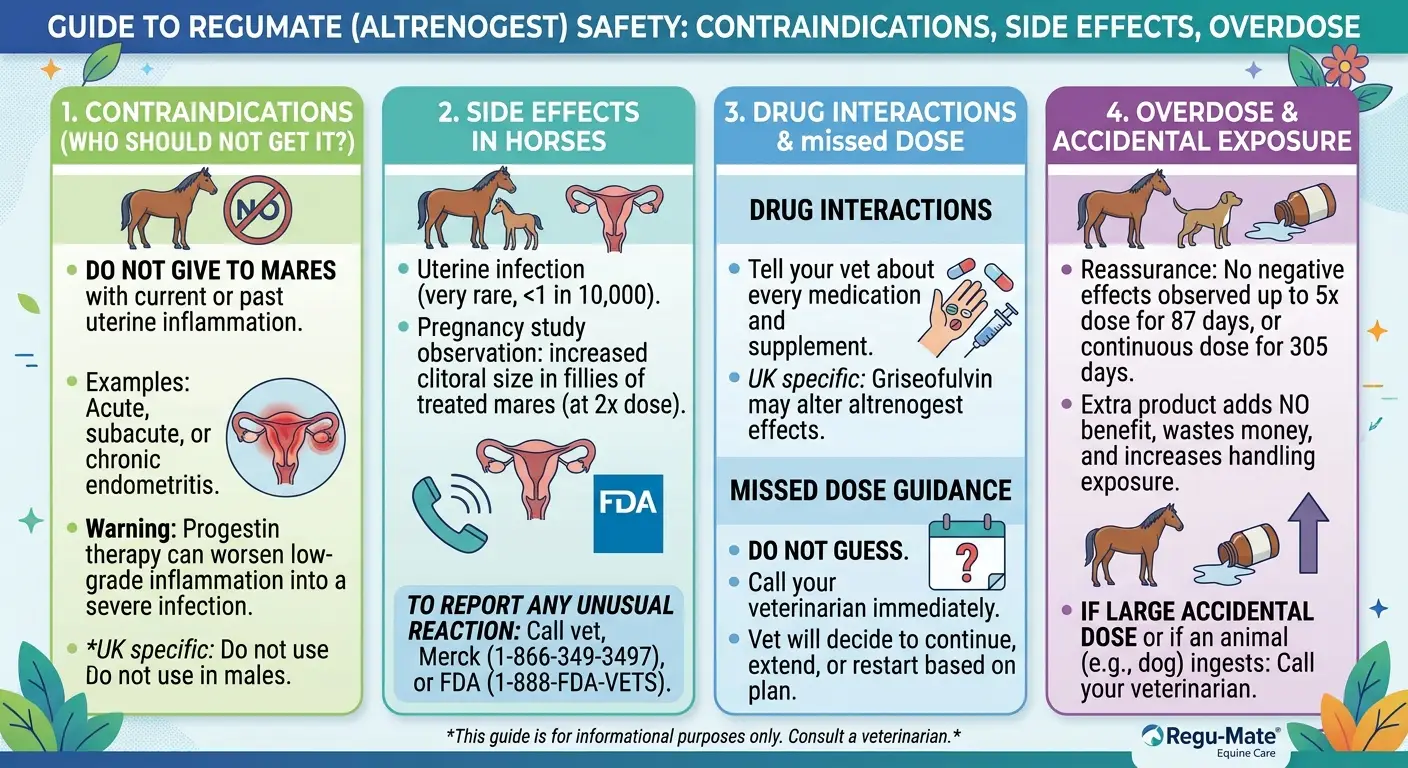
Do not give Regumate to a mare with a current or past history of uterine inflammation, such as acute, subacute or chronic endometritis. The label warns that progestin therapy can turn low-grade, “smoldering” inflammation into a fulminating uterine infection in some cases.
The UK datasheet likewise says not to use it where uterine infection has been diagnosed, and not to use it in males.
Side Effects in Horses
The US label does not list a table of common adverse reactions in horses. The UK datasheet lists one: uterine infection, reported as very rare (fewer than 1 in 10,000 animals treated). In the label’s pregnancy study, daughters of mares treated at twice the dose had increased clitoral size (covered below).
For anything unusual, call your vet and report it to Merck at 1-866-349-3497 or to the FDA at 1-888-FDA-VETS.
Drug Interactions
The UK datasheet says griseofulvin may alter the effects of altrenogest if given at the same time. Tell your vet about every medication and supplement your mare receives.
What Happens in an Overdose?
The UK datasheet reports that no negative effects were observed in horses given up to five times the recommended dose for 87 days, or the recommended dose continuously for up to 305 days. Treat that as reassurance about accidents, not permission to experiment.
Extra product adds no benefit, wastes money and raises handling exposure. If a mare gets a large accidental dose, or an animal such as a dog gets into the bottle, call your vet.
What If You Miss a Dose?
None of the sources I reviewed gives instructions for a missed dose, so I will not guess. Call your veterinarian, who can tell you whether to continue, extend or restart the course based on your breeding or competition plan.
Regumate and Pregnant Mares
Regumate’s labeled use is suppressing estrus, not maintaining pregnancy. Even so, safety data in pregnant mares exists because it is sometimes given to them.
The manufacturer’s three-year study gave 27 pregnant mares 2 mL per 110 lb (twice the estrus-suppression dose) from day 20 to day 325 of gestation, and compared them with 24 untreated mares.
27 treated pregnant mares (2x dose, day 20 to 325) vs 24 untreated controls
| Measure | Result |
|---|---|
| Filly offspring | Clitoral size was increased in fillies of treated mares |
| First ovulation (fillies) | Shorter interval from Feb. 1 to first ovulation than fillies of untreated mares |
| Pregnancy at 50 days | Treated: 81.8% (9 of 11). Untreated: 100% (4 of 4) |
| Pregnancy after 3 cycles | Treated: 91.7% (11 of 12). Untreated: 100% (4 of 4) |
| Colts reaching puberty | About the same age: 82 weeks (treated) vs 84 weeks (control) |
| Stallion offspring | No differences in semen volume, concentration, motility, sperm per ejaculate, sexual behavior or testicular measurements |
Source: Regu-Mate label, DailyMed (Shoemaker et al., 1989; Squires et al., 1989). Group sizes were small.
The small sample sizes mean you should read these numbers with care. The label does not give a pregnancy dosing schedule, so any use in a pregnant mare is off-label and has to be directed by your veterinarian.
The UK datasheet adds that accidental administration during pregnancy is not detrimental, because mare studies showed no evidence of teratogenic, fetotoxic or maternotoxic effects.
Storing and Disposing of Regumate
Store the bottle, and the dosing device when loaded, at or below 77°F (25°C) with the cap tightly closed. Put empty containers, rinse waste from the dosing device, used gloves and anything else that touched the product in a leak-resistant container, and dispose of it according to federal, state and local rules.
Common Regumate Dosing Mistakes to Avoid
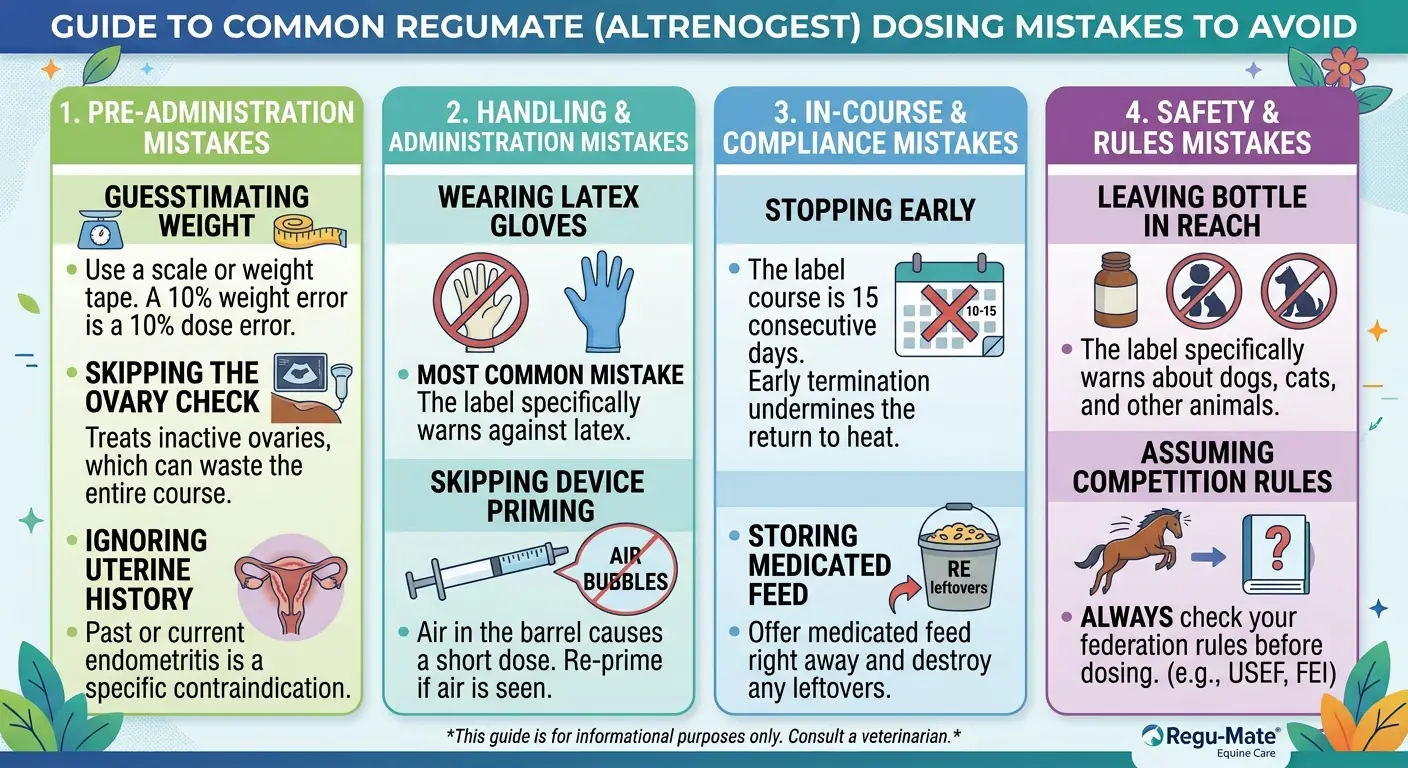
- Guessing weight. A 10% weight error means a 10% dose error. Use a scale or weight tape.
- Wearing latex gloves. This is the most common handling mistake, and the label specifically warns against it.
- Skipping the ovary check. Treating a mare with inactive ovaries often wastes the course.
- Ignoring uterine history. Past or current endometritis is a contraindication.
- Stopping early. The label course is 15 consecutive days. Ending early undermines the predictable return to heat.
- Skipping device priming. Air in the barrel means a short dose.
- Storing medicated feed. Offer it right away and destroy any leftovers.
- Leaving the bottle in reach of pets or children. The label specifically warns about dogs, cats and other animals.
- Assuming competition rules allow it. Check your federation before dosing.
Do Calming Supplements Replace Regumate?
No. Regumate is a hormone. Calming supplements and sedatives work differently, and none of the sources I reviewed shows that a supplement can replicate altrenogest’s control of estrus. If your mare’s behavior is mild, your vet may suggest starting with management changes or a gentler option.
If you are comparing options, our guides cover chasteberry dosage for horses (a common mare-support herb), hops dosage for horses, magnesium dosage for horses, and trazodone for horses dosage chart for behavior support.
Each is a separate product with its own risks. Do not combine any of them with Regumate without asking your vet.
FAQs
What is the correct Regumate dosage for horses?
The US label dose is 1 mL per 110 pounds of body weight (0.044 mg/kg) by mouth once daily for 15 consecutive days. The UK datasheet uses 1 mL per 50 kg, which is the same rate. A 1,100-lb mare receives 10 mL per day.
How much Regumate should I give a 1,000-lb horse?
A 1,000-lb mare needs about 9 mL per day (1,000 divided by 110 is 9.1 mL). The manufacturer’s printed chart rounds to whole milliliters, so ask your vet how to handle weights that fall between chart lines.
How much Regumate does a 500 kg mare need?
A 500 kg mare needs 10 mL once daily, based on 1 mL per 50 kg. Over a 15-day course that is 150 mL in total, and over a 10-day UK course it is 100 mL.
How long should a horse stay on Regumate?
The US label course is 15 consecutive days. The UK datasheet lists 10 consecutive days. Follow the course length printed on your product and in your vet’s plan, and do not extend treatment without veterinary direction.
How long does Regumate take to work in mares?
Regumate suppresses heat in about 95% of mares within three days of starting treatment, according to the US label. The UK datasheet says suppression usually occurs after 1 to 3 days of treatment.
How soon will a mare come into heat after stopping Regumate?
Mares that were cycling normally typically return to heat 4 to 5 days after the last dose and ovulate 5 to 7 days after heat begins. Mares in winter anestrus with small follicles may not show normal heat after treatment.
Can you give Regumate to a gelding or stallion?
No. Regumate is labeled for mares, and the UK datasheet says not to use it in males. One UK vet’s guide also states that giving it to stallions is an offense under FEI rules. Talk to your vet about any behavior problem in a male horse.
Can you mix Regumate in feed?
Yes. The US label allows dosing directly onto the base of the tongue or onto the mare’s usual grain ration. The UK datasheet says to offer medicated feed immediately, never store it, and safely destroy any part-eaten feed.
Does Regumate need a prescription?
In the US, yes. The label states that federal law restricts Regumate to use by or on the order of a licensed veterinarian. Rules differ by country, so check with your vet or local regulator.
Is Regumate safe for pregnant mares?
The label includes a three-year reproductive safety study in 27 pregnant mares given twice the estrus-suppression dose, but it does not give a pregnancy dosing schedule. Any use in a pregnant mare is off-label and must be directed by your veterinarian.
What are the side effects of Regumate in horses?
The US label does not list common adverse reactions in horses. The UK datasheet lists uterine infection as very rare, fewer than 1 in 10,000 treated animals. Regumate must not be used in mares with a history of uterine inflammation.
Is it safe for humans to touch Regumate?
No. Regumate is absorbed through unbroken skin and can cause serious effects in women and men. Wear vinyl, neoprene or nitrile gloves. Pregnant women, or women who may be pregnant, should not handle it. Wash any skin contact right away with soap and water.
Why are latex gloves not safe for handling Regumate?
Regumate is an oil-based product that can penetrate latex and other porous gloves. The label specifically says latex gloves are not protective and directs handlers to use vinyl, neoprene or nitrile gloves instead.
Can I use Regumate on a mare I plan to compete?
It depends on the sport. One UK vet’s guide says the FEI allows mares to compete on Regumate with an approved ETUE 2 declaration, while racing bodies may require a mare to be off it for at least eight days. Check your federation’s current rules before dosing.
How should Regumate be stored?
Store the bottle, and a loaded dosing device, at or below 77 degrees F (25 degrees C) with the cap tightly closed. Keep it away from children, dogs, cats and other animals, and dispose of waste and gloves in a leak-resistant container.
Key Takeaways and Next Steps
- The label dose is 1 mL per 110 lb (0.044 mg/kg) by mouth once daily for 15 consecutive days.
- Calculate it from an accurate weight, and check the number against the chart.
- It suppresses heat in about 95% of mares within 3 days, and most return to heat 4 to 5 days after the last dose.
- Mares need active ovaries (follicles of 20 mm or more) to respond well after treatment.
- Never use it in mares with current or past uterine inflammation.
- Humans must wear vinyl, neoprene or nitrile gloves. Pregnant women should not handle it.
- Check your sport’s rules before competing, and follow your vet’s plan.
Your next steps: book a reproductive exam to confirm ovarian activity, get an accurate weight, confirm the course length printed on your product, and plan who will handle dosing. Then use the calculator above to double-check your vet’s numbers.
Sources and Further Reading
- Regu-Mate (altrenogest) FDA label on DailyMed (U.S. National Library of Medicine)
- Merck Animal Health USA: Regu-Mate product page
- NOAH Compendium (UK): Regumate Equine 2.2 mg/ml, clinical particulars
- Equitait veterinary practice: Regu-mate for the moody mare, an owner’s guide (PDF)
- MSD Animal Health UK
- FDA: report an animal drug adverse event
Medical disclaimer: This article is for education and does not replace veterinary advice. Regumate is a prescription drug. Dosing, course length and off-label use must be decided with your licensed veterinarian, who knows your mare’s reproductive history. Always follow the label printed on your product.