Psyllium Husk Dosage for Horses: Calculator, Chart & Complete Feeding Guide
Psyllium Husk Dosage Calculator for Horses
Enter your horse’s bodyweight and choose a feeding purpose to work out a psyllium husk dose.
Recommended dose
Psyllium husk is likely to be found on your feed room shelf, should your horse live on sandy ground or graze on short pasture. The hard part is not locating it, but knowing how much to give, how many times and whether you are doing it correctly.
This guide provides you with a personalized dosage calculator, a complete weight-based chart, and a concise answer to the wet-versus-dry feeding debate, as well as what the actual equine research says about whether Psyllium Husk Dosage for Horses works as most feed labels say.
Key Takeaways
- The most common type of a vet-monitored nasogastric therapy of sand colic is 1 gram of psyllium per kilogram of bodyweight, administered over 3-7 days.
- There is a common monthly at-home sand purge (usually 50 grams/100 kg of body weight) that is fed over approximately 4 days.
- The evidence on whether home feeding of psyllium is effective in clearing sand is inconclusive, with some studies indicating a benefit, others indicating no benefit, and nasogastric feeding with a laxative such as magnesium sulfate being the most supported.
- Psyllium overfeeding, particularly when the dosage is several times the recommended dose, has been associated with bezoars (compacted mass of fibers) and in one reported case, a fatal stomach burst.
- Never self-dose, and always check with your veterinarian, particularly when administering treatment to a suspected case of sand colic.
What Is Psyllium Husk, and Why Do Horses Need It?
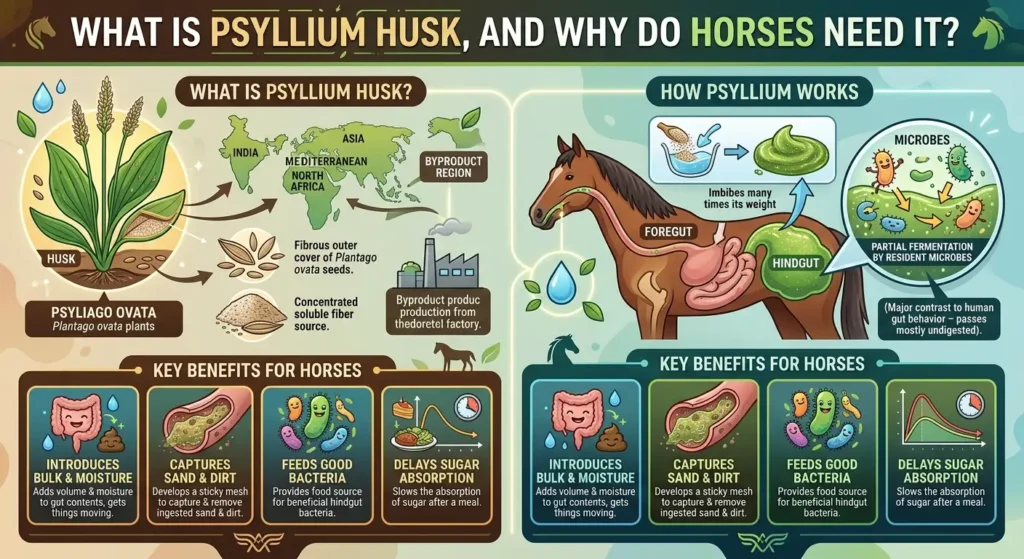
Psyllium husk for horses is the fibrous outer cover of the seed of the plant Plantago ovata, which is cultivated in India, Asia, the Mediterranean, and North Africa. It’s harvested as a byproduct of psyllium seed production and used as a concentrated source of soluble fiber.
When a horse is fed on psyllium, the husk imbibes many times its own weight of water, and becomes a thick, gel-like compound. In humans, about half or two-thirds of that husk material is a gel, which cannot be digested by digestive enzymes. In horses the fiber enters the hindgut, where resident microbes partially ferment it – a major contrast to its behavior in the human gut, where it mostly passes through undigested.
It is that gel-forming, water-absorbing quality that makes psyllium be fed to horses. It’s believed to:
- Introduce bulk and moisture to the gut contents, and get things moving.
- Develop a sticky mesh that is able to capture and perform ingested sand and dirt.
- Feed good hindgut bacteria.
- Delays the absorption of sugar in a meal.
Why Horses Ingest Sand in the First Place
The horses that browse on overgrazed, sparse or sandy pasture (or that are fed hay or grain on the ground) will always pick up some dirt and sand with their food. This is absorbed in small quantities without problem. With time, however, it can become established in the large colon, where it can lead to irritation, diarrhea, low-grade discomfort, or more severe complications, such as a blockage called sand colic.
The most at-risk horses usually have a few features in common: they are kept on sandy soil, not fed in a bucket or feeder, and have limited access to plentiful forage that otherwise would keep them grazing to bare ground.
Psyllium Husk Dosage Chart for Horses By Weight
The various feeding purposes require varying quantities. The chart below is constructed based on dosing conventions that have been reported most consistently in each case of use. Always look at the label of your product first – concentration and suggested amount of scoops depends on the brand – and use this chart as a guideline, not a replacement of the veterinary.
| Horse Weight | Vet-Administered Treatment (1 g/kg/day, 3–7 days) | Monthly At-Home Purge (50 g/100 kg/day, 4 days) | Approx. Scoops/Day (Monthly Purge)* |
| 250 kg (550 lb) — pony | 250 g/day | 125 g/day | ~14 scoops |
| 300 kg (660 lb) | 300 g/day | 150 g/day | ~17 scoops |
| 400 kg (880 lb) | 400 g/day | 200 g/day | ~22 scoops |
| 500 kg (1,100 lb) — average horse | 500 g/day | 250 g/day | ~28 scoops |
| 600 kg (1,320 lb) | 600 g/day | 300 g/day | ~33 scoops |
| 700 kg (1,540 lb) — draft type | 700 g/day | 350 g/day | ~39 scoops |
Scoop estimate is calculated as 9 g/scoop, which is an estimate of a 108 g/12-scoop loaded-week reference. The size of scoops differs widely by brand – be sure to check the actual scoop size of your product.
To put this into perspective, the majority of commercial sand-clearing products are formulated around a 1,000 lb (approximately 450 to 500 kg) average horse and instructions such as two scoops (100 g) once a day, 3-7 consecutive days or 30 days. When feeding a lighter horse, pony, or draft breed, adjust the dose to the bodyweight instead of using a fixed per-horse dose.
Dosage by Purpose
| Purpose | Typical Dose | Duration | Who Should Administer It |
| Sand colic treatment (nasogastric) | 1 g/kg/day | 3–7 days, 1–2 doses/day | Veterinarian only |
| Monthly sand-clearing “loaded week” | 50 g per 100 kg/day | 4–7 consecutive days, once a month | Owner, in-feed |
| Hindgut/microbiome support | 50–400 g/day | 1–2 weeks | Owner, in-feed |
| Metabolic support | 90–270 g/day | 30–60 days | Owner, with vet oversight |
| Endurance/hydration support | ~150 g/day | 8 days pre-competition | Owner, in-feed |
These are the ranges that have been reported in feeding trials and product labeling, they are not a guarantee that every horse will respond to them and long term or metabolic use should be discussed with your vet, particularly when your horse has an underlying health issue.
Nasogastric Administration: How Vets Use Psyllium for Sand Colic
When a horse is found to have a considerable amount of sand, the most justifiable solution is not feeding it a psyllium loose in a bucket, but a veterinarian passing a nasogastric tube up the nostril, down the esophagus, and into the stomach to administer a psyllium solution directly.
In research involving this technique, therapy is usually 3-7 days with 1-2 doses per day with a dosage of approximately 1 gram of psyllium per kilogram of bodyweight – approximately 500 grams per day in a 500 kg (1,100 lb) horse.
Before you suppose that the more psyllium you have the better the sand clearance, you should know two things:
It is typically effective with a laxative. A study comparing nasogastric psyllium to magnesium sulfate (Epsom salt) to the combination of the two, found that the combination cleared sand in the colon of up to about three-quarters of the treated horses – a significantly superior outcome than either of the two treatments.
Psyllium alone has shown unsatisfactory results in over a trial. Ponies or horses fed on psyllium alone did not show any significant increase in sand clearance in at least two studies. This does not imply that psyllium is useless, it just implies that the combination and route of administration is as important as the psyllium.
Nasogastric intubation is associated with actual risks in case of improper implementation (aspiration, esophageal injury) and it should never be performed by a veterinarian. There’s no safe home version of this procedure.
Feeding Psyllium at Home: The Monthly “Sand Purge”
In terms of routine, at home prevention, and not active treatment, most of the advice will come together on a similar pattern: take psyllium every day, in a series of days, once a month, and not all the time.
One of the most popular feeding rates is 50 grams per 100 kg of bodyweight (or approximately 2 ounces per 250 lb) per day, approximately 4 days per month. Other product labels go as far as a full 7-day (purge) week, but explicitly limit it to no more than 7 consecutive days in any 30 days.
In the case of an average 1,000-1,100 lb horse, this is usually approximately 5-7 ounces (approximately 1-1.5 scoops) per day during the purge period, but the size of scoops does differ by brand – never assume that scoops are standardized.
Practical hint: Have a reminder on your phone or barn calendar on the first of the month. One of the most frequent causes of horse owners thinking that psyllium is not working is missing the monthly purge – consistency is more important than the day you start.
Should You Feed Psyllium Wet or Dry? (Here’s the Real Answer)
It is among the best disputed aspects of horse-keeping discussion-boards, and is worth clearing up, as the two camps are really at loggerheads:
Have it dry, or but slightly dampened – never pre-soaked into a gel. The rationale: the sand-trapping effect of psyllium relies on the fact that it will form its gel in the gut of the horse, but not in the feed bucket. Some manufacturers specifically recommend that the product be fed dry, as pre-wetting it may make it less efficient at picking up sand, and that a horse that has ingested psyllium which has already become a slick gel outside the body may not receive the same advantage.
There is also the safety aspect: when psyllium for horse dosage is in water, it swells rapidly, and when a horse swallows a wad of pre-soaked swollen husk, it increases the chances of choke.
Wet it slightly to make it stick to feed and enhance palatability – do not wet it. Other sources suggest moistening the psyllium to the extent that it sticks to a favorite feed, specifically stating that it should not be made completely wet, as a completely sticky gooey mixture is intolerable and most horses will not eat it.
The pragmatic halfway covenant that the two camps settle on: do not make psyllium soup before putting it in the bucket. Light dampening to make powder stick to feed is not the same as wetting it to a wet gel. Whatever your product label suggests, do it- and always make sure that your horse has plenty of easy access to fresh water during his feeding of psyllium, as the entire mechanism is reliant on proper hydration.
Benefits of Psyllium for Horses
Sand Clearance
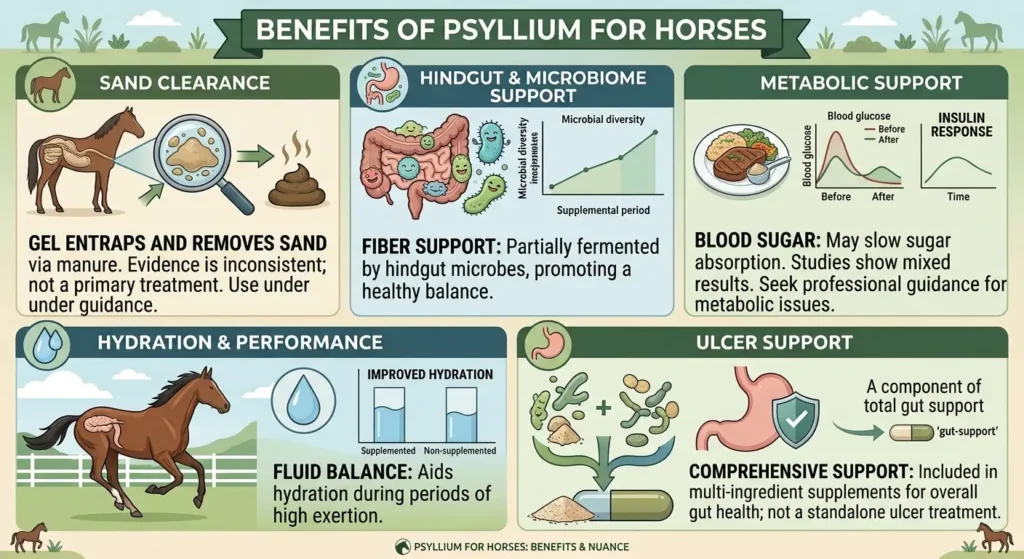
That is why a majority of owners turn towards psyllium first. The husk is believed to create a gel, which can entrap and remove sand or dirt out via the manure. With that said, the evidence on this is truly inconclusive – some feeding experiments indicate higher sand production with psyllium, others indicate no difference compared to a control group, and at least one study indicates that sand clearance was actually higher during a plain-water feeding period than during psyllium feeding.
The best results are always consistent with nasogastric administration with a laxative, but not with psyllium fed in a bucket.
Hindgut & Microbiome Support
In horses, the fiber is partially fermented by hindgut microbes in contrast to humans where psyllium is mostly undigested. A controlled feeding trial established that psyllium supplementation was linked to quantifiable changes in fecal microbial communities, and the highest level of microbial diversity occurred in the middle of the supplement.
Scientists also found improvements in indicators of antioxidant generation and nitrogen consumption by intestinal bacteria with supplementation – the first signs that psyllium could be a true prebiotic substrate, but the authors of the study were keen to point out that their results were tentative and required further investigation.
Metabolic Support
Since the gel psyllium forms slow the speed at which food is passed through the gut, some studies have investigated whether it also slows the absorption of sugar. Some studies reported that horses fed psyllium had reduced blood glucose and insulin responses following a meal; others, which compared longer periods of feeding, did not report any significant difference – and one even reported a greater insulin peak in the psyllium group.
The candid overview: there is a reasonable mechanism and some supportive evidence, but the findings across studies have not been uniform and any horse with metabolic issues such as insulin resistance needs to be treated under the guidance of the veterinarian and nutritionist and not as a standalone intervention using psyllium.
Hydration & Performance
Since psyllium medication for horses holds water in the colon, it has been researched as a means to keep competition horses hydrated. Feeding psyllium before a long-distance ride was found to reduce the increase in hematocrit (a sign of dehydration) after riding in endurance horses, in comparison with non-supplemented horses.
This has given rise to regimes of feeding psyllium about a week prior to an endurance event with the express purpose of aiding in fluid balance during competition.
Ulcer Support
One ingredient in combination gut-support supplements to minimize the severity of gastric ulcers in performance horses is sometimes psyllium. Since these products contain other ingredients (minerals, prebiotics, yeast) it is hard to attribute any perceived improvement to psyllium per se, but this is more of a component of a larger gut-support approach than an ulcer treatment in itself.
Side Effects, Risks & Who Should Avoid Psyllium
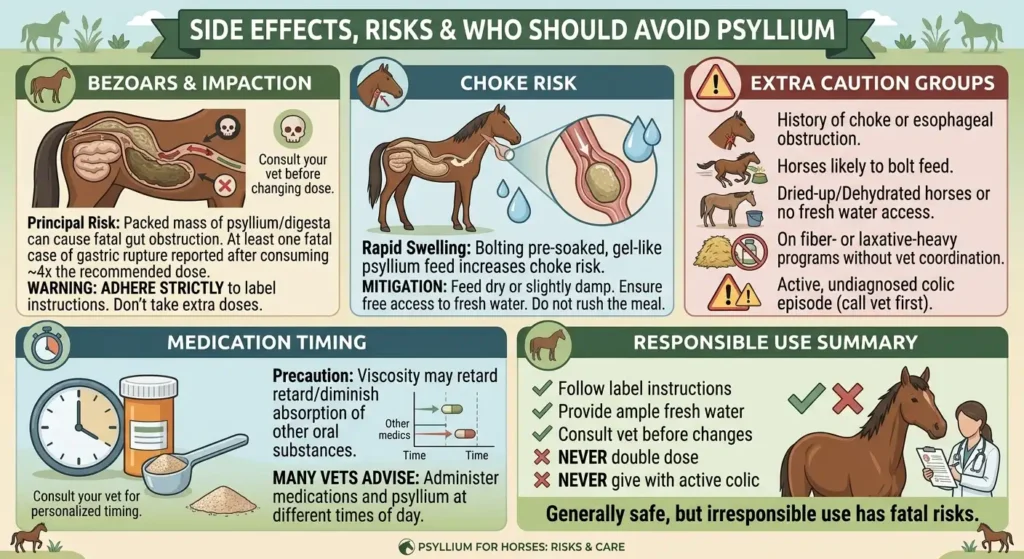
Psyllium is typically a low risk supplement when administered as per the labeled instructions, but generally safe is not the same thing as impossible to abuse.
Bezoars and Impaction
The principal risk that is recorded is the development of a bezoar – a firmly packed mass of psyllium and digesta that may cause an obstruction of the gut. This is not an issue of theory: the veterinary literature contains at least one reported case of a horse having a fatal gastric rupture following the consumption of psyllium at approximately four times the recommended daily intake.
This is the very reason why each dosing suggestion in this guide is accompanied by the same warning – adhere to label instructions, do not take more than one dose to accelerate effects and consult your vet before taking more or longer than what is written on the label.
Choke Risk
Due to the rapid swelling of psyllium when it comes into contact with water, horses that bolt their feed, particularly feed containing pre-soaked, gel-like psyllium are at risk of choke. This risk can be reduced by feeding a horse dry or slightly damp (see above), by making sure that a horse has free access to water, and by not rushing a horse through a meal containing psyllium.
Horses That Should Use Extra Caution
- Horses that have a history of choke or obstruction of the esophagus.
- Horses that are likely to bolt their feed.
- Dried-up horses, or horses that do not have access to fresh water.
- Horses already on a fiber- or laxative-heavy program, without coordination with the vet.
- Any horse that has an active, undiagnosed colic episode – call your vet before adding any supplement.
Medication and Supplement Timing
No equine studies have measured the effects of psyllium on the absorption of other oral drugs or supplements in horses. But the identical gel-forming, viscosity-increasing, process which renders psyllium useful in cleansing sand, is the process which in other species is known to retard or diminish the absorption of other substances ingested with it.
Many vets recommend that oral medications and psyllium be administered at different times of day, not at the same time, as a general precaution, but your veterinarian may have a different recommendation depending on whether your horse is taking other medications.
Myth vs. Fact
| Myth | Fact |
| “More psyllium means faster sand clearance.” | Overdosing has been linked to bezoars and, in at least one case, a fatal gastric rupture. Sticking to the labeled or vet-recommended dose matters more than the amount. |
| “Psyllium alone, fed any way, reliably clears sand.” | Research results are mixed. The strongest evidence supports nasogastric administration combined with a laxative like magnesium sulfate, not psyllium fed alone in a bucket. |
| “You should always soak psyllium before feeding it.” | Most manufacturers recommend feeding it dry or only lightly dampened — a fully soaked, gel-like mixture may be less effective and less palatable. |
| “Human psyllium products are fine for horses.” | Human products aren’t formulated or dosed for equine bodyweight, and may contain flavorings, sweeteners, or additives not intended for horses. Use an equine-specific product and consult your vet or nutritionist first. |
| “Daily, ongoing psyllium is always better than monthly dosing.” | For sand prevention, the common protocol is several consecutive days per month, not continuous daily feeding — check your specific product’s label, since formulations differ. |
You May Also Like to Read:
- Panacur Dosage for Horses: Calculator, Weight-Based Chart & Complete Safety Guide
- Magnesium Dosage for Horses: Calculator, NRC Chart & Complete Safety Guide
FAQs
Is psyllium safe for horses?
Psyllium husk is believed to be safe when fed at the recommended dose and with sufficient water access. The main issues are due to serious overdosing, which has been associated with the formation of bezoars and, in rare cases, severe complications.
Will psyllium impact horses?
Yes, but this is not common at normal doses. The danger is extreme when it comes to overfeeding; there was a case where a horse was given about four times the recommended dose.
What is the maximum length of stay of a horse on psyllium?
The majority of labeled protocols limit continuous feeding to approximately 7 consecutive days, with weeks off in between. In research settings, there are longer-term hindgut or metabolic support regimens lasting weeks at a time, but these must be overseen by a veterinarian or equine nutritionist.
Is it better to feed psyllium wet or dry?
Feed it dry or slightly moistened to aid in sticking to feed. Do not put it in a full gel and then feed it, as this can impair its action and cause it to choke.
Does psyllium actually clear sand from a horse’s gut?
The study is both qualitative and quantitative. Other studies indicate that psyllium feeding results in higher sand production; others indicate that psyllium feeding has no significant effect relative to a control group. Vet-administered nasogastric treatment with a laxative is the most reliable.
What is the use of psyllium to treat colic?
In the case of diagnosed sand colic, a veterinarian will usually prescribe the use of psyllium through the nasogastric tube, usually with magnesium sulfate, within a 3-7 day course. This is not something you should be trying to do at home.
May I feed my horse with human psyllium?
It is not usually advised unless advised by a veterinarian. Horse body weights are not dosed with human products, and they might contain ingredients that are not meant to be used in horses. Select a horse product.
What’s the difference between the monthly purge and daily maintenance feeding?
A purge with a higher dose is administered on a monthly basis, but over a narrow and specific time (around 4-7 days) to promote sand clearance. More continuous daily feeding is occasionally employed in its place, in the form of continuous prebiotic/hindgut support, at a reduced portion of the purge dose.
Will psyllium decrease the risk of ulcers in horses?
It can be used as a supplement to a larger gut-support supplement, but the evidence does not support psyllium alone but combination products.
Which is better, pellets or powder, in horses?
They are both used well, and it is often a matter of preference of your horse and the ease at which each form can be incorporated into their normal feed. Powder is more concentrated per scoop; pellets are usually more palatable to picky eaters.
Final Thoughts
Psyllium husk is a highly popular aid to equine gut health, but it is not a supplement to eyeball. The dose that is helpful – 1 g/kg in a treatment administered by a vet, or about 50 g/100 kg in a monthly at-home purge – is far less than the dose that has been associated with severe complications, and the difference between helpful and harmful is not a matter of conjecture.
Also important: the studies on the effectiveness of psyllium in clearing sand are more divided than the majority of the marketing of the products indicate. It does not imply that it is not worth feeding, it only implies that a combination of it with good management (enough forage, off the ground as little as possible, enough water) will give you a better chance at getting results than psyllium.