
Magnesium Dosage for Horses: Calculator, NRC Chart & Complete Safety Guide
Magnesium Dosage Calculator For Horses
Based on NRC Nutrient Requirements for Horses
Recommended Minimum Daily Requirement
When your horse is strained, or tight along the topline, or simply not his usual self, magnesium dosage for horses is the first mineral to which people turn, and not in vain. It plays a role in muscle relaxation, nerve signaling, and hundreds of enzyme reactions. But it is not a dose to give him some magnesium and speculation can be underfeeding a horse that actually requires assistance or it can be giving a horse a vitamin that it did not require at all.
This guide provides you with the precise daily magnesium requirement of your horse depending on its weight and work load according to data of the National Research Council (NRC) as well as a free calculator, an analysis of bioavailability of all common forms of magnesium and the safety information which most articles omit.
Key Takeaways
- The minimum of magnesium that a 500 kg (1,100 lb) horse at maintenance requires is 7.5 grams/day; intense exercise, pregnancy, and lactation increase this need.
- The NRC values are minimums to avoid shortage – not the optimum to perform or to relax.
- The majority of forage-based rations already satisfy minimum magnesium requirements; supplementation is most applicable to overworked, stressed or deficient horses.
- The most convenient supplemental source is usually magnesium oxide – concentrated, inexpensive, and moderately absorbable.
- Over-supply of magnesium is uncommon since normal horses lose it in the urine, although certain types of over-supplementation and chronic over-supplementation are also associated with certain dangers (see below Safety section).
- To dose your horse, always weigh and know how much they have to work with, use the calculator to get a personalized number in seconds.
What Is Magnesium and Why Does Your Horse Need It?
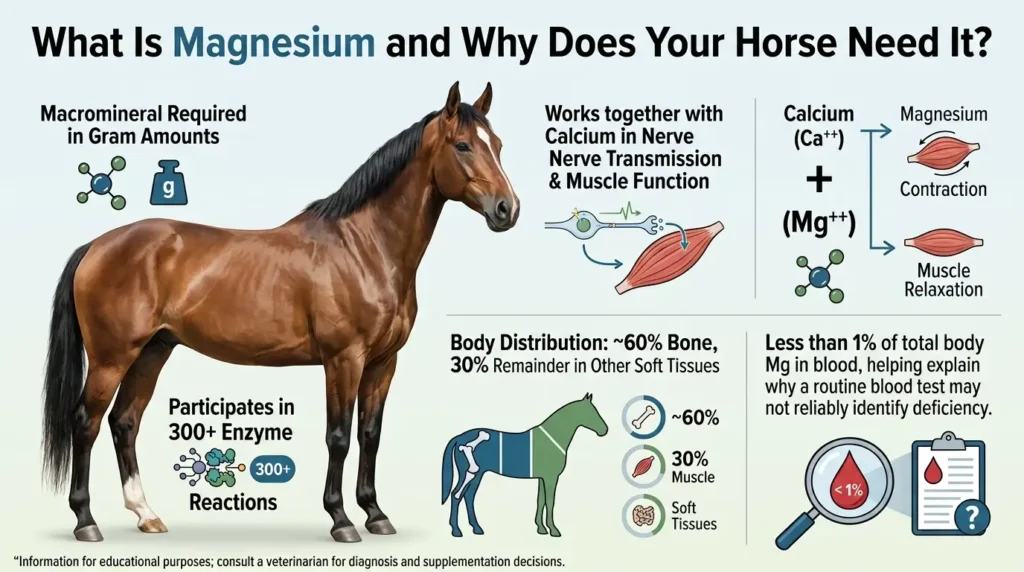
Magnesium for horses is a macromineral, or a mineral that requires gram amounts, not trace amounts, and is involved in more than 300 enzyme reactions in the body. It functions together with calcium in the transmission of nerves and the contraction of muscles: calcium causes a muscle to contract and magnesium helps it relax back afterward. This is the process of most popular uses of magnesium, whether it be in soothing muscle or in sedation.
The total body content of magnesium in a horse is approximately 60 percent bone, 30 percent muscle and the rest in other soft tissue. Even when it is in the blood, it is less than 1% of the total, and that is one reason why a routine blood test will so often fail to determine whether a horse is actually deficient or not, more on that below.
How Much Magnesium Does a Horse Need? (NRC Dosage Chart)
The European Union dietary mineral requirements of a horse are established by Nutrient Requirements of Horses by the National Research Council. NRC number is a minimum, not an objective – it is the lowest amount of magnesium that is necessary to avoid visible signs of deficiency, not necessarily the optimal level of magnesium in a competition horse or one that has suffered an episode of magnesium-responsiveness.
Magnesium Requirements by Workload & Life Stage
The values below are in a mature 500 kg (1,100 lb) horse. Horse requirements are proportional to body weight (i.e. a horse weighing less or more than the weight mentioned above) and can be compared with a calculator below. Magnesium for Horses Dosage is Bellow:
| Horse’s Status | Daily Magnesium Requirement (500 kg horse) | Approx. mg per kg body weight |
| Maintenance (not in work) | 7.5 g/day | ~15 mg/kg |
| Light exercise | 9.5 g/day | ~19 mg/kg |
| Moderate exercise | 11.5 g/day | ~23 mg/kg |
| Heavy or very heavy exercise | 15 g/day | ~30 mg/kg |
| Late gestation (9–11 months) | 8 g/day | ~16 mg/kg |
| Lactation (first 3 months) | 11 g/day | ~22 mg/kg |
Quick facts:
- These are minimums. Other equine nutritionists and veterinary sources recommend operating at rates of 10 to 15 g per day with an average 500 kg horse at actual work (travel, heavy sweating, high-potassium spring pasture) at reduced workloads, as the NRC minimum is based on an ideal environment.
- The amount of maintenance required by growing horses and ones experiencing considerable physiological stress may be approximately twice the amount.
- The upper limit of dietary content that horses can tolerate is 0.8% of total diet (on dry matter basis) – approximately 80 g/day of a 500 kg horse on a typical ration. This is not a goal, but a limit; what occurs somewhere near it or beyond it can be found in the Safety section.
How to Calculate Your Horse’s Exact Dose
You do not have to do the calculations by hand, the calculator above does this on your behalf but the formula is as follows:
- Find the per-kg rate for your horse’s workload: divide the 500 kg reference value by 500 (e.g., moderate exercise: 11.5 g ÷ 500 kg = 0.023 g/kg, or 23 mg/kg).
- Multiply by your horse’s actual weight in kg. A 420 kg horse in moderate work needs roughly 0.023 × 420 = 9.66 g/day.
- Compare this figure with what the diet already provides through forage and any existing feed and then make a decision as to whether and how much to supplement.
In case you are not sure of the weight of your horse, a weight tape around the girth will give you an approximate weight and most feed stores or vets have livestock scales that can weigh a horse and get you an actual number.
Signs of Magnesium Deficiency in Horses
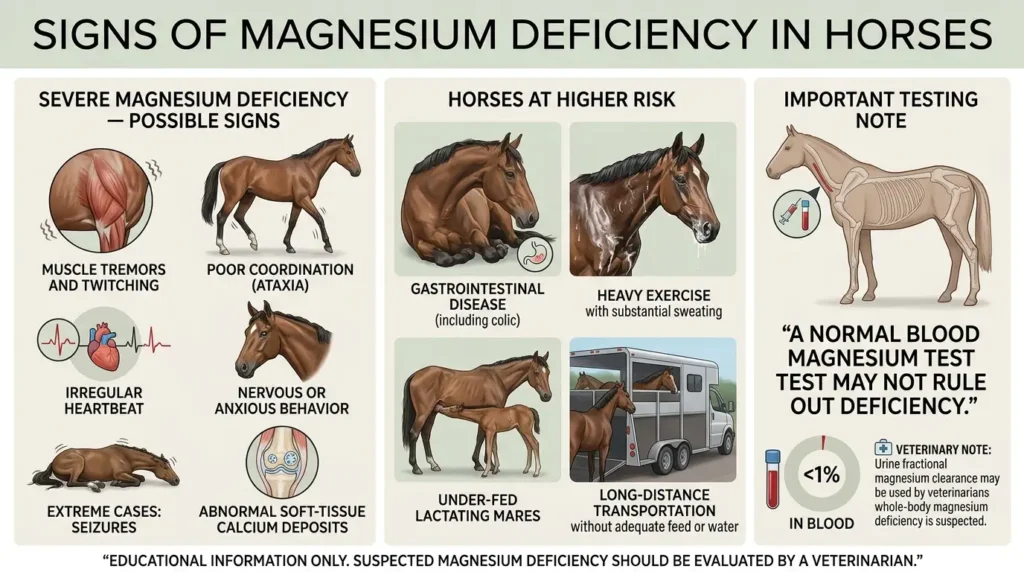
Clinical magnesium deficiency is not common in horses on a sound diet, whereas subclinical (mild, hard-to-detect) deficiency is more controversial. Severe deficiency has been reported with symptoms such as:
- Tremors and twitching of muscles.
- Poor coordination (ataxia)
- Irregular heartbeat
- Anxious or nervous behavior.
- In extreme cases: seizures or soft tissue abnormal calcium deposits.
Horses that are most exposed to low levels of circulating magnesium are those having gastrointestinal disease (including colic), heavily exercising horses that lose massively of water through sweating, under-fed lactating mares and those being transported long distances with no access to feed or water.
Why blood tests are deceptive: since only a small percentage of all the magnesium mineral in the body is carried in blood, a normal serum magnesium test would be considered normal even in a horse with an actual tissue deficiency. A urine fractional clearance test is more commonly used to diagnose the whole-body magnesium status of the patient, and will often be used by veterinarians who suspect a deficiency.
Where Horses Get Magnesium From (Diet vs. Supplements)
Majority of horses obtain most of their magnesium in forage. Normal hays have about 0.1-0.3 percent magnesium on a dry matter basis, with legume hays such as alfalfa and clover usually higher than grass hays such as timothy or bermuda. The forage absorption is estimated at approximately 40-60%.
Example: A 500 kg horse with a diet of 10 kg of hay (dry matter basis) a day at 0.2% magnesium is fed approximately 20 g of magnesium per day. That is about 812 g of elemental magnesium actually absorbed, at 40-60 percent absorption, or about 8-12 g, which comfortably satisfies the maintenance requirement and frequently light-to-moderate work as well.
This is what makes most horses on a forage based diet a non-magnesium supplement. Supplementation is more likely to be beneficial in horses that are in heavy or very heavy work, on forage of poor quality or with low magnesium levels, and with a particular magnesium-responsive condition that your veterinarian has diagnosed.
Which Form of Magnesium Is Best for Horses?
Not all magnesium supplements are created equal. Two are important: concentration (the amount of elemental magnesium in each gram of product) and bioavailability (a percentage of that magnesium that the horse absorbs).
A highly concentrated form would imply that you are putting on less product to reach the same target dose – which is important to both cost and palatability, as powdered magnesium is not particularly a tasty substance unto itself.
Bioavailability & Concentration Comparison Chart
Magnesium oxide, magnesium sulfate and magnesium carbonate are the only magnesium salts that have been directly investigated in horses and the others have been estimated based on human and rodent studies, hence those values are a rough estimate rather than an actual number.
| Form | Elemental Mg Concentration | Estimated Bioavailability | Amount Needed to Supply 20 g Elemental Mg |
| Magnesium oxide | ~56% | ~70%* | ~36 g |
| Magnesium carbonate | ~45% | ~70%* | ~44 g |
| Magnesium citrate | ~16% | ~45% | ~125 g |
| Magnesium sulfate (Epsom salt) | ~20% | ~70%* | ~100 g |
| Magnesium chloride | ~12% | ~50% | ~167 g |
| Magnesium aspartate | ~10% | ~10% | ~200 g |
| Magnesium lactate | ~12% | ~10% | ~167 g |
Studied directly in horses. Any other bioavailability values are extrapolated using non-equine studies.
Magnesium Oxide vs. Citrate vs. Sulfate vs. Chloride
- The most recommended supplemental source of magnesium to horses dosage is magnesium oxide. It is very concentrated, comparatively cheap and, since it is not absorbed in the body of the horse to such an extent when magnesium status is no longer critical, is said to be one of the less intolerant choices in the event of accidental overfeeding.
- Magnesium sulfate (Epsom salt) is very accessible but attracts water into the bowel hence it may result in loose manure or diarrhea. It is typically given as a treatment measure with veterinary advice (such as in impaction colic) and not as a daily supplement.
- Magnesium chloride is a good absorber but particularly unpalatable by itself, and this can limit the amount of horse will voluntarily consume.
- Magnesium citrate has been demonstrated to have some efficacy in the case of headshaking syndrome, but may be due to the citrate component of the molecule rather than magnesium itself, although there is more equine-specific research required.
Summary: magnesium oxide for horses is often the first, practical option of everyday supplementation; other forms are more specific and targeted and should be discussed with your vet or an equine nutritionist.
Benefits & Uses of Magnesium Supplementation
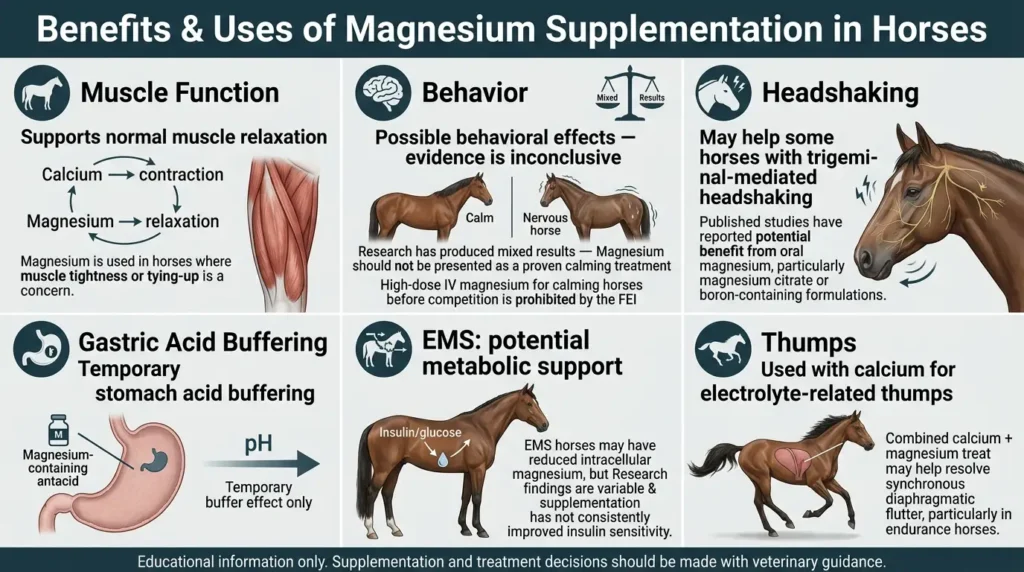
Magnesium has been shown to be useful in a number of situations in horses:
- Relaxation and comfort of muscles – magnesium is used in horses that are at risk of tightness or tying-up and its effect is based on the contract/relax cycle with calcium being the opposite.
- Reducing behavior – here the evidence is inconclusive. Other studies which have involved magnesium aspartate have reported better reaction times or behavior in some horses whereas others have reported none. International equestrian bodies (FEI) have prohibited the use of high-dose intravenous magnesium to calm horses prior to competition, although it can be tested.
- Headshaking syndrome – oral magnesium (especially citrate or boron) has been demonstrated to be useful in horses with trigeminal-mediated headshaking in published studies.
- Gastric acid buffering – magnesium containing antacids have the capacity to temporarily increase the stomach pH but this is only temporary.
- Equine metabolic syndrome (EMS) support – EMS horses exhibit reduced intracellular magnesium and there is interest in whether supplementation can enhance insulin sensitivity. But findings are variable: a single placebo-controlled study did not observe any significant difference in insulin sensitization between supplemented and unsupplemented horses.
- Thumps (synchronous diaphragmatic flutter) – combined calcium and magnesium treatment has been used to help resolve this electrolyte-imbalance condition, most often seen in endurance horses.
Side Effects, Risks & Safe Upper Limits
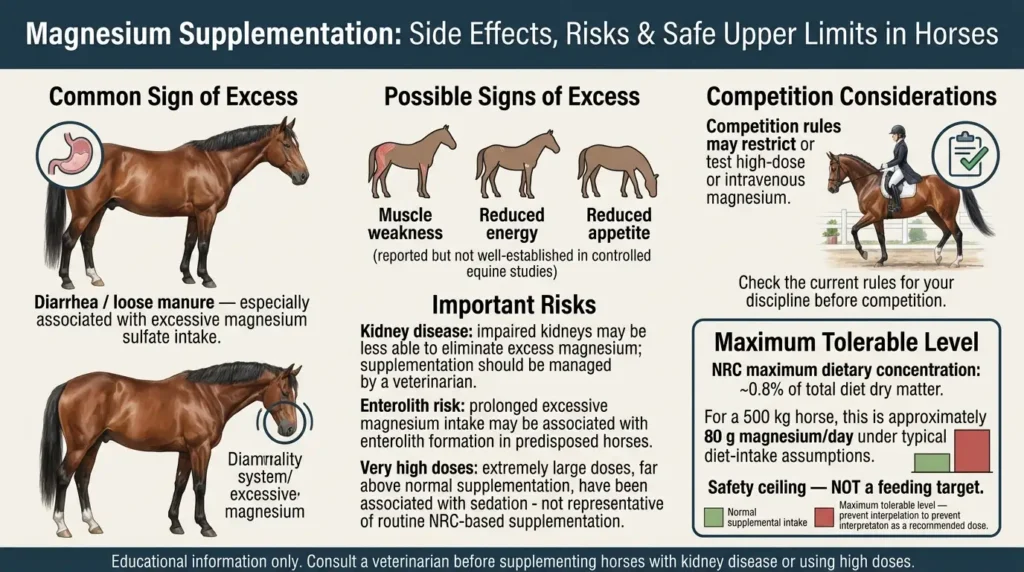
The safest of the minerals to handle is magnesium since the healthy equine kidney is effective in excretion of excess via the urine. With that said, however, the notion of generally safe does not mean that there are no limits:
- Diarrhea / loose manure The most frequent sign of excessive feeding, particularly with magnesium sulfate, which causes the gut to absorb water.
- Muscle weakness, decreased energy levels or decreased appetite – reported indicators of excess consumption in some sources, but not well-documented in controlled studies on equines.
- Enterolith risk – according to some veterinary sources, excessive and prolonged magnesium supplementation can be linked to an increased risk of enterolith (mineral stone) formation in predisposed horses.
- Kidney disease – horses with a damaged kidney system cannot get rid of excess magnesium as effectively and therefore only with the supervision of a veterinarian, the supplementation in the horse should be administered.
- Very high doses -doses many times higher than normal supplemental levels (hundreds of grams of magnesium sulfate taken as a one-time large dose) have been implicated in sedation; this is not a risk at NRC-based levels.
- Competition regulations magnesium supplementation, especially to a high or intravenous concentration, can be limited or subject to test in accordance with the guidelines of some competition bodies due to its past use as a calming/sedating agent. Review the existing regulations of your discipline prior to the competition.
Maximum tolerable level: the NRC has established the maximum dietary concentration at about 0.8 percent of total diet dry matter, which equates to about 80g/day of magnesium in a 500 kg horse on normal diet intake – way above the normal supplemental intake. This is not a target to feed towards, but a safety ceiling.
Drug & Nutrient Interactions
Magnesium does not act alone – a combination of dietary factors influences the amount of magnesium that your horse absorbs and utilizes:
Nutrients that may decrease magnesium absorption:
- High dietary phosphorus
- High dietary potassium
- Phytates and oxalates (found in some plants)
- Both fermentable and non-fermentable fibers, in high quantities.
Nutrients which could increase magnesium absorption (according to research in other species):
- Dietary protein
- Medium-chain triglycerides
- Some unfermentable carbohydrates (e.g., oligosaccharides, inulin)
Calcium-to-magnesium ratio: Due to the antagonistic relationship that exists between calcium and magnesium in muscle activity, most nutritionists suggest maintaining a balance between dietary calcium and magnesium in a ratio of about 2.5:1 to 3:1. A similar and frequently-mentioned goal is maintaining the potassium-to -(calcium + magnesium) ratio at a level below 2.2, to ensure that all the three macrominerals are well absorbed and in balance.
Medication note: since this is not a medication but a nutritional mineral, there is no direct pharmaceutical interaction information in horses. When your horse is under other drugs or IV fluids, particularly the ones that impact kidney clearance, calcium levels, or heart rhythm, loop in your veterinarian prior to beginning or altering magnesium supplementation.
Myth vs. Fact
| Myth | Fact |
| “Magnesium always calms a nervous horse.” | Research results are mixed — some horses show a behavioral response, others show none. It’s not a guaranteed calming agent. |
| “More magnesium is always better for muscle horses.” | Once requirements are met, extra magnesium doesn’t add further benefit and may increase enterolith or GI risk over time. |
| “A normal blood magnesium test rules out deficiency.” | Blood tests capture less than 1% of total body magnesium and often miss tissue-level deficiency. Urine fractional clearance is more reliable. |
| “All magnesium supplements are basically the same.” | Forms vary widely in concentration and bioavailability — feeding rates that supply the same elemental magnesium can differ by 5x or more between products. |
| “You can’t overdose a horse on magnesium.” | True toxicity is rare because of efficient renal excretion, but it isn’t impossible, especially in horses with kidney disease or with very high, prolonged intakes. |
How to Safely Add Magnesium to Your Horse’s Diet (Step-by-Step)
- Have your horse weighed on a scale or weight tape to have a good baseline.
- Determine their category of workload (maintenance, light/moderate/heavy exercise, gestation or lactation) based on the above chart.
- Use the calculator to get their NRC-based daily gram requirement.
- Determine present level of dietary intake of hay and any present feed – a forage analysis provides the most precise figure, although the 0.1-0.3 percent average is a decent starting point.
- Determine the difference between what the diet is providing and target requirement.
- Select a form – magnesium oxide is the default but most horses can use; consult your vet on other options depending on circumstances.
- Do not start on full dose but slowly over 7-10 days, monitor manure consistency and behavior.
- Reevaluate after 3-4 weeks and fine-tune with the aid of your veterinarian or an equine nutritionist, particularly when you are aiming to address a particular issue such as headshaking or tying-up.
Common Feeding Mistakes to Avoid
- Estimating the dose, rather than using real body weight and workload.
- With an assumed label of calming, it implies a clinically effective dose of calming – verify the actual elemental amount of magnesium per serving.
- Taking magnesium sulfate (Epsom salt) per day as an overall supplement – its laxative action disqualifies it as a daily supplement.
- Bypassing forage – adding supplement to an already-sufficient diet without determining what is already being fed.
- Horses with kidney problems, metabolic disorders or those on other medications will be skipped during the conversation on the vet.
You May Also Like to Read:
- Lutalyse Dosage for Horses: The Complete Chart, Calculator & Safety Guide
- Fenbendazole Dosage For Horses: Calculator, Chart & Safe Guide
FAQs
What is the effect of magnesium on horses?
It helps in contraction and relaxation of the muscles, nerve conduction, and hundreds of enzyme reactions in the body and functions in close competition with calcium.
Which are the symptoms of magnesium deficiency in horses?
And muscle tremors, lack of co-ordination, nervousness and in extreme cases, irregular heart beat or seizures. Mild or subclinical deficiency is more difficult to diagnose and may depend on veterinary tests.
Will magnesium make horses calm?
Infrequently, yet studies findings are incongruent. There are those horses that respond better to supplementation or become more receptive; there are horses that do not respond at all.
Is it possible to overdose a horse on magnesium?
It is rare as normal kidneys can eliminate excess magnesium effectively, though it is not impossible especially in horses with kidney disease or very high sustained magnesium intakes far in excess of the 0.8% dietary limit of the NRC.
What’s the best form of magnesium supplement for horses?
Magnesium oxide would be the most feasible one to use in daily supplementation because it is of high concentration and cost and bio-availability is reasonable. Other types are more applicable to particular circumstances.
Is magnesium oxide safe to horses?
Yes, when used in due doses. It is one of the most widely utilized and most researched among supplemental magnesium in horses.
Is there a difference in the effect of magnesium sulfate (Epsom salt) compared to magnesium oxide?
Yes – Epsom salt possesses a laxative effect due to its capacity to pull water into the bowel, and should therefore not be included in daily supplementation but in some cases is used therapeutically to impaction with veterinary advice.
What are the vets tests of magnesium levels in horses?
Blood tests are not very reliable since such small amounts of magnesium in the body are carried in blood. A urine fractional clearance test is usually thought to be a much more reliable way of evaluating the total magnesium status.
Will magnesium help in headshaking syndrome?
Published reports indicate that oral magnesium, especially when used with boron or magnesium citrate, can help to decrease headshaking in some affected horses.
Is magnesium an interactor with calcium in the diet?
Yes. The two minerals are functional opposites in the muscle contraction and relaxation process, and nutritionists usually seek a 2.5:1 to 3:1 ratio between the two minerals.
Is it safe to take magnesium in addition to other supplements?
Yes, generally, but since various other nutrients (phosphorus, potassium, fiber) may influence magnesium absorption, it would be better to review the entire diet, preferably with a nutritionist, than to add a bunch of supplements and hope that they will interact.
Final Thoughts
Magnesium supplement for horses is among the more truly helpful minerals to have a good idea about, simply because it can be so readily under-thought or over-supplemented. The easiest, as well as the safest option is the most obvious: know the actual weight of your horse, know how much work they have to do, calculate the actual NRC-based target using the calculator above, and compare it with what is already being offered to them in their current diet before introducing anything new.
That check-in alone will indicate that they are already covered to most horses on a solid forage-based diet. To horses at hard labour, or when under nutritional stress, or in a condition that is magnesium-responsive in a particular direction, it provides you with an actual figure to operate on – and a type of magnesium adapted to the purpose – rather than an approximate. Loop in your veterinarian, or an equine nutritionist, as ever before you start making any major changes, particularly with horses having kidney disease or metabolic issues or undergoing other medications.
This is a general education article and should not take the place of personalized veterinary or nutritional counseling. Never initiate, discontinue, or change any supplement program of your horse without consulting your veterinarian.