Fenbendazole Dosage For Horses: Calculator, Chart & Safe Dosing Guide
Fenbendazole Dosage Calculator for Horses
Enter your horse’s weight and select the target parasite to calculate the correct fenbendazole dose.
Total Fenbendazole Dose
0 mg
This calculator provides a general dosage estimate based on standard fenbendazole guidelines. Always confirm the dose and administration schedule with a licensed veterinarian before treating your horse.
Assuming you have a tube of fenbendazole paste and you need to deworm your horse, the only figure you actually need to know is this: 2.3 mg per pound (5 mg per kg) of body weight strongyles and pinworms, or 4.6 mg per pound (10 mg per kg) ascarids. All the rest of this guide is there to enable you to use that number correctly, safely and without fear.
Fenbendazole Dosage For Horses is a commonly researched and popular dewormer in equine medicine, available as Panacur (and Safe-Guard (both by Merck Animal Health)). Below you will see an interactive calculator, a printable dosage chart, and a full disclosure of uses, safety, side effects and drug interactions all provided through official FDA drug label documentation and manufacturer documentation.
Quick Answer: Fenbendazole Dosage at a Glance
| Purpose | Dose | Frequency |
|---|---|---|
| Large strongyles, small strongyles, pinworms | 2.3 mg/lb (5 mg/kg) | Single dose |
| Ascarids (roundworms) in foals/weanlings | 4.6 mg/lb (10 mg/kg) | Single dose |
| Encysted small strongyle larvae (all stages) & S. vulgaris arteritis prevention | 4.6 mg/lb (10 mg/kg) | Once daily for 5 consecutive days (“Power Pack” protocol) |
The standard 25 gram tube of 10% fenbendazole paste (2,500 mg total) is used to treat one 1,100 lb horse at the standard dose, or one 550 lb horse at the double (ascarid) dose.
What Is Fenbendazole?
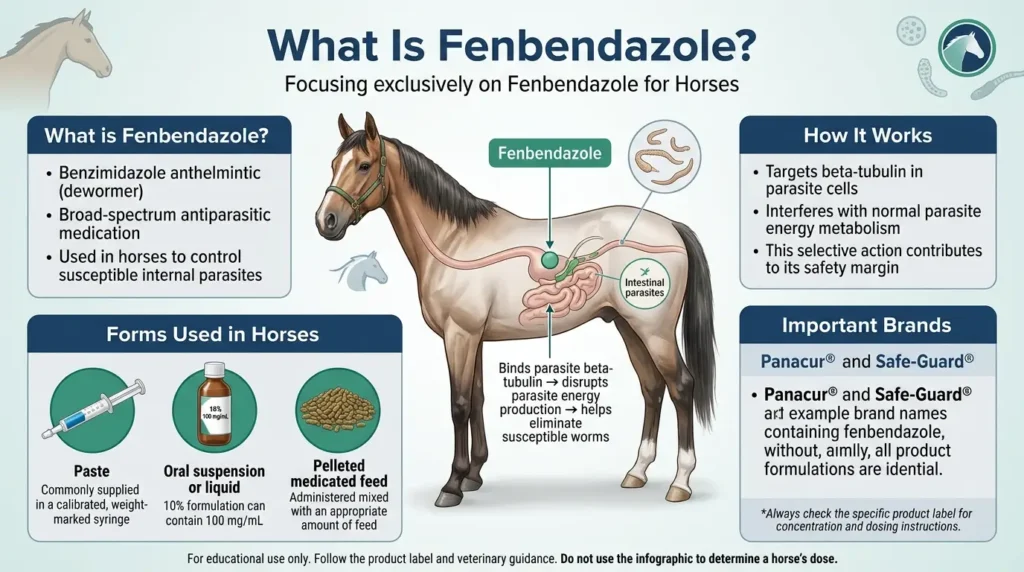
Fenbendazole is a benzimidazole anthelmintic (dewormer) which is a broad-spectrum anthelmintic. It acts by attaching itself to a protein called beta-tubulin within parasite cells. This prevents the production of energy by the parasite, thus it virtually starves to death in several days.
Since fenbendazole binds much better to parasite beta-tubulin than to cells in the horse, they clear worms without affecting the tissue in the horse – this selectivity is a large factor in why it has such a wide margin of safety.
It’s sold in three forms for horses:
- Paste the most widely used, apple-cinnamon flavored, with a calibrated syringe by body weight.
- Oral suspension/liquid -10% concentration (100 mg per mL), commonly administered by veterinarians, or in large barns.
- Pelleted medicated feed (Type C) – added to an appropriate volume of feed.
The two brand names Panacur and Safe-Guard are merely two brand names of the identical active ingredient but at the same concentration (100 mg fenbendazole per gram of paste, or 100 mg/mL of the liquid). Dose math below is the same regardless of which one is on the shelf.
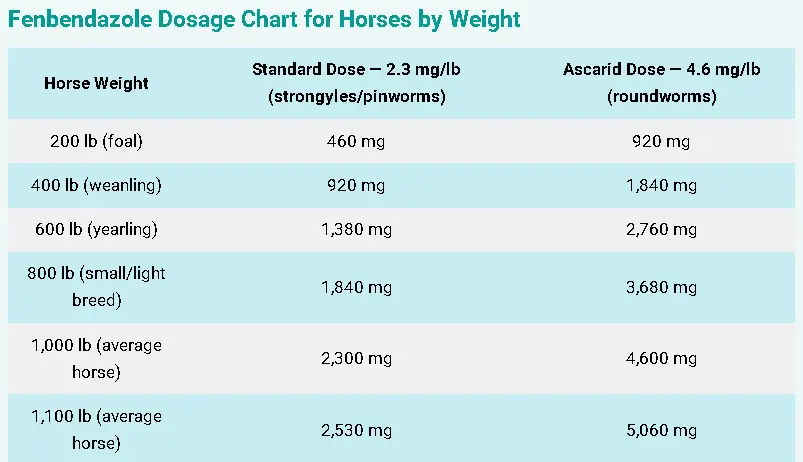
Fenbendazole Dosage Chart for Horses by Weight
Keep this chart as a reference. Total milligrams of fenbendazole required – to translate to mL or grams of paste required by your syringe, check the label on your product.
The Standard Fenbendazole Dosage for horses is:
| Horse Weight | Standard Dose — 2.3 mg/lb (strongyles/pinworms) | Ascarid Dose — 4.6 mg/lb (roundworms) |
| 200 lb (foal) | 460 mg | 920 mg |
| 400 lb (weanling) | 920 mg | 1,840 mg |
| 600 lb (yearling) | 1,380 mg | 2,760 mg |
| 800 lb (small/light breed) | 1,840 mg | 3,680 mg |
| 1,000 lb (average horse) | 2,300 mg | 4,600 mg |
| 1,100 lb (average horse) | 2,530 mg | 5,060 mg |
| 1,200 lb (large horse) | 2,760 mg | 5,520 mg |
| 1,400 lb (draft-type) | 3,220 mg | 6,440 mg |
Hint: Do not guess but weigh your horse (a livestock scale is preferable; a weight tape is a satisfactory approximation). One of the largest contributors to dewormer resistance in strongyle populations is underdosing, hence whenever in doubt, round up the next weight bracket instead of rounding down.
What Does Fenbendazole Treat in Horses? (Uses & Indications)
The FDA-approved label also shows that fenbendazole is used to treat and manage:
- Large strongyles Strongylus edentatus, S. equinus, S. vulgaris and Triodontophorus species.
- Small strongyles (cyathostomes) – such as Cyathostomum, Cylicocyclus, Cylicostephanus and Cylicodontophorus species, and – at the 5-day larvicidal dose – their encysted third and fourth stage larvae in the gut wall.
- Pinworms (Oxyuris equi)
- Ascarids / roundworms (Parascaris equorum), which is mostly a problem in foals and weanlings below 18 months.
- Arteritis due to the migration of fourth-stage larvae of Strongylus vulgaris – with the 5-day larvicidal dose, the only FDA-approved treatment of this stage of the life cycle.
The large strongyle larvae move through the blood vessels of the horse as they develop, which may cause inflammation and blood clots that block blood to parts of the intestine, a life-threatening condition commonly known as thromboembolic colic. This is the reason why it is important that migrating larvae should be controlled and not only adult worms.
How to Give Fenbendazole to a Horse
Standard Single Dose
- Determine the dose based on the body weight of your horse (2.3 mg/ lb strongyles/ pinworms or 4.6 mg/ lb ascarids).
- Check the mouth of your horse, get it empty of feed.
- Place the syringe nozzle in the interdental space (space between the back and front teeth) and apply the paste to the back of the tongue.
- Press the plunger to the bottom, and keep the head of the horse suspended in the air a few moments to make it swallow.
- Observe several minutes to ensure that dose is not spit out.
The 5-Day “Power Pack” Larvicidal Dose
In cases of encysted small strongyle larvae or to treat migrating S. vulgaris larvae, the label recommends 4.6 mg/lb (10 mg/kg) a single dose daily during 5 days. This is the slower sustained exposure protocol that enables fenbendazole to access and kill larvae embedded deep in the gut wall – one dose cannot do it.
A day of absence in the middle of the course will result in counting the day as a day in the count, as sub-therapeutic exposure will not completely eliminate encysted larvae but will only create the force of resistance.
Benefits of Fenbendazole for Horses
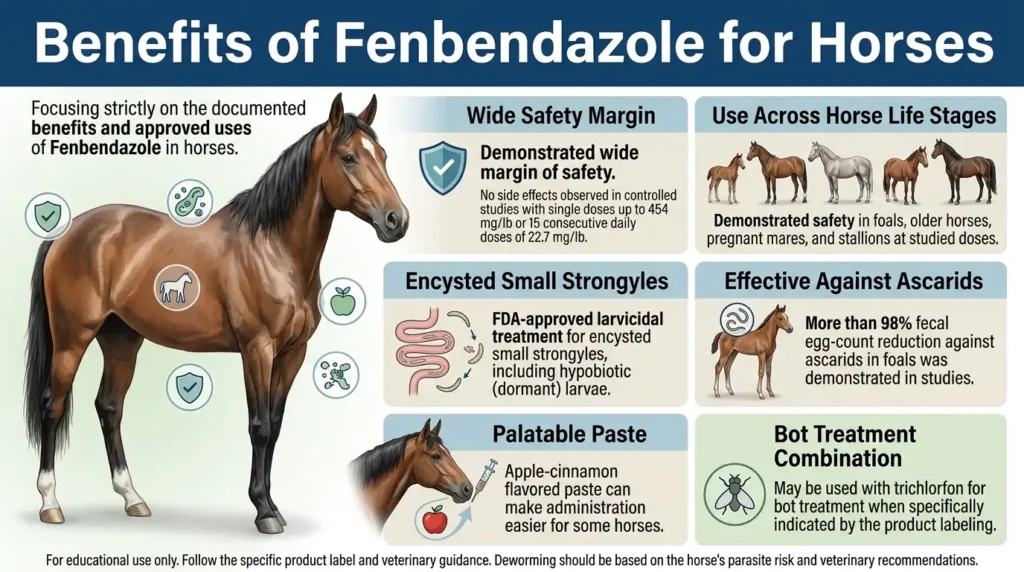
- Large margin of safety. No side effects were observed in the controlled studies with single doses of up to 454 mg/lb, or with 15 consecutive daily doses of 22.7 mg/lb – many times higher than the labeled dose.
- Protective at any age. Safe in foals, older horses, and pregnant mares and stallions at high doses of up to 11.4 mg/lb (25 mg/kg).
- The only FDA-approved larvicide that kills all encysted small strongyle stages, including hypobiotic (dormant) larvae that other types of dewormer fail to kill.
- Very effective against ascarids in foals, where it has been demonstrated to reduce the fecal egg count by more than 98 percent.
- Palatable. Its flavoring, apple-cinnamon, is one of the most easily administered pastes to fussy horses.
- Combined with trichlorfon in the treatment of bots (Gasterophilus species) where a product is marked to be used with trichlorfon.
Side Effects and Safety
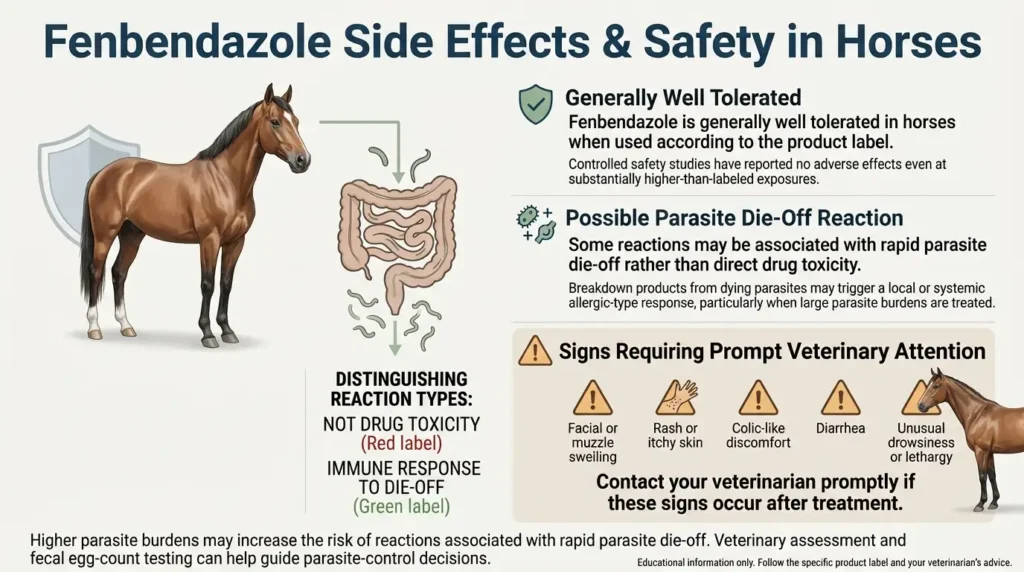
The brief: fenbendazole medicine is one of the most tolerated dewormers in horses when administered at the correct dosage. Even at much higher levels than the normal label dosage, controlled safety studies did not identify side effects.
The only thing to be taken note of is a hypersensitivity reaction by the dying parasites themselves and not the drug. The breakdown products may at times result in a local or systemic allergic-type reaction when the parasite load dies rapidly, particularly when the higher larvicidal dose is used. This is not a common thing, and the following are indications that you need to contact your vet immediately:
- Swelling of the face or the muzzle.
- Rashes or itchy skin.
- Colic-like discomfort
- Diarrhea
- Excessive drowsiness or idleness.
The most probable suspects of this response are horses that have a highly heavy strongyle load and are particularly those that have not been treated to eliminate a strongyle recently, which explains why a fecal egg count prior to treatment is a handy tool, as you know what you are dealing with.
Is Fenbendazole Safe for Pregnant Mares, Foals & Stallions?
Yes, at the normal dose. Fenbendazole paste for horses has been tested as safe in pregnant mares during any gestation phase and in stallions at dosages up to 11.4 mg/lb (25 mg/kg) – over two times the dose of the standard treatment – and reproduction was found to be unaffected.
A single important limitation: the 5-day, 4.6 mg/lb larvicidal protocol (so-called Power Pack) has not been tested specifically concerning its safety in stallions or pregnant mares. Talk to your veterinarian first, in case your mare is in foal, or you are treating a breeding stallion and considering a larvicidal course.
Foals can be safely dewormed using fenbendazole and actually, the 4.6 mg/lb dose of ascaris exists because the horse is a young horse, and a heavy burden of roundworms in foals may sometimes result in intestinal obstruction, making it essential to treat them properly at the earliest opportunity.
Drug Interactions and Contraindications
- The approved label of the use of fenbendazole on horses does not list any contraindications.
- No drug interactions have been observed.
- Fenbendazole may be used concomitantly with trichlorfon (used as a bot control) in a product labelled that it contains this combination, but the trichlorfon label should have its own warnings, and should not be used in combination.
- Should not be used on horses that are to be consumed by humans. It is a food-safety labeling requirement, which applies in case your horse might ever become part of the food chain.
- Not for human use. Store equine dewormers out of reach to children and out of the way of other species – horse-strength paste is much more concentrated than dog or cat dewormers, and should never be administered to small animals.
Fenbendazole Resistance: Does It Still Work?
This is the section, which most product pages overlook, and it is important. Fenbendazole is extensively used and has resulted in a high degree of resistance in small strongyle (cyathostome) populations in a large number of farms.
A parasitology study at a university that followed the number of fecal eggs prior to and after treatment of the feces with fenbendazole found an average reduction of strongyles egg of approximately 72 percent – a far lesser reduction than the expected 90 percent+ that a fully active dewormer would achieve – and a range of results of 40 percent to 100 percent. Even the 5-day 2-dose regimen only achieved a moderate response in certain resistant groups.
The situation is quite different with ascarids: the effects of fenbendazole on roundworms in foals are still very effective, and the average percentage of eggs decreases is more than 98 percent.
What this means practically:
- Fenbendazole dose remains a potent and dependable option in the treatment of ascarids in foals, and its larvicidal effect against encysted small strongyles, a single activity not shared by any other larvicide.
- In control of routine strongyles in adults, its reliability now widely depends on farm and region.
- The only way to determine whether fenbendazole is still effective on your property or not is by a fecal egg count reduction test (testing the number of eggs before treatment and after 10-14 days of treatment).
- The idea of rotating data-free dewormer classes is not a valid resistance-management approach – the recommended approach to the present-day parasitology guidelines is targeted, test-based deworming.
Panacur vs. Safe-Guard: What’s the Difference?
| Feature | Panacur® | Safe-Guard® |
| Manufacturer | Merck Animal Health | Merck Animal Health |
| Active ingredient | Fenbendazole 10% (100 mg/g) | Fenbendazole 10% (100 mg/g) |
| Standard dose | 2.3 mg/lb (5 mg/kg) | 2.3 mg/lb (5 mg/kg) |
| Ascarid dose | 4.6 mg/lb (10 mg/kg) | 4.6 mg/lb (10 mg/kg) |
| Forms available | Paste, oral suspension | Paste, pelleted Type C feed |
| Primary market positioning | General equine dewormer + “Power Pack” 5-day larvicidal kit | General equine dewormer + feed-through option |
Bottom line: these are the same active ingredient, in the same concentration, of the same manufacturer, and given the same dose. Every decision often depends on what form (paste vs. feed vs. liquid) is most in line with your management process, rather than a difference in the drug.
Common Mistakes to Avoid
- Making assumptions about the weight rather than weighing it. A scale is preferable to a weight tape, which is in turn more accurate than eyeballing it.
- To be on the safe side. This is retrograde–underdosing does not save the horse, but the parasites, and fosters resistance.
- Discontinuation of a 5-day larvicidal course. Part course will not get encysted larvae and is a waste of product.
- Fixated, calendar-based deworming without feces testing. With small strongyles recorded to be resistant to blind rotation, it is not a replacement to knowing what is actually in the gut of your horse.
- Conjecture dog or cat dewormer is a substitute that is less expensive. The strengths of formulations vary according to species – never use a product not intended to be used on horses.
Myth vs. Fact
| Myth | Fact |
| “A double dose deworms faster.” | A single double dose is specifically for ascarids, not a way to speed up strongyle treatment. The larvicidal effect on encysted strongyles requires 5 consecutive daily doses, not one large dose. |
| “Fenbendazole medication treatment isn’t safe for pregnant mares.” | It’s been evaluated as safe in pregnant mares at all gestation stages at more than double the standard dose. The 5-day larvicidal course specifically hasn’t been evaluated in pregnant mares, which is a narrower caveat. |
| “If it worked before, it’ll always work.” | Resistance in small strongyles has increased over time and varies by farm. Past effectiveness doesn’t guarantee current effectiveness — testing is the only way to know. |
| “More frequent deworming is always better.” | Over-deworming accelerates resistance. Evidence-based programs use fecal testing to deworm only when and as needed. |
You May Also Like to Read:
- Ventipulmin Dosage For Horses: Calculator, Chart & Safe Guide
- Dormosedan Dosage For Horses: Calculator, Chart & Safe Guide
FAQs
What is the dose of fenbendazole paste in 1,000 lb horse?
A 1,000lb horse requires 2,300 mg of fenbendazole at the normal dose. That horse will require 4,600 mg at the ascarid (double) dose.
Is it possible to administer fenbendazole to a pregnant mare?
Yes. It has been tested to be safe in pregnant mares at any point of gestation at higher rates than the standard rate of treatment. The 5-day larvicidal Power Pack protocol has not specifically been tested on pregnant mares, so consult your veterinarian before administering that one in that specific course to pregnant mares.
Is foal safe with fenbendazole?
Yes, it is the most common medicine against ascarids (roundworms) who are the number one parasites of young horses.
So, what is the difference between Panacur and Safe-Guard?
None, chemically. They are both fenbendazole 10% (Merck Animal Health) at the same concentration and same labeled dose – the only difference is in the available forms (paste, liquid, feed) and branding.
How many times should I deworm my horse using fenbendazole?
No more one universal schedule. The current best practice is that the decision to deworm should not be guided by a calendar but the number of fecal eggs as this resistance is not uniform across farms. Discuss testing-based program with your veterinarian.
What are the side effects of fenbendazole in horses?
At labeled doses, side effects are rare. Sometimes a hypersensitivity response may be present due to the death of an excessive load of parasites – look out in case of swelling of the face, hives, colic, or diarrhea, and call your veterinarian in case you notice these.
Is it possible to use fenbendazole with other dewormers?
It can be used together with trichlorfon to control bots in products that indicate this. Never mix anything without going to the labels of both products.
Does fenbendazole still work against strongyles?
It continues to be effective against ascarids and encysted larvae with the 5-day protocol. To maintain routine control of small strongyles in adult animals, the resistance is recorded and random by farm – the most appropriate method of determining whether it is working in your farm is through a fecal egg count test.
What will happen to my horse in case I underdose it?
Undertreating will lead to insufficient clearance of parasites and has been shown to be a contributor to dewormer resistance. Dose to actual current weight of your horse, never below the next bracket, but always round up.
Is it possible to administer horse fenbendazole to humans?
No. Fenbendazole horse paste is only labeled to be used in horses and not in humans.
What is the route of administration of fenbendazole?
By mouth, with a calibrated dosing syringe. The nozzle is then placed into the interdental space and the paste applied on the back of the tongue and the mouth of a horse is emptied of feed prior to the nozzle being inserted.
Is fenbendazole and ivermectin the same?
No. They are different classes of drugs that have different mechanisms. Fenbendazole: benzimidazole, ivermectin: macrocyclic lactone. The patterns of resistance also vary between the two and hence the importance of fecal testing in the selection of the one to be used.
Final Thoughts
There is no hard-and-fast rule when it comes to administering the dose of fenbendazole dosage correctly: it is simply a matter of knowing the actual weight of your horse and correlating that weight with the appropriate rate of what you are treating. The thing that gets people stuck is not the math, it is not the larvicidal course that has been ended too soon, it is not the deworming that is done without other thought as to whether the product is still actually being effective at eliminating the parasites on their farm.
Enter the weight of your horse into the calculator above to obtain the exact dose of the horse, hang on to the chart next time and when you are actually dealing with something other than routine strongyle and pinworm control (pregnancy mares, foals with a heavy ascarid burden, a 5-day course of larvalicidal) call in your veterinarian. Fenbendazole horse dosage has a very good safety history at the labeled dosage: the idea is merely to maintain it so in your horse and useful over a long period.
This guide is informational and not a substitute to veterinary advice. To obtain diagnosis, treatment and parasite control specific to your horse, always consult your veterinarian.