Sucralfate Dosage For Horses: Calculator, Chart & Complete Guide
🐴 Sucralfate Dosage Calculator For Horses
For Horses & Foals — Gastric & Hindgut Ulcer Dosing
Recommended Dosage
This tool provides general dosing guidance based on published ranges and is not a substitute for veterinary advice. Always confirm dosing with your veterinarian.
© medsdog.com
If your horse has ever been diagnosed with gastric or hindgut ulcers, the chances are that your veterinarian has recommended the use of sucralfate dosage. One of the most popular add-on treatments in equine ulcer care – but, it is important to get the dosage right and the numbers you see online don’t always match.
This guide explains in detail how and when to dose a horse with sucralfate dosage for horses as well as why, with dosing figures that are not guesses, but based on veterinary references and published research. There is also a dosage chart, instructions on how to take sucralfate with omeprazole, and a complete list of side effects and drug interactions.
Quick Facts Before You Start:
- Sucralfate Dosage is not FDA-approved for use in horses and is used off label, as is the case for so many species.
- The usual dose of gastric ulcers is 10-20 mg/kg orally 6-8 hourly.
- A standard dose of the hindgut ulcer drug is 22 mg/kg/orally every 6-8 hours.
- It is usually taken on an empty tummy in the morning, preferably as the initial dose of the day.
- This article is intended for educational purposes only — always consult your vet before beginning or altering dosage.
What Is Sucralfate?
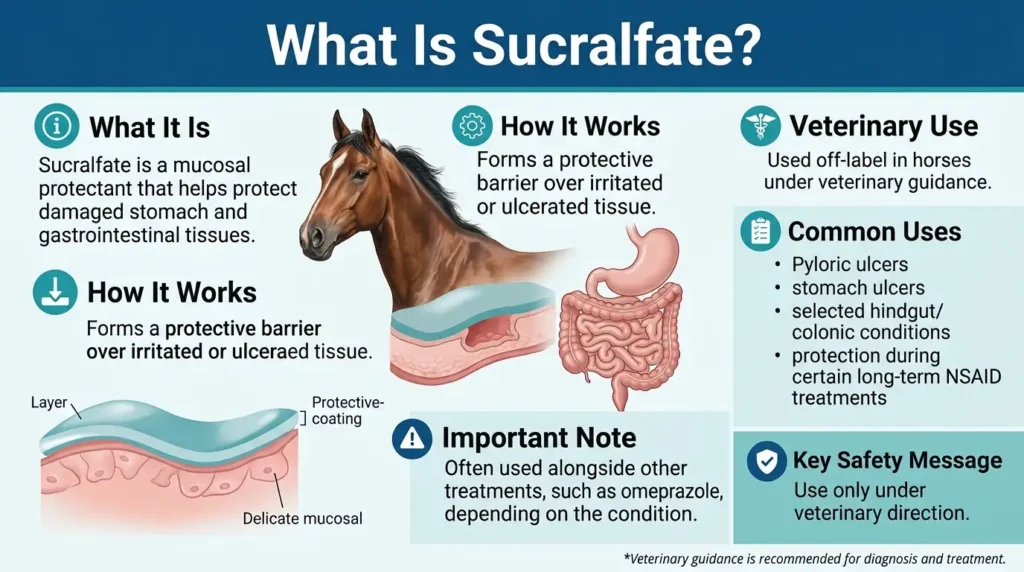
Sucralfate is a mucosal protectant, which is a type of medication that protects stomach tissues from harm rather than just decreasing stomach acid like antacids and proton pump inhibitors. Chemically, it is a hydroxy aluminium salt of sucrose octasulfate, which was developed and FDA approved for human ulcer treatment (under the name Carafate).
In horses, it’s used off-label — a common and legal practice in veterinary medicine when a human drug has been proven to be safe and effective in animals.
Sucralfate is applied by the veterinarian for:
- Glandular Gastric Ulcer Disease in horses (EGGD)
- Squamous gastric ulcer disease in horses (ESGD)
- Pyloric ulcers
- Hindgut (colonic) ulcers
- Right dorsal colitis
- Prevention in horses taking high or long-term doses of NSAIDs
It is effective in most situations, except for ulcers in the glandular portion of the stomach, and is usually combined with other drugs (most commonly omeprazole) for other ulcers in the GI tract.
How Sucralfate Works in a Horse’s Stomach

When taken in the stomach, sucralfate binds with the hydrochloric acid to create a thick, sticky gel. This gel attaches to the exposed proteins in an ulcer crater, forming a sort of bandage over the wound. This barrier:
- Physically prevents stomach acid and digestive enzymes from coming in contact with the ulcer
- Has an inhibitory effect on the activity of pepsin, which may otherwise be responsible for deepening ulcer craters
- Buffers the hydrogen ions and slightly reduces the acidity of the injured area
- Increases the production of prostaglandin E2 that helps repair tissue
- Helps to increase mucus and bicarbonate production which are natural defense mechanisms of the stomach.
- Slowly reduces the emptying of the stomach, increasing the barrier’s time of contact
- Promotes circulation to the injured area
None of this affects the stomach’s total output of acid; sucralfate acts locally and not systemically. That’s also the reason why it’s regarded very safe: very little of the drug enters the bloodstream.
Protection is approximately 6-8 hours, hence the redosing of sucralfate multiple times daily, not once.
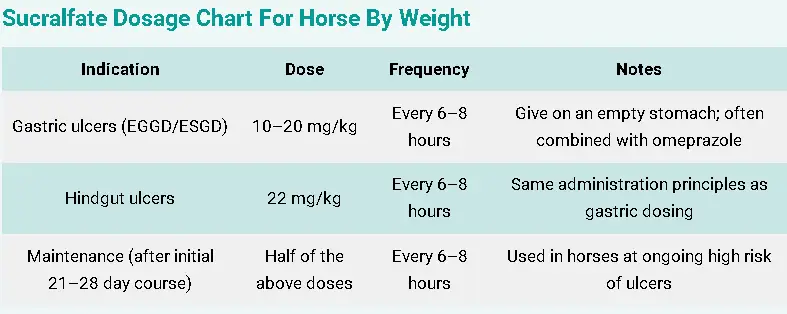
Sucralfate Dosage Chart For Horse By Weight
The essential dosing data by indication. These doses are based on the normal veterinary recommendations for oral sucralfate dosage for horses.
| Indication | Dose | Frequency | Notes |
| Gastric ulcers (EGGD/ESGD) | 10–20 mg/kg | Every 6–8 hours | Give on an empty stomach; often combined with omeprazole |
| Hindgut ulcers | 22 mg/kg | Every 6–8 hours | Same administration principles as gastric dosing |
| Maintenance (after initial 21–28 day course) | Half of the above doses | Every 6–8 hours | Used in horses at ongoing high risk of ulcers |
Example Dosing Chart For Horses By Weight
| Weight (kg) | Weight (lbs) | Gastric Low (10 mg/kg) | Gastric Std (15 mg/kg) | Gastric High (20 mg/kg) | Hindgut (22 mg/kg) |
|---|---|---|---|---|---|
| 200 | 441 | 2.0 g | 3.0 g | 4.0 g | 4.4 g |
| 300 | 661 | 3.0 g | 4.5 g | 6.0 g | 6.6 g |
| 400 | 882 | 4.0 g | 6.0 g | 8.0 g | 8.8 g |
| 450 | 992 | 4.5 g | 6.75 g | 9.0 g | 9.9 g |
| 500 | 1102 | 5.0 g | 7.5 g | 10.0 g | 11.0 g |
| 550 | 1213 | 5.5 g | 8.25 g | 11.0 g | 12.1 g |
| 600 | 1323 | 6.0 g | 9.0 g | 12.0 g | 13.2 g |
| 700 | 1543 | 7.0 g | 10.5 g | 14.0 g | 15.4 g |
| 800 | 1764 | 8.0 g | 12.0 g | 16.0 g | 17.6 g |
How to use it:
- Values shown are per single administration. For daily total, multiply by 3 (every 8 hrs) or 4 (every 6 hrs).
- Example: 500 kg horse, gastric ulcer, standard rate, every 8 hrs → 7.5 g × 3 = 22.5 g/day.
How to Calculate Your Horse’s Exact Dose
To work out the dose in Milligrams, multiply your horse’s body weight in kg by the mg/kg amount for the indication you are treating.
Example — 500 kg (roughly 1,100 lb) horse with gastric ulcers, dosed every 8 hours:
- Low end: 500 kg × 10 mg/kg = 5,000 mg (5 g) per dose
- High end: 500 kg × 20 mg/kg = 10,000 mg (10 g) per dose
- At 3 doses per day (every 8 hours), total daily dose ranges from 15 g to 30 g
Example — 500 kg horse with hindgut ulcers, dosed every 8 hours:
- 500 kg × 22 mg/kg = 11,000 mg (11 g) per dose, or 33 g per day across 3 doses
If you work in pounds, convert to kilograms first by dividing by 2.2 (1,100 lb ÷ 2.2 = 500 kg), then use the same math above.
Calculating the amount your horse needs to take when you change from weight (kg) to dose (mg) can become tedious, especially when the range is 10-20mg/kg, and the math to work out the maintenance dose can be done incorrectly by adding or subtracting the decimal point; a dosage calculator, which is dependent on your horse’s weight, indication and frequency, removes the guesswork and decimal point risk.
Maintenance (Half) Dosing
The initial 21-28 day treatment course is followed by a half dose to some horses for long-term treatment, especially if they are prone to repeated ulcers. This is something decided by your veterinarian, depending on the horse’s reaction to the gastroscopy re-checks and not something you should commence or terminate on your own.
How and When to Give Sucralfate
The time of administration is more important with sucralfate dosage than with most other drugs; it must come into contact with the ulcer and is most effective when the stomach is empty and has an acidic pH.
Best practices:
- Administer the initial dose before grain or hay is available, since it will be absorbed and come into direct contact with the ulcerated area of the stomach.
- Each dose is only good for 6–8 hours, so continue to dose throughout the day to ensure constant protection.
- Take sucralfate either 30 minutes or 2 hours before or after any other oral medications or supplements (see drug interactions section below) — may bind to other drugs in the gut and reduce their absorption.
Tablets vs. Liquid vs. Granules
Horses may be given Sucralfate in several different ways: as a tablet, in an oral powder or granules, or as a liquid suspension.
- Liquid suspension is the best form because it is more likely to be evenly distributed over the stomach lining.
- Tablets should be crushed prior to administration – this increases the surface area that can be used to form the protective gel. Crushed tablets are easily dissolved in lukewarm water and easier to accurately dose in feed or to be administered via oral syringe.
- Granules or powder are pre-measured, either by a sachet or scoop, and may be top-dressed over a small amount of feed, mixed in oil, molasses or corn syrup or mixed with water and syringe dosed.
Regardless of the form, do not combine sucralfate for horses dosage with a complete meal — it should get to the stomach either before or well removed from a large amount of feed in order to be effective.
Sucralfate vs. Omeprazole (and Using Them Together)
This is one of the most common misconceptions that horse owners have, so let’s clarify.
Omeprazole is a type of proton pump inhibitor. It lessens the initial production of stomach acid and inhibits the pump that secretes hydrochloric acid. Omeprazole for horses is used first line for most stomach ulcers in horses as it helps to reduce the acid load.
Sucralfate does not lower acid, it covers up and protects the damaged tissue from the existing acid. It’s a completely different mechanism and for this reason the two drugs are not used interchangeably.
What the Research Actually Shows
Omeprazole is superior to sucralfate alone. A controlled comparison of the two as the single therapy in a NSAID/fasting challenge in horses has demonstrated that omeprazole was significantly more effective in glandular ulcer scores; that is, succaralfate alone was not effective in the prevention of glandular ulcers under those circumstances.
Another concern of that study was that horses receiving sucralfate had increased ultrasound wall thickness of the right dorsal colon compared to horses receiving omeprazole, which may indicate a relationship between NSAID use in the hindgut and sucralfate that requires further investigation.
As for combination therapy (sucralfate and omeprazole used together), the published data are truly mixed, and it’s important to be honest about it rather than selecting the more positive study, which is a number:
- A retrospective study of 204 sport and leisure horses in the UK that were treated with 12 mg/kg of sucralfate twice daily and 4 mg/kg of omeprazole once daily revealed a 63.2% healing rate.
- A different study that employed the same two drugs (sucralfate 10 mg/kg bid and omeprazole 4 mg/kg od for 28 days) reported only 22% healing rate.
That is a big discrepancy in a seemingly similar protocol, and it’s an indication that the field doesn’t yet have a definitive answer about when, and which horses, it works best to add sucralfate to omeprazole. If your horse is on both medications, it is a one that your veterinarian has prescribed based on your horse’s ulcer type, severity and responsiveness to treatment — not a one-size-fits-all formula.
Practical advice for mixing them: Do not give at the same time if using together. Sucralfate for horse requires stomach acid to be activated and to form the protective gel, so consider using it approximately 30 minutes before an H2 blocker (if they are being used) and also separate from omeprazole (as directed by your veterinarian) as it may also interfere with the absorption of other oral medications if they are administered too close together.
Sucralfate for Foals
There are few studies on the use of sucralfate in foals and the results are inconsistent, so veterinary advice is more important than ever.
- One study indicated that 3-4 month-old foals receiving 4 grams of sucralfate daily exhibited less gastric ulceration and hindgut damage after administration of phenylbutazone (helpful, for folks administering their foals NSAIDs).
- In another study, 6- to 7-month-old foals with naturally occurring, unrecognized, subclinical gastric ulcers were treated with 22 mg/kg of the drug every 8 hours for 15 days; the drug was no more effective than plain corn syrup for healing those lesions. Partly the reason for the disappointing result is that the treatment is so short, 15 days; perhaps a longer treatment period would yield a different result, but this is not yet confirmed.
Dosing should be based on a veterinarian’s best judgment for each individual foal; there is limited, inconsistent evidence in foals to extrapolate from adult-horse dosing charts.
Side effects and risks

Sucralfate dose for horse is very safe in horses due to minimal absorption into the bloodstream and working locally in the gut. Side effects reported are rare but here are some to know:
- Most common side effect is mild constipation, which is due to the tendency of sucralfate to slow the rate of gastric emptying and GI transit time. Be vigilant for slight colic-like discomfort – consult your vet if present.
- Hypophosphatemia (low blood phosphorus) — not well studied in horses and is rare. The suggested action is that the aluminum from sucralfate will bind to the phosphorus in the gut, thereby lowering its uptake.
- Theoretical concerns related to aluminum exposure as a result of long-term use at high doses, as seen in human medicine. This has not been well documented in horses, but it is a sound discussion with your veterinarian if your horse will need to be on the medication for a prolonged period.
The risk of overdose is low: Sucralfate is not absorbed systemically and very high experimental doses of it in laboratory animals have not resulted in serious toxicity. However, “safe in overdose” doesn’t mean “fine to guess at” — follow your vet’s instructions.
When to call your vet: If your horse exhibits signs of colic, blood in the stool or continued teeth grinding while on sucralfate, this is a red flag to check in to ensure the ulcers are improving or the treatment plan is being adjusted.
Drug Interactions
Sucralfate forms a physical gel in the gut by binding to tissue, so it can also bind to other medicines in the gut and lessen absorption of those medicines. It’s the number one most important practical safety point every horse owner should know.
Give sucralfate separately from:
- Cimetidine and ranitidine (H2 blockers) — give 30 minutes before either of these as the stomach acid is required to activate the action of the sucralfate.
- Proton pump inhibitors, such as omeprazole
- Fluoroquinolone antibiotic, Tetracycline antibiotic
- Other oral medications and supplements typically are not effective for managing pain.
As a general guideline, leave a 30-minute to two-hour interval between sucralfate and other drugs, supplements, or complete meals (depending on the specific product or the drug that is being used, there may be a shorter or longer interval — consult the product label or ask your veterinarian).
How Long Horses Stay on Sucralfate
A typical course is 21-28 days in duration, which is what most equine gastric ulcer courses are. Horses at persistently high risk (busy competition schedule, chronic use of NSAIDs, history of recurrent ulcers, etc.) may require continued use for longer periods of time, often with the drug given at half the dosage to maintain the horse after the initial healing period.
If longer courses of treatment are planned, this should be based on a recheck (usually gastroscopy) and not on a guess as the size and location of the ulcer will determine when it will heal.
Storage and Handling
- Keep sucralfate in a tightly capped, dark-colored bottle.
- Store in cool, dry place, avoid extreme heat as it can affect the product.
- Do not allow children or pets to have access to it.
- Check the expiration date on your particular product; do not use medication past its expiration date.
Cost of Sucralfate for Horses
The cost of the product varies greatly from one formulation and his or her source:
- Granule/sachet products can be sold either as a single dose in a sachet or in multi-sachet packs (a few dollars per dose).
- In general, tablet products (usually 1 g strength, in 100- or 500-count bottles) are priced between approximately $30 and $160 for various quantities, and autoship or subscription discounts may apply.
- The compounded oral powder or suspension from a veterinary compounding pharmacy will usually cost more, often $150-$200 for a course of treatment, as it will be compounded to prescription and may require cold chain or special handling.
Sucralfate is a horse prescription product and pricing and availability may vary from veterinarian to veterinarian, dependent on the veterinarian’s pharmacy/supplier — never assume the source/supplier or the formulation without consulting your veterinarian.
Myth vs. Fact
Myth: “Sucralfate dosage is a substitute for omeprazole.
Fact: They have different actions — Omeprazole slows down acid production, Sucralfate helps to heal existing damage. Usually, omeprazole is superior to sucralfate alone in healing gastric ulcers; it is an adjunct not an alternative.
Myth: “The more sucralfate, the more protection.
Fact: Giving more than the dosage your veterinarian recommends does not mean it will work better and can cause side effects such as constipation. Administer within the recommended dosage of 10–20 mg/kg (gastric) or 22 mg/kg (hindgut).
Myth: “It doesn’t matter when I give it relative to feeding.
Fact: One of the largest factors in whether or not sucralfate is effective is how it is administered. No food in stomach, particularly in the morning, allows direct access of the drug to ulcerated tissue.
Myth: “Tablets and liquid sucralfate are not the same.
Fact: Liquid formulations tend to be more effective in lining the stomach; if taking tablets, crush them and take with lukewarm water, which will cover up a lot of that.
You May Also Like to Read:
- Penicillin G Dosage For Horses: Calculator, Chart & Safe Guide
- Ivermectin Dosage For Horses: Calculator, Chart & Safe Guide
FAQs
What does sucralfate do in horses?
Sucralfate medication is used to treat gastric ulcers (glandular or squamous), hindgut ulcers, pyloric ulcers and right dorsal colitis by coating the ulcerated area. Also used in a preventative manner in horses on high dose or long term NSAID.
What is the frequency of giving sucralfate to horses?
Every 6 to 8 hours, since its protective effect only lasts about that long. Most horses will be dosed every 3-4 hours.
Which is better: Sucralfate or Omeprazole?
No — Studies indicate that omeprazole by itself is generally more effective at healing gastric ulcers than is sucralfate alone. Sucralfate is used most frequently in combination with omeprazole instead of being a replacement.
Is it OK to take Sucralfate with Omeprazole?
Yes, it’s a combination that is often used. The published healing rates with the combination therapy vary widely, however, depending on the study (from about 22% to more than 60%) and your veterinarian will make this decision based on your horse’s type and severity of the ulcers.
Does sucralfate help with hindgut ulcers?
Yes. There is a slightly higher dose for hindgut ulcers (22 mg/kg) than for gastric ulcers (10-20 mg/kg).
When is the best time to give sucralfate?
When the animal is hungry, preferably as a first dose of the day before it has been fed grain or hay.
Which works best for horses, a liquid or a tablet of succalfate?
Liquid suspension is normally thought to be more effective. If taking tablets, crush them and take with warm water to increase the protective effect.
Are there any side effects of using sucralfate in horses?
Side effects are uncommon since sucralfate isn’t absorbed systemically. Constipation, which is not severe, is the most commonly reported problem and low blood phosphorus (hypophosphatemia) has been reported rarely.
Are there any other drugs that can interact with sucralfate?
Yes. It may decrease the absorption of other oral medications such as H2 blockers (cimetidine, ranitidine), fluoroquinolone and tetracycline antibiotics, and maybe omeprazole. Do not dose at the same time, or within 30 minutes to 2 hours of each other.
What is the usual length of time that horses are on sucralfate?
Standard course is 21-28 days long. Horses still at risk for ulcers can continue long term, and sometimes at a lower maintenance dose.
Is sucralfate safe for foals?
Sucralfate can be used in foals, however studies in this age group are limited and results are inconsistent; dosing should be determined on a case-by-case basis by a veterinarian and not be scaled back based on adult dosing.
Sucralfate may be used in pregnant or lactating (nursing) mares?
Sucralfate may be administered to pregnant or lactating mares, under veterinary supervision, with care, because it is not absorbed in large quantities.
Has FDA approved sucralfate for horses?
Sucralfate has been FDA approved for humans, and is used off label in horses, which is legal and commonly done in veterinary medicine supported by clinical experience and research.
Is sucralfate a veterinary prescription only medicine?
Yes, most of the time, sucralfate horse is sold by prescription, only through a veterinary or veterinary pharmacy.
Final Thoughts
Sucralfate is a real and valuable weapon in the arsenal against equine ulcers, but it is what the horse gets on time and what it gets regularly that make the difference. The magic numbers to keep in mind are at 10–20 mg/kg for gastric ulcers and at 22 mg/kg for hindgut ulcers, and to be given every 6–8 hours on a “clean” stomach (first dose of the day is the most important).
Other than the math, there are other details that can make a difference, such as administering it away from other drugs, using liquid or crushed tablet preparations that coat better, and following the complete course of treatment (21-28 days, as recommended by your veterinarian) rather than stopping early.
Sucralfate dosage for horses research is still ongoing and research that was done in combination with omeprazole showed varying healing rates than what many owners are prepared to accept. That doesn’t give you an excuse to question your vet’s advice, but it does give you the reason to talk through your horse’s treatment plan, to recheck with gastroscopy when your vet suggests that this is the best approach and to adjust the treatment protocol in response to your horse’s actual response rather than any published number.
This article should not be used as a substitute for veterinary diagnosis or treatment. Never administer, withhold or change any drugs without your veterinarian’s advice.