Rosehips Dosage for Horses: Chart, Calculator & Safe Guide to Loading and Maintenance Doses
Written & Reviewed By: Medshorse Team
Last Updated: November 2026
Most rosehips dosage for horses guidelines land in the same place: 5 grams of rosehip powder per 100 kg of body weight each day, or 10 grams per 100 kg for the first four weeks. For a 500 kg horse, that means 25 g a day for maintenance and 50 g while loading.
The trouble starts when you read the label on the bag in your tack room. One brand says “1 to 2 tablespoons”. Another says “20 to 40 g”. A third talks about scoops. This guide puts every rate side by side, gives you a weight chart and a calculator, and explains what the research does (and does not) show, so you can feed rosehips with confidence.
Disclaimer: This article is for general education and is not veterinary advice. Product names mentioned, including Rosehips, belong to their respective owners, and MedsHorse is not affiliated with them. Always follow your veterinarian’s instructions and the current product label.
Quick answer: key takeaways
- Standard dose: 5 g of rosehip powder per 100 kg of body weight per day.
- Loading dose: 10 g per 100 kg daily for the first 4 weeks, then drop to the maintenance dose.
- 500 kg horse: 50 g a day while loading, 25 g a day afterwards (about two scoops, then one).
- Ponies: use the same weight-based rate. A 300 kg pony needs 15 g a day on maintenance.
- Safety: loose manure is the most commonly reported problem when too much is fed. Ask your vet first if your horse is pregnant, insulin resistant or competes under drug-testing rules.
- Always check the label: products differ in strength and form, and the label rate for your product beats any general chart.
What Are Rosehips and Why Do People Feed Them to Horses?
What is a rosehip?
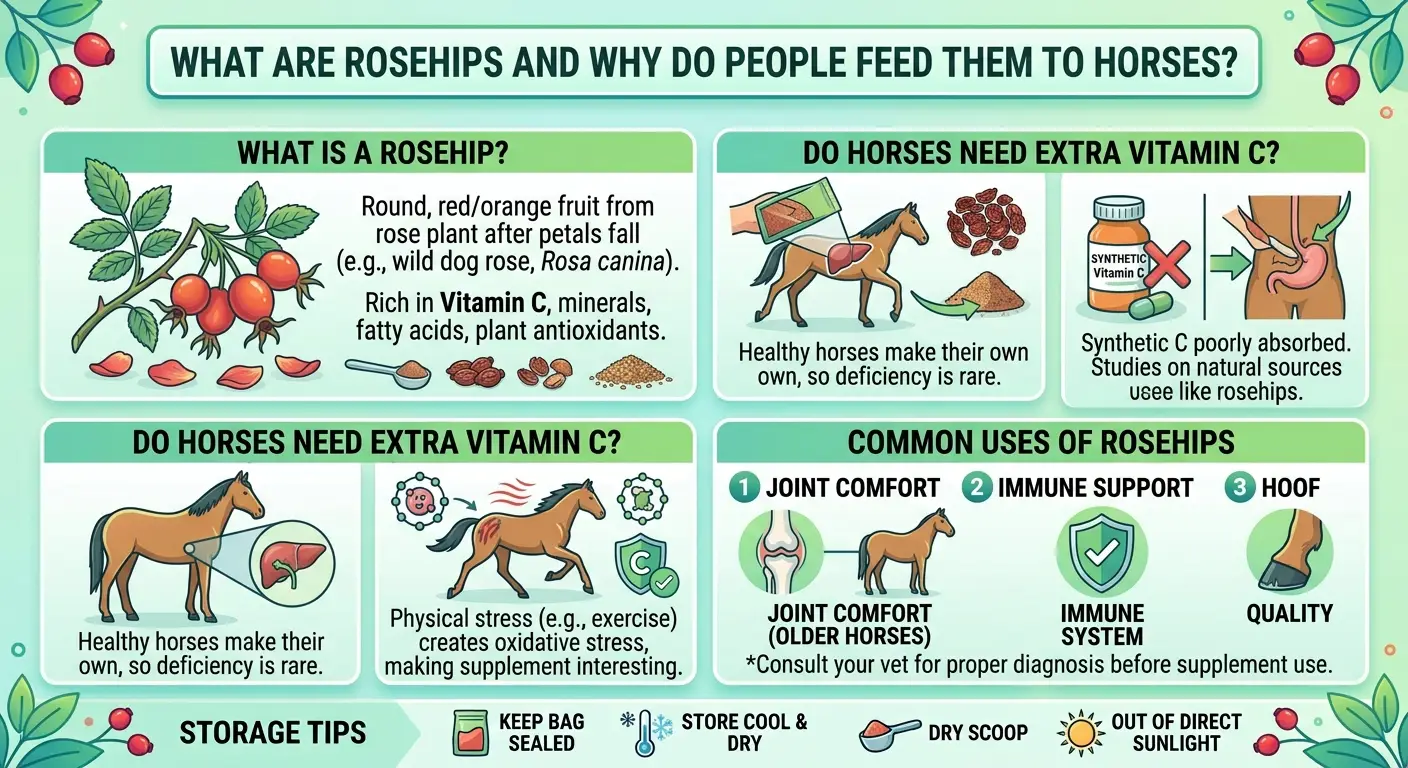
A rosehip is the round, red or orange fruit that forms on a rose plant after the petals fall. The wild dog rose (Rosa canina) is the species most horse supplements are made from. Rosehips are rich in vitamin C, and they also contain other vitamins, minerals, fatty acids and plant antioxidants.
Horse owners feed them as dried shells, cut pieces, granules, pellets or a fine powder. Some horses also pick fresh hips straight off a bush in the paddock.
Do horses need extra vitamin C?
Healthy horses make their own vitamin C in the liver, so a deficiency is unusual. The interest in supplementing comes from horses under physical stress. Research on trotting horses notes that exercise creates oxidative stress, and vitamin C is a key part of the body’s antioxidant defence.
There is a catch. Earlier work cited in the research literature found that synthetic vitamin C is poorly absorbed from the horse’s gut. That is one reason natural sources such as rosehip have been studied.
Owners also use rosehips for joint comfort in older horses, immune support and hoof quality. We separate proven benefits from traditional claims later in this guide.
Rosehips Dosage for Horses: The Standard Guideline
The most widely used rosehips dosage for horses is 5 g per 100 kg of body weight daily, with a doubled “loading” dose of 10 g per 100 kg for the first four weeks. This rate appears on the label of the best-known equine rosehip powder and on at least one other supplier’s guide.
Dosing by body weight matters. A flat “one scoop” rule overfeeds a pony and underfeeds a draft horse. If you do not know your horse’s weight, use a weight tape rather than a guess.
Loading dose vs maintenance dose
The loading dose is simply double the maintenance dose, fed for the first four weeks. The idea is to reach the full effect sooner. One manufacturer says results are typically noticed after about three weeks of loading. Treat that as a brand observation rather than a guarantee.
After four weeks, drop to the maintenance dose and keep it there. If you want to boost support again, for example in a hard training block, some brands say you can return to the loading dose for a while.
Rosehip feeding timeline for horses
Begin with about a teaspoon of powder in the feed and raise the amount each day until you reach the loading dose. Roughly a week works for most horses.
Loading dose, split across meals if your horse eats twice a day. A 500 kg horse gets 50 g daily.
Maintenance dose, fed once or twice daily. A 500 kg horse gets 25 g daily.
Check body condition, manure, comfort and cost. Ask your vet whether it is still doing a job.
Rosehips dosage chart by horse weight
This chart applies the 5 g and 10 g per 100 kg label rate to common horse sizes. One level scoop in many branded powders is 25 g, but scoop sizes vary, so weigh your first few servings on a kitchen scale.

Rosehip powder dosage chart for horses
Label rate: maintenance 5 g per 100 kg daily, loading 10 g per 100 kg daily for 4 weeks.
| Horse type | Weight | Maintenance (g/day) | Loading (g/day, 4 weeks) | 25 g scoops (maint. / loading) |
|---|---|---|---|---|
| Miniature horse | 150 kg (330 lb) | 7.5 g | 15 g | 0.3 / 0.6 |
| Small pony | 200 kg (440 lb) | 10 g | 20 g | 0.4 / 0.8 |
| Pony | 300 kg (660 lb) | 15 g | 30 g | 0.6 / 1.2 |
| Cob or Arabian | 400 kg (880 lb) | 20 g | 40 g | 0.8 / 1.6 |
| Average riding horse | 500 kg (1,100 lb) | 25 g | 50 g | 1 / 2 |
| Warmblood | 600 kg (1,320 lb) | 30 g | 60 g | 1.2 / 2.4 |
| Large warmblood | 700 kg (1,540 lb) | 35 g | 70 g | 1.4 / 2.8 |
| Draft horse | 800 kg (1,760 lb) | 40 g | 80 g | 1.6 / 3.2 |
| Large draft horse | 900 kg (1,980 lb) | 45 g | 90 g | 1.8 / 3.6 |
Based on the label rate of a standardised Rosa canina powder. Always follow the directions printed on your own product.
Rosehips dosage calculator for horses
Enter your horse’s weight, pick a phase, and the calculator returns the daily amount, the amount per feed and how long a bag will last. It uses the 5 g and 10 g per 100 kg label rate for standardised powder.
Rosehips Dosage Calculator for Horses
© medshorse.com
Dosage for ponies, minis and older horses
Ponies and miniatures follow the same per-100-kg rule, so no special pony formula is needed. One South African supplier suggests halving the horse dose for ponies, which lines up with weight-based feeding. For example, a 300 kg pony on maintenance receives 15 g a day.
For senior horses, the same weight-based rate applies. I could not find any published rosehip dose that is specific to age, pregnancy, foals or donkeys, so ask your vet for those animals.
What if your rosehips are shells, granules or whole hips?
This is where owners get confused. The 5 g and 10 g per 100 kg rate belongs to standardised powders. Plain dried shells, granules and whole hips are usually sold as a feed ingredient, and suppliers give much looser guidance. Some vendors state outright that their granules are a raw material with no set dose.
Rosehip label rates compared
Published feeding guidance from equine suppliers. Rates differ because products differ.
| Source type | Form | Stated rate | Works out to (500 kg horse) |
|---|---|---|---|
| Rose-Hip Vital Equine (AU) | Standardised powder | 10 g/100 kg first 4 weeks, then 5 g/100 kg | 50 g, then 25 g |
| Rosehip Farm (ZA) | Powder | 10 g/100 kg first month, then 5 g/100 kg | 50 g, then 25 g |
| HorseAdds (NL) | Ground hips | 5 g/100 kg; 20-30 g for 600 kg, 10-15 g for a 300 kg pony | about 25 g |
| Back on Track (SE) | Coarse powder | 5 g/100 kg normal training, 10 g/100 kg intensive | 25 g or 50 g |
| Hilton Herbs (UK) | Fine-cut shells | 10-20 g daily, split across two feeds | 10-20 g |
| Elite Equine (ZA) | Dried shells | 15-20 g daily, halved for ponies | 15-20 g |
| Omega Equine (UK) | Rosehips | Horses 20-40 g daily, ponies 10-20 g | 20-40 g |
| Global Herbs (UK) | Whole berries | 27-45 g daily (500 kg horse) | 27-45 g |
| Country Park (AU) | Granules | 1-2 tablespoons daily, more for hard workers | weigh it, spoons vary |
| ehorses magazine (DE) | Fresh or dried hips | about a handful (30-40 g) for a 600 kg horse | about 25-35 g |
Notice how the numbers cluster. Almost every rate for a 500 kg horse falls between 20 g and 45 g a day. The standardised powder maintenance dose of 25 g sits comfortably inside that range, while its loading dose of 50 g sits just above it. That tells you the “right” amount is not a precise number. It is a sensible band, and your product’s label decides where in the band you land.
Which dose rate should I follow?
What Does the Research Say About Rosehips for Horses?
Short answer: there is some equine data on vitamin C absorption, a lot of human data on joints, and very little independent horse data on everything else. Here is what exists.
The vitamin C absorption trial in trotters
The study most often quoted was published in Comparative Exercise Physiology in 2012. Researchers split sixteen trotters in training into two groups and fed rosehip powder for three months. One group received 25 g a day (equal to 125 mg of natural vitamin C).
The other received 50 g a day (250 mg). The powder was standardised to roughly 500 mg of vitamin C per 100 g.
Rosehip vitamin C trial: 16 trotters, 3 months
- Serum vitamin C trended upward after 84 days
- The rise was not statistically significant
- Serum vitamin C rose significantly by day 14 (P < 0.02)
- Higher than the 125 mg group (P < 0.03)
- Release of oxidative anions fell significantly (P < 0.001)
Small trial, one branded powder, horses in training. Results may not apply to every product or every horse.
Here is the part most articles skip. The lower dose in the trial (25 g) matches the maintenance dose for a 500 kg horse. The higher dose (50 g) matches the loading dose.
That is my reading of the numbers, not a claim by the researchers, but it suggests why brands recommend loading first: in this trial, the higher amount was the one that clearly moved blood vitamin C.
Other evidence worth knowing
A 2024 study in the Journal of Veterinary Internal Medicine gave healthy adult horses vitamin C by injection. At 100 mg per kg, oxidative markers dropped two hours later and plasma vitamin C rose in a dose-dependent way.
That sounds impressive, but 100 mg per kg is about 50,000 mg for a 500 kg horse, roughly 200 times the higher dose in the rosehip trial. It is a vet-administered treatment, not a feeding guide.
For joints, the best-known research is in people. A 2008 meta-analysis of randomised trials examined rose hip powder for osteoarthritis pain, and a 2016 review in Botanics: Targets and Therapy covered both animal and human work.
Some supplement makers also point to a plant compound called a galactolipid (often marketed as GOPO) as the active ingredient, and one brand states that rosehip products without it have not been shown to be anti-inflammatory. That is a manufacturer statement, so treat it as a reason to look at how your product is made, not as settled science.
What I could not find is an independent, peer-reviewed clinical trial showing that rosehips improve lameness or arthritis in horses. If a label promises that, ask to see the study.
Rosehip benefits for horses: evidence check
How strong is the support behind each common claim?
| Claimed benefit | What sources say | Evidence level |
|---|---|---|
| Raises blood vitamin C | A randomised trial in trotters found a significant rise at 250 mg vitamin C daily from rosehip powder. | Some equine data |
| Antioxidant support | The same trial found fewer oxidative anions released at the higher dose. | Some equine data |
| Joint comfort and mobility | Human osteoarthritis research exists. Equine claims come mainly from manufacturers and conference presentations. | Limited |
| Immune support | Linked to vitamin C and plant antioxidants. Equine results are mostly manufacturer-reported. | Limited |
| Hoof growth and quality | Suppliers describe a long tradition of use and “believed” benefits from flavonoids and vitamin C. | Traditional use |
| Firmer manure | Described as astringent at recommended doses. Too much can do the opposite. | Traditional use |
| Coat, allergies, appetite | Listed on some product pages. I found no supporting equine study. | Anecdotal |
Do Rosehips Help Horse Hooves, Joints and Immunity?
Possibly, but the proof varies by claim. Rosehips have the most support as a source of absorbable vitamin C. Joint and immune claims rest on thinner evidence, and hoof claims are mostly tradition.
For hooves, the usual explanation is that flavonoids plus vitamin C support strong protein bonds. It is an appealing theory, not a proven mechanism. If hoof quality is your goal, a balanced ration matters more, and many owners look at a separate biotin dosage for horses guide alongside forage and mineral balance.
For joints, think of rosehips as a possible add-on for comfort, not a treatment. A horse that is lame, stiff or reluctant to move needs a vet exam before any supplement.
How to Feed Rosehips to Your Horse (Step by Step)
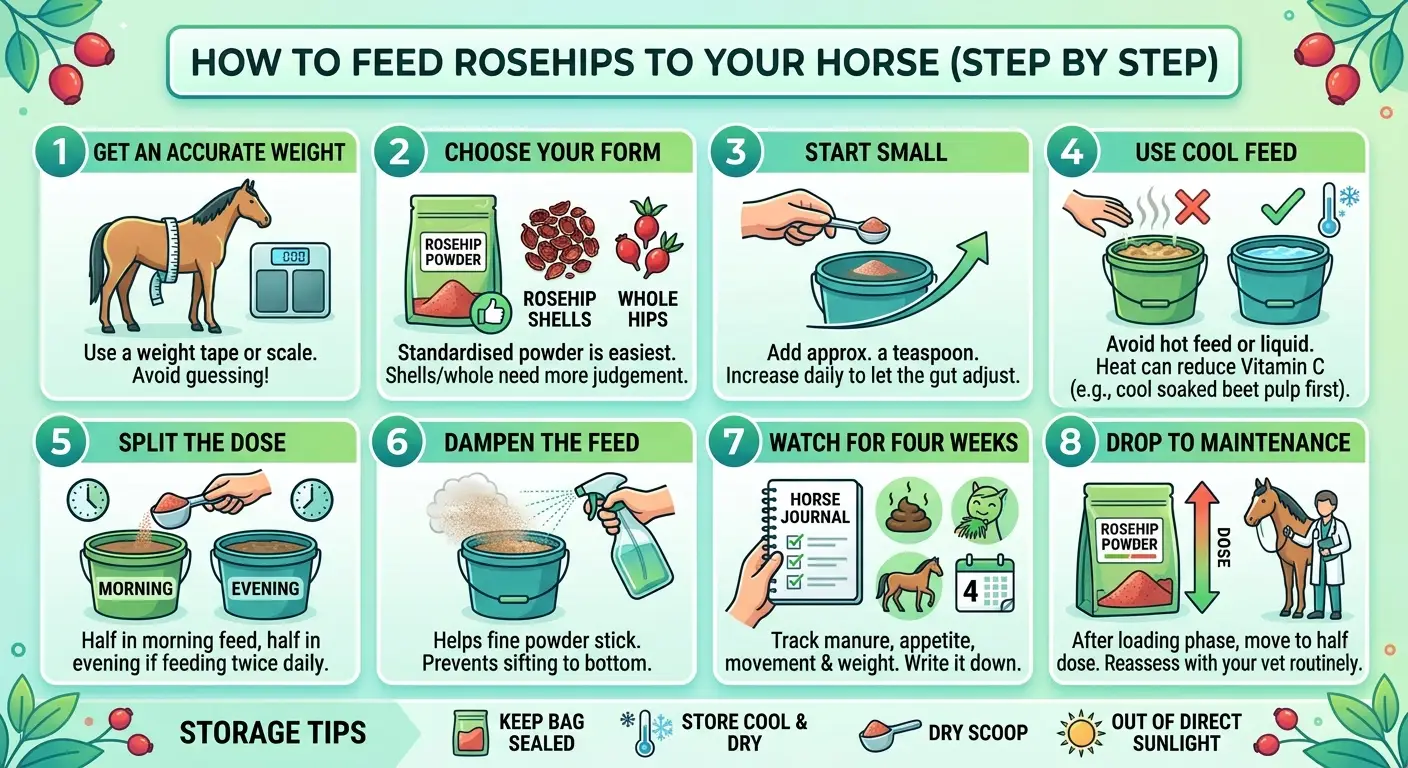
- Get an accurate weight. Use a weight tape or scale. Guessing by eye is the commonest cause of wrong doses.
- Choose your form. A standardised powder with a printed dose is easiest. Shells and whole hips need more judgement.
- Start small. Add about a teaspoon of powder to the feed and increase daily until you reach the target. This lets the gut adjust.
- Use cool or room-temperature feed. One manufacturer warns against mixing with hot feed or hot liquid. Heat can reduce vitamin C, so soaked beet pulp should cool first.
- Split the dose if you feed twice daily. Half in the morning feed and half in the evening feed works well.
- Dampen the feed slightly. This is a practical tip, not a label rule: it helps fine powder stick instead of sifting to the bottom of the bucket.
- Watch for four weeks. Track manure, appetite, movement and weight. Write it down so you can judge honestly.
- Drop to maintenance. After the loading phase, move to half the dose and reassess with your vet at routine visits.
Store the bag cool, dry and out of direct sunlight. Keep the scoop dry and keep the bag sealed.
Can horses eat fresh rose hips from the garden?
Yes, with a condition. Many horses happily pick hips from a bush, and one South African supplier suggests one or two handfuls daily if feeding fresh. The condition is that the plants must not have been sprayed with fertilisers or pesticides.
If you cannot be sure, skip them. A handful works out to roughly 30 to 40 g for a large horse, which sits inside the normal dried-hip range.
Rosehips Side Effects and Safety for Horses
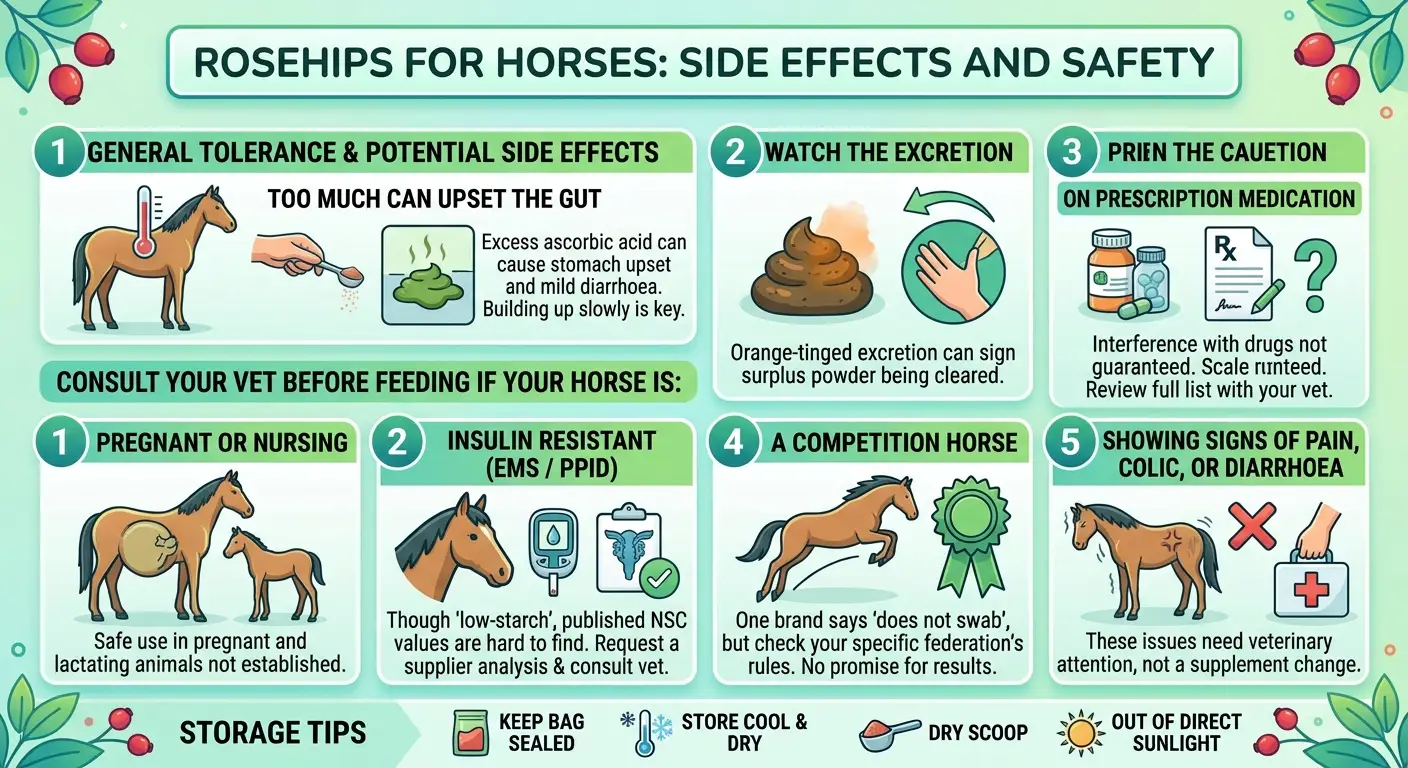
Rosehips are generally described as well tolerated, and one brand lists no known contraindications. Still, “natural” does not mean “no limits”. Here is what the sources actually say.
Too much can upset the gut. One supplier notes that feeding excess can cause stomach upset and mild diarrhoea because of the ascorbic acid content. A manufacturer also reports that orange-tinged excretion is a sign the body is clearing surplus powder, and says to scale back if you see it. Both are good reasons to build up slowly.
Speak to your vet before feeding rosehips if your horse is:
- Pregnant or nursing. One manufacturer states that safe use in pregnant and lactating animals has not been established.
- Insulin resistant, has EMS or has PPID (Cushing’s). Some sources call rosehips a low-starch treat, but I could not find a published sugar (NSC) figure. Ask your supplier for an analysis and ask your vet.
- On prescription medication. One brand says it does not interfere with drugs or other supplements, but your vet knows your horse’s full list.
- A competition horse. One manufacturer says its powder does not swab and has no withholding period. No product can promise a test result, so check your federation’s rules.
- Showing signs of pain, colic or diarrhoea. These need a vet, not a supplement change.
Common mistakes to avoid
- Skipping the weight check and using “one scoop for everyone”.
- Assuming every rosehip product has the same strength and the same dose.
- Jumping straight to the full loading dose on day one.
- Mixing powder into steaming hot mash.
- Feeding hips from sprayed garden roses.
- Expecting rosehips to fix lameness that has not been examined.
- Adding several new supplements at once, so you cannot tell what is working.
Rosehips for horses: pros and cons
Pros
- Natural source of vitamin C with some equine absorption data
- Simple weight-based dosing with standardised powders
- Horses generally accept the taste
- Mixes easily into regular feed
- Often described as well tolerated
Cons
- Joint and immune claims lack independent equine trials
- Label rates vary widely between products
- Too much may cause loose manure
- Not established as safe for pregnant or nursing mares
- Sugar content for metabolic horses is unclear
Rosehips vs Other Supplements: Where They Fit
Rosehips are one option in a crowded shelf. Here is how owners typically think about the neighbours.
For cartilage support, owners often compare rosehips with glucosamine dosage for horses guidelines. Glucosamine is a building-block ingredient, while rosehip is a whole-fruit source of vitamin C and plant compounds. They are not interchangeable, and some owners feed both after asking their vet.
For herbal comfort support, the Devils Claw dosage for horses guide covers another popular plant. Devil’s claw works differently from rosehip, so the doses cannot be swapped.
For antioxidants and general condition, owners also look at the spirulina dosage for horses, bee pollen dosage for horses and kelp dosage for horses guides. Add one new product at a time so you can see what each one does.
One firm line: rosehips are not a substitute for veterinary pain relief. If your vet has prescribed an anti-inflammatory, follow the plan on the label and see our bute dosage for horses safety guide for how that medication is handled.
FAQs
How much rosehips should I give my horse per day?
Most standardised rosehip powders list 5 g per 100 kg of body weight daily for maintenance. That is 25 g for a 500 kg horse. Plain dried shells and whole hips use looser ranges, commonly 10 to 45 g a day depending on the supplier, so follow your product label.
How much rosehip powder does a 500 kg horse need?
A 500 kg horse needs about 25 g a day on the maintenance dose and 50 g a day during the four-week loading phase. In many branded powders one level scoop is 25 g, so that is one scoop and two scoops. Check your own scoop size first.
What is the rosehip loading dose for horses?
The loading dose is double the maintenance dose: 10 g per 100 kg of body weight daily for the first four weeks. After that you drop to 5 g per 100 kg. Build up to the loading dose gradually instead of starting at the full amount.
How long does it take rosehips to work in horses?
One manufacturer says results are usually noticed after about three weeks on the loading dose. Treat that as a guide, not a promise. Track manure, movement, appetite and condition for four weeks, then decide with your vet whether to continue.
Can you give a horse too many rosehips?
Yes, too much can cause problems. Suppliers report stomach upset and mild diarrhoea at high amounts because of the ascorbic acid content. One manufacturer says orange-tinged excretion signals surplus powder and advises scaling back. Stay on the label dose and build up slowly.
Can horses eat fresh rose hips from the garden?
Yes, if the plants have not been sprayed with fertilisers or pesticides. One supplier suggests one or two handfuls a day when feeding fresh. A handful is roughly 30 to 40 g for a large horse. If you are unsure how the bush was treated, do not feed it.
Are rosehips good for horses with arthritis?
Owners often use rosehips for joint comfort in older horses, but I found no independent clinical trial proving they treat arthritis in horses. Human osteoarthritis research exists, and some manufacturers make equine claims. See your vet for a diagnosis and treat rosehips as an optional add-on.
Are rosehips safe for horses with Cushing’s or insulin resistance?
Some sources describe rosehips as low in starch, and some retailers advise checking with a vet before feeding them to Cushing’s horses. I could not find a published sugar (NSC) figure. Ask your vet and your supplier for an analysis before you start.
Can pregnant or nursing mares have rosehips?
Speak to your vet first. One manufacturer states that safe use in pregnant and lactating animals has not been established. I found no published rosehip dose specific to pregnant mares, nursing mares or foals.
Do rosehips show up in a horse drug test?
One manufacturer says its rosehip powder does not swab and has no withholding period, but no feed or supplement can guarantee a test result. Read your federation’s rules and ask your vet before competing.
Can rosehips replace bute or other pain relief?
No. Rosehips are a supplement, not a medication. A lame or painful horse needs a veterinary exam and a treatment plan. If your vet prescribes an anti-inflammatory, rosehips should only be added with their approval.
Should I give rosehips once or twice a day?
Either works. If your horse eats twice a day, splitting the daily amount between the morning and evening feed is common. If it eats once, give the whole dose in that meal. Mix it into cool or room-temperature feed rather than hot mash.
Are rosehips good for horse hooves?
Rosehips have a long traditional reputation for hoof quality, often linked to flavonoids and vitamin C. Treat that as tradition rather than proof. A balanced ration, regular trimming and a vet or farrier check matter more.
How long can a horse stay on rosehips?
I found no published maximum duration. The maintenance dose is described as ongoing, and one brand allows a return to the loading dose when extra support is wanted. Review the benefits and cost with your vet at routine visits.
What is the rosehip dose for a pony?
Use the same weight-based rate. A 300 kg pony needs about 15 g a day on maintenance and 30 g a day while loading. One supplier suggests halving the horse dose for ponies, which works out similarly for smaller animals.
Bottom Line: Is Rosehip Worth Feeding?
Rosehips are a reasonable, low-risk supplement for many horses when you dose by weight, build up slowly and keep expectations realistic. The 5 g per 100 kg maintenance rate and the 10 g per 100 kg loading rate are the best-supported starting points for a standardised powder. Plain shells and whole hips use looser ranges, so lean on your label and your vet.
Your next steps
- Weigh or tape your horse and run the numbers in the calculator above.
- Check the label of your product against the label comparison table.
- Run any questions about pregnancy, metabolic issues or competition past your vet first.
- Start low, load for four weeks if your product advises it, then move to maintenance.
- Review after a month and keep only what shows a clear benefit.
Sources and Further Reading
- Winther K, Kharazmi A, Hansen ASV, Falk-Rønne J. The absorption of natural vitamin C in horses and anti-oxidative capacity: a randomised, controlled study on trotters during a three-month intervention period. Comparative Exercise Physiology, 2012. Full text summary (manufacturer-hosted)
- Marstrand K, Campbell-Tofte J. The role of rose hip (Rosa canina L) powder in alleviating arthritis pain and inflammation, part II: animal and human studies. Botanics: Targets and Therapy, 2016. DOI link
- Taylor SD, Hart KA, et al. Effects of intravenous administration of ascorbic acid (vitamin C) on oxidative status in healthy adult horses. Journal of Veterinary Internal Medicine, 2024. Abstract
- Rose-Hip Vital Equine dosage and administration guide. rosehipvital.com.au
- Rosehip Farm, rosehip powder for horses. rosehipfarm.co.za
- Elite Equine, rosehips as natural vitamin C. eliteequinesa.com
- HorseAdds, rosehip for horses. horseadds.com
- ehorses magazine, rose hips for horses and dosage. ehorses.com
- Hilton Herbs rosehip shells, feeding guide. supplementsolutions.co.uk
- Omega Equine rosehips, feeding guide. equus.co.uk
Please note: This guide is for general education and is not a substitute for veterinary advice. Dose rates come from manufacturer labels and published studies, and products vary. Always follow your product label and consult your veterinarian before adding any supplement, especially for pregnant, metabolic, sick or competition horses.