Bute Dosage For Horses: Calculator, Chart & Safe Guide
One of the most frequently used non-steroidal anti-inflammatory drugs (NSAIDs) in equine medicine is phenylbutazone, commonly referred to as “Bute,” which is used to treat pain and inflammation, such as laminitis, arthritis and soft tissue injuries. It is important to get the dose of Bute right: the recommended oral dose is 2.2–4.4 mg/kg daily, which is usually divided into two equal portions, although some vets prefer to follow a single daily dose as a Bute is a long-acting anti-inflammatory.
Higher doses of up to 8.8 mg/kg can be administered in more severe cases, including laminitis; only under veterinary supervision. Bute comes in a few different formulations – oral paste, powder, tablets (like Bute SAFE 500) or bolus for long-term feed-mixed use and an IV only injectable solution for rapid relief, and each has different considerations and times of onset.
Since effectiveness and safety depend on the accuracy of the dose, always be careful to calculate Bute dosage by weight and always check with a licensed veterinarian before giving Bute to horses.
Bute Dosage Calculator For Horses
Phenylbutazone dosing reference for horses — paste, oral, and IV formulations.
Calculated Dosage
What Is Bute (Phenylbutazone)?
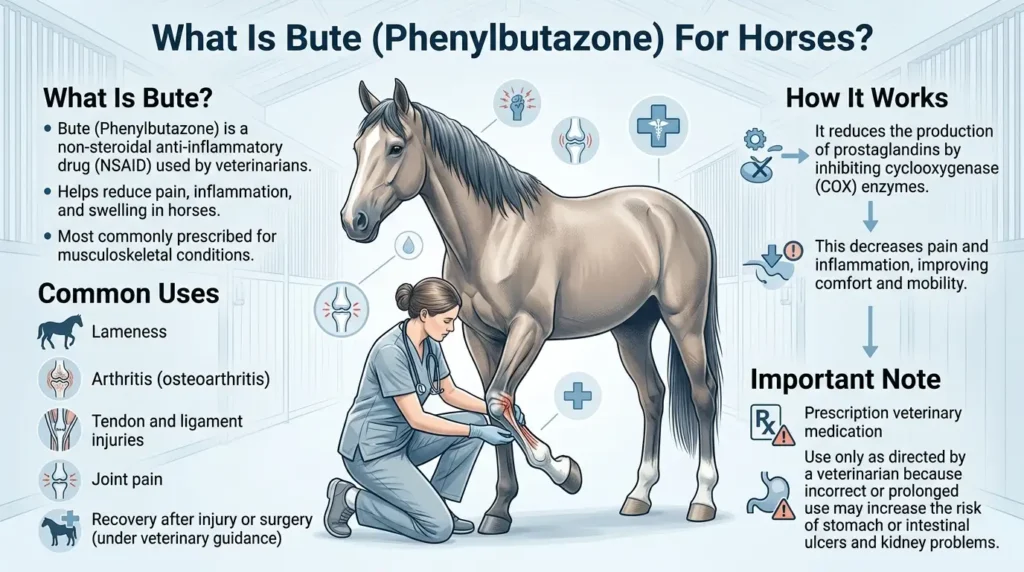
Bute is a barn term for phenylbutazone, a Nonsteroidal Anti-inflammatory Drug (NSAID) which has been around in horses for many, many years. It functions through the inhibition of the COX enzymes which help to decrease the inflammation and pain associated with arthritis, muscle soreness, laminitis outbreaks and overall lameness. It is popular because it is cheap, effective and comes in multiple convenient forms to administer.
Bute is not aspirin or ibuprofen for people, and is not to be administered to a horse using human logic. It’s also a federally-controlled prescription drug in the U.S. — it is to be dispensed by, or on the order of, a licensed veterinarian, not simply picked up casually at a farm store without direction.
The bottomline is that Bute works on pain and inflammation, but will not resolve the issue. If your horse requires bute for more than a few days, it’s a red flag to seek a veterinary diagnosis rather than simply refilling the tube.
How Bute Works in Horses
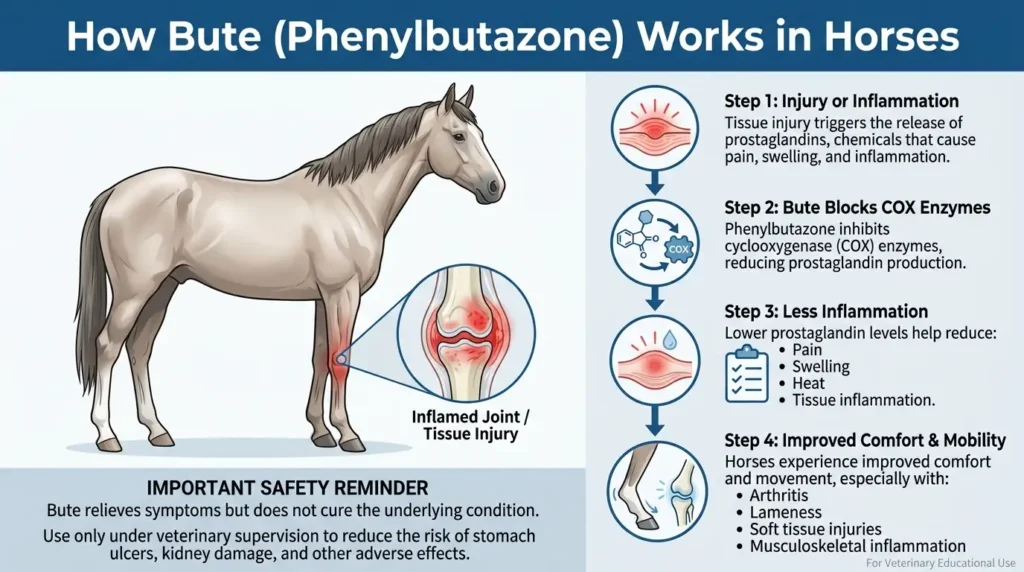
Phenylbutazone or “Bute” is a non-selective NSAID–a non-steroidal anti-inflammatory drug–that is widely used in equine medicine to treat pain & inflammation & fever. It does this by blocking two enzymes (COX-1 and COX-2) in the horse’s body which normally produce prostaglandins, chemicals that cause inflammation, swelling and pain.
Bute blocks the pathway of COX-2, which results in decreased inflammation and fever as well as effective pain relief, making Bute a popular choice for short-term injuries and chronic, long-standing conditions.
Bute for horses is non-selective meaning it also inhibits the COX-1 pathway simultaneously. An important side effect to know about is that COX-1 is beneficial in the digestive tract, kidneys, and blood clotting, so blocking it raises the chances of gastrointestinal and renal side effects.
Bute comes in a variety of forms, such as oral paste, powder, tablets, bolus and an injectable solution, to suit various treatment requirements.
Bute Dosage Chart by Horse Weight
This chart is based on the generally accepted veterinary dosage of 2.2–4.4 mg/kg/day in one or two doses. Remember, this is a guideline and should always be used in conjunction with your vet’s individual advice.
| Horse Weight | Low Dose (2.2 mg/kg/day) | High Dose (4.4 mg/kg/day) | Typical Oral Paste/Powder |
| 400 lb (pony, ~180 kg) | ~400 mg | ~800 mg | 0.4–0.8 g |
| 700 lb (small horse, ~320 kg) | ~700 mg | ~1,400 mg | 0.7–1.4 g |
| 1,000 lb (average horse, ~450 kg) | ~1,000 mg (1 g) | ~2,000 mg (2 g) | 1–2 g |
| 1,200 lb (large horse, ~545 kg) | ~1,200 mg | ~2,400 mg | 1.2–2.4 g |
| 1,500 lb (draft horse, ~680 kg) | ~1,500 mg | ~3,000 mg | 1.5–3 g |
The doses in this chart are given as the total daily dose, which is usually divided in two doses 12 hours apart.
Oral Paste and Powder Dosing
The real confusion occurs because most bute paste tubes or powder scoops are marked according to weight and not milligrams. A typical label dose is about 1-2 gram/500 lb of body weight, and the maximum dose is about 4 gram/day in an average horse. Check the label on your particular product; they have different concentrations.
Tablet Dosing
Bute is typically available in 1 gram tablets. It’s usually 2 tablets for a 1,000 lb horse, but your veterinarian may prescribe it as half a tablet in the morning and half a tablet in the evening.
Injectable (IV) Dosing
Injectable bute is administered intravenously only at the rate of approximately 1-2 g/1,000 lb of body weight daily and must be given slowly. IV bute should be administered for a max of 5 consecutive days and then an oral preparation is normally used if required.
Callout box: Do not administer any bute, injectable product, IM (into the muscles). It is only to be used intravenously and will cause painful swelling, tissue death and abscesses if injected anywhere else.
How to Calculate Your Horse’s Bute Dose (Step-by-Step)
- Obtain a correct body weight. If available, weigh the livestock on a livestock scale. A weight tape is an acceptable alternate, but it can be off by 50-100lb which is significant for a very close-margin drug, such as bute.
- If your reference is using mg/kg, convert the weight (lb) to weight (kg) by dividing by 2.2.
- Repeat this by the dose per kg that your vet outlined (usually 2.2 to 4.4 mg/kg/day).
- To know how much paste, powder or tablets to give, divide by the concentration of your product.
Worked example: A 1,100-lb horse needs a 2.2 mg/kg dose.
- 1,100 ÷ 2.2 = 500 kg
- 500 kg × 2.2 mg/kg = 1,100 mg (1.1 g) per day
- If taking 1 gram tablets, this should be about 1 tablet plus the rest as your vet prescribes.
Key takeaway: When in doubt, round down and call your vet — always round down and ask your vet a question, rather than making a guess.
Loading Dose vs. Maintenance Dose
Vets may choose to use a higher dose for the first 24-48 hours to quickly reduce the inflammation, and then reduce to the lowest effective maintenance dose. This will create rapid pain control and avoid the gradual GI and kidney strain from high dosages.
If your horse’s pain persists, the idea is to slowly decrease or eliminate the use of the drug, not to continue it “just in case.
Bute Dosage for Foals, Minis, and Ponies
Foals, miniature horses and ponies are considered to be more susceptible to side effects of bute treatment, and such treatment by weight alone may remain a risk for these types of horses. Use of any bute in a foal should be directed and carefully monitored by a veterinarian as their safety margin is smaller and gastrointestinal issues are more likely.
Never reduce the dose from an adult horse to a pony or foal without advice from a professional.
How Long Can a Horse Stay on Bute?
There is no one-size-fits-all solution, but the general veterinary advice is:
- Long-term (chronic) use: For more than a few days, at a higher dose as the horse improves.
- The diagnosis should be rethought and the dose not further ramped up if there is no improvement after approximately 5 days.
- Long term (chronic) use for arthritis: May be used at the lowest effective dose with periodic blood tests, monitoring for ulcers and a gastroprotectant is often necessary and should be under veterinary supervision.
Research has shown gastrointestinal changes may begin to occur in horses even at clinically appropriate doses, after only a few weeks of daily bute administration, so long-term bute isn’t something you want to manage on autopilot.
Signs of Bute Overdose or Toxicity
Bute has a smaller margin for error than most people think. Watch for:
- Decreases in appetite or total inappetence
- Unusual tiredness or sadness
- Ulcers in mouth or on tongue, drooling
- Crying or spitting up of milk, diarrhea.
- Protein loss causes swelling under the belly and/or legs.
- Fever
- Tarry or black manure (GI bleeding)
Two well documented side effects are indicated by these signs: gastric ulcers and right dorsal colitis (large colon inflammation and ulceration); both are associated with phenylbutazone use, particularly at doses higher than recommended, or when it is used for longer than recommended. Bute is thought to be more likely to cause these GI problems than other equine NSAIDs like flunixin meglumine or ketoprofen.
Stop medication if you think you may have overdosed or if you observe any of these symptoms, contact your veterinarian right away. Never attempt to treat signs of toxicity at home: GI and kidney problems associated with bute can progress rapidly and hospitalization is necessary in severe cases.
Bute vs. Banamine: What’s the Difference?
| Feature | Bute (Phenylbutazone) | Banamine (Flunixin Meglumine) |
| Best for | Musculoskeletal pain, arthritis, lameness | Colic pain, eye inflammation, endotoxemia |
| GI ulcer risk | Higher | Lower than bute, still present |
| Common forms | Paste, powder, tablet, IV | Paste, IV |
| Can combine with the other? | Not recommended without vet direction | Not recommended without vet direction |
Key takeaway: there is no substitute for Bute and Banamine, and most competition and veterinary advice is to not give both simultaneously unless directed by your vet – NSAID stacking is a meaningful increase in the risk of ulcers and kidney damage.
Bute and Horse Show Withdrawal Times
Bute for horses dosage is a controlled/regulated medication under FEI and USEF rules and not a banned substance (there are limits, however, if you are in competition). USEF rules generally allow only a single NSAID to be administered in the vicinity of competition, and the use of more than one NSAID (such as banamine and bute) is prohibited; owners are responsible for adhering to the detection-time guidance and disclosure requirements published by USEF.
Always consult the FEI or USEF drugs and medicine rule (or ask your show vet) for blood levels and withdrawal times, since these figures are specific and subject to change over time and not based on a fixed time (in hours) that is “safe”.
Common Bute Dosing Mistakes
- Not using a weight tape or weighing the horse.
- Mixing up gram, milligram and millilitres on the labels of different products.
- Feeding with bute on an empty stomach or when the animal is not eating – this increases ulcer risk, feed a small meal first if possible.
- Bute continued beyond 5 days without a recheck by a vet.
- Administering bute in addition to Banamine or other NSAIDs without veterinary guidance.
- Giving IV-only bute in muscles, which can damage the muscle.
- Dehydrated or sick horses may not be able to tolerate a standard dosage – illness and dehydration increase the risk for toxicity.
Side Effects & Risks of Bute Dosage For Horses
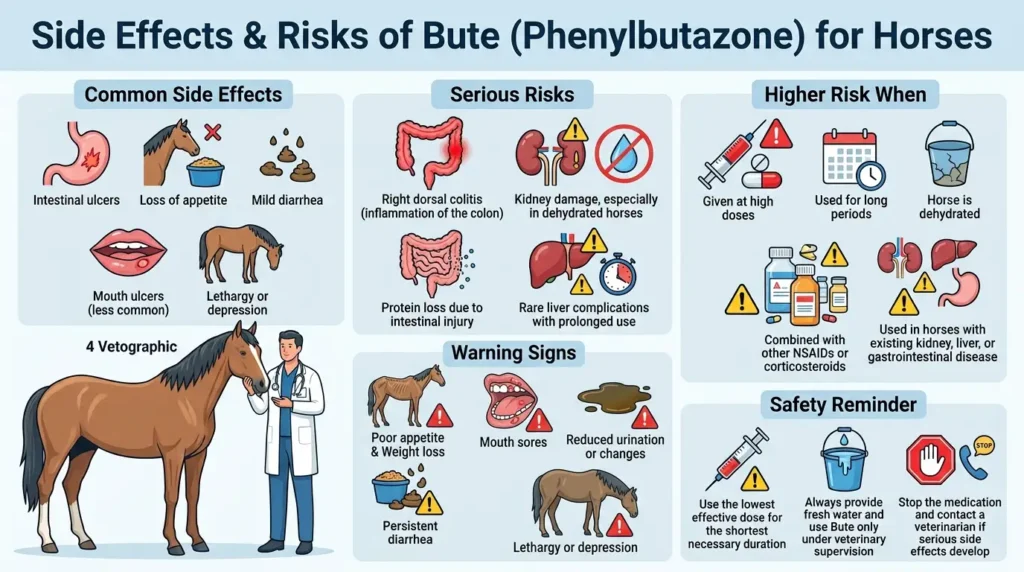
Although this drug (Bute, or phenylbutazone) is generally safe for horses, there are a number of potential side effects that owners should be very aware of.
Gastrointestinal Side Effects
- Ulcers in the mouth and stomach.
- Oral ulcers and stomatitis (especially with paste or bolus forms)
- Reduced appetite
- Diarrhea
- Manure that is black or tarry in color.
- Right dorsal colitis, characterised by diarrhoea, dehydration, lethargy, inappetence, dark mucous membranes and a raised heart rate.
Kidney-Related Risks
- In sensitive or dehydrated horses as a general stress response of the kidneys
- Renal papillary necrosis
- Kidney disease/impairment
Other Side Effects that May Occur
- Suppression of bone marrow (anemia, leucopenia)
- Liver damage or yellowing of the skin.
- Hypoproteinemia (low blood protein levels), which can present as weight loss or limb swelling (edema)
- Swelling, inflammation and formation of wounds at the injection site.
- Severe inflammation and clostridial myositis if mistakenly given intramuscularly (IM) instead of IV
Precautions
- Should be used with caution in horses with drug allergy history.
- Do not use simultaneously with other anti-inflammatory agents (including NSAIDs or corticosteroids) or use with caution.
- Do not use in humans food animals
Treatment duration should be determined by the physician.
If any gastrointestinal upset, jaundice, blood dyscrasia (abnormal blood conditions) or unusual symptoms occur, discontinue the use of Bute and contact your veterinarian immediately.
Bute Drug Interactions & Contraindications in Horses
Drug Interactions
- Do not use simultaneously with other NSAIDs (e.g. flunixin, firocoxib) or corticosterone — risk of additivity
- Be careful in using Anticoagulants with the risk of bleeding.
Contraindications
- Do not use in horses with known kidney, liver or gastrointestinal disease.
- Carefully use in pregnant, very young or elderly horses.
- Not for use in food animals — illegal in lactating horses/slaughter animals.
How to Store Bute for Horses
- Store Bute at controlled room temperature, below 25°C (between 59°–86°F)
- Sachets should be kept to remain closed.
- For specific storage instructions, please check individual product packaging, which may vary according to formulation.
- Handle and dispose of used needles with care in compliance of all federal, state and local environmental regulations.
- Ensure that children and pets are kept away
Myth vs. Fact
Myth: “Bute is like aspirin for horses, so if my horse is really sore, the more he gets, the better it is.
Fact: Bute dose has a much smaller margin for error than aspirin – and large doses have a significant effect on the development of ulcers, colitis and kidney damage.
Myth: “Since a little bute helps, it’s not a problem to administer it daily for a long time.
Fact: GI changes have been reported even at normal clinical doses in as little as weeks and therefore long-term use should be monitored.
Myth: “But Bute and Banamine work together will knock out pain better and faster.
Fact: NSAIDs have been shown to increase the risk of ulcers and kidney damage when administered together and most veterinary and competition guidance says not to do this.
You May Also Like to Read:
- Adequan Dosage For Horses: Calculator, Chart & Safe Guide
- Banamine Dosage For Horses: Calculator, Chart & Safe Guide
FAQs
What about the amount of bute that I feed my horse?
The recommended daily dose is in the range of 2.2–4.4 mg/kg (1–2 mg/lb) which is usually divided into one or two doses — the specific dose should be prescribed by your veterinarian depending on your horse’s condition, weight and health history.
What is the maximum amount of times a horse can be given bute?
Typically, most protocols involve once or twice a day doses, and most are given at a higher ‘loading dose’ for the first 48 hours followed by a lower ‘maintenance dose’.
What is the safe duration for a horse to be on bute?
A few days of short courses are usual for acute soreness. Longer term use can occur with chronic diseases such as arthritis with the vet’s monitoring and blood work.
Is there too much of a good thing as it relates to bute for horses?
Yes. Gastric ulcers, right dorsal colitis and kidney damage are associated with overdose or with prolonged high dosages. Be on the lookout for loss of appetite, colic, diarrhea or swelling, and contact your veterinarian with any of these immediately.
What is the difference between bute and Banamine?
No, bute is an equine NSAID typically prescribed for musculoskeletal pain, while Banamine is usually prescribed to treat colic and inflammation of the eye. They act in different ways and should not be mixed together without a veterinarian’s advice.
Can I give bute on an empty stomach?
It’s better not to. However, feeding bute with a small amount of feed can help alleviate stomach upset.
What is the quantity of bute in a scoop of powder?
This depends on the product; not all brands have consistent scoop sizes and concentrations.
Is it OK to give foals or ponies bute?
May be administered only under veterinary supervision. Foals, minis and ponies are more susceptible to the side effects of bute than older horses.
What’s the maximum number of days I can give IV bute?
Typically, IV phenylbutazone is used for no more than 5 consecutive days in veterinary settings.
Is there an option of rotating between bute paste and tablets?
Yes, provided the total amount of milligrams in a day remains the same, but check with your veterinarian because the concentration is different in different products.
Do I need a prescription for bute?
Phenylbutazone is only used in the U.S. by or on the order of a licensed veterinarian.
What is the first indication that something is wrong post bute?
Appetite loss, dullness, mouth ulcers, diarrhoea or colic are early signs that should alert you to contact your vet.
Bute for horses at a show – is it safe?
Bute dosage is a controlled substance under FEI and USEF rules and has specific detection-time and disclosure requirements (check current federation rules or your show veterinarian before competing).
Final Thoughts
Although Bute Dosage is still among one of the most common and effective pain and inflammation control agents used in horses, it is only as effective as when used properly. The best rule of thumb is to weigh your horse, use the smallest dose needed to be effective, don’t extend the treatment beyond a few days without veterinary re-check, and be vigilant for early signs of weight loss or changes in appetite or loose manure.
Bute is a well functioning drug when used sensibly and with veterinary advice. The very medication that’s supposed to make your horse feel better can be a way greater issue when used in a casual or extended manner.
This article is for general education and is not a substitute for veterinary care. Each horse’s proper bute dosage varies based on the horse’s condition, weight, kidney and GI tract condition — check with a licensed veterinarian before giving.