Glucosamine Dosage for Horses: Weight Chart, Free Calculator and the Safe Way to Dose Joint Support
Written & Reviewed By: Medshorse Team
Last Updated: November 2026
Getting the glucosamine dosage for horses right is harder than it looks. Product labels disagree, studies use different amounts, and a scoop of powder can hold far less glucosamine than the front of the tub suggests. So how much does your horse really need?
Most published guidance lands between 10 and 20 mg per kilogram of body weight per day. For a 500 kg (1,100 lb) horse, that is 5 to 10 grams. This guide gives you a weight chart, a calculator, the loading and maintenance approach, and the safety rules that matter most.
Disclaimer: This article is for general education and is not veterinary advice. Product names mentioned, including Glucosamine, belong to their respective owners, and MedsHorse is not affiliated with them. Always follow your veterinarian’s instructions and the current product label.
Key takeaways: glucosamine dosage for horses
The numbers most sources agree on, in one place.
- Dose by body weight, not by scoop. Check how many milligrams of glucosamine your product really delivers.
- A loading phase (up to roughly 2–4 weeks) is common, then drop to maintenance.
- Evidence is promising but mixed, and product quality varies a lot.
- Talk to your vet first if your horse is lame, insulin resistant, pregnant, or competing.
Glucosamine Dosage for Horses: The Short Answer
Most sources recommend 10 to 20 mg of glucosamine per kilogram of body weight per day. For a 500 kg (1,100 lb) horse, that is 5 to 10 grams daily. Some plans start higher for two to four weeks (a loading phase), then drop to a maintenance dose. Always check how much actual glucosamine your product delivers.
The quick dose formula
Multiply your horse’s weight in kilograms by 10 to 20 mg. A 450 kg horse at 20 mg/kg needs 9,000 mg, or 9 grams, a day. To convert pounds to kilograms, divide by 2.2.
Why published doses do not match
There is no official standard glucosamine dose for horses. Mississippi State University Extension notes that studies suggested roughly 10,000 mg a day for a mature horse, yet product recommendations in one survey ranged from 1,800 to 10,000 mg a day. That gap is why weight-based dosing and label-checking matter.
Glucosamine Dosage Chart for Horses by Weight
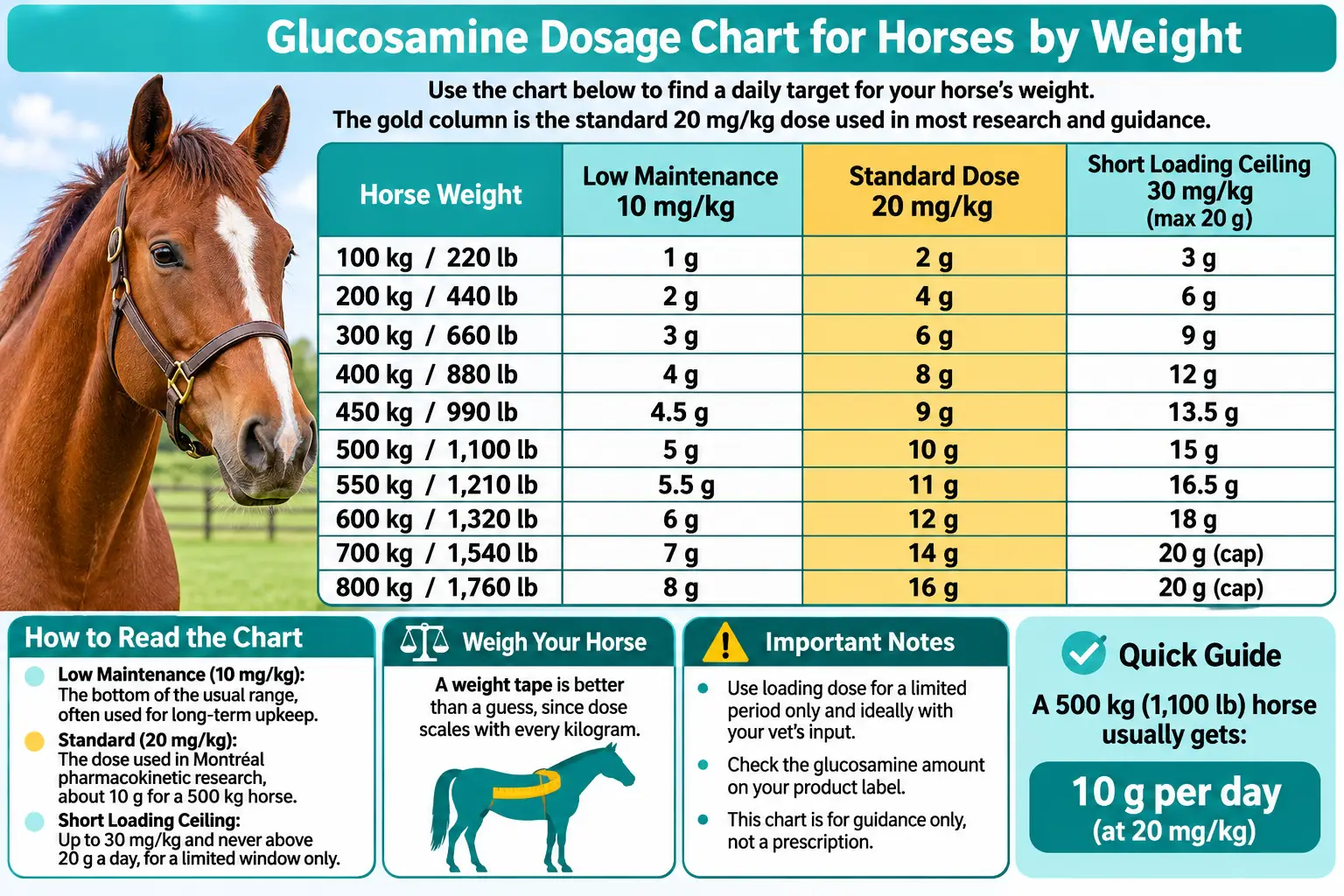
Use the chart below to find a daily target for your horse’s weight. The gold column is the standard 20 mg/kg dose used in most research and guidance.
Glucosamine dosage chart for horses by body weight
Grams of glucosamine per day. Compare against the glucosamine amount printed on your product label.
| Horse weight | Low maintenance 10 mg/kg | Standard dose 20 mg/kg | Short loading ceiling 30 mg/kg (max 20 g) |
|---|---|---|---|
| 100 kg / 220 lb | 1 g | 2 g | 3 g |
| 200 kg / 440 lb | 2 g | 4 g | 6 g |
| 300 kg / 660 lb | 3 g | 6 g | 9 g |
| 400 kg / 880 lb | 4 g | 8 g | 12 g |
| 450 kg / 990 lb | 4.5 g | 9 g | 13.5 g |
| 500 kg / 1,100 lb | 5 g | 10 g | 15 g |
| 550 kg / 1,210 lb | 5.5 g | 11 g | 16.5 g |
| 600 kg / 1,320 lb | 6 g | 12 g | 18 g |
| 700 kg / 1,540 lb | 7 g | 14 g | 20 g (cap) |
| 800 kg / 1,760 lb | 8 g | 16 g | 20 g (cap) |
Built from the 10–20 mg/kg range in published guidance. The loading column reflects the upper end seen in the sources reviewed (about 15–20 g/day), capped at 20 g. Use loading for a limited period only and ideally with your vet’s input. Not a prescription.
How to read the chart
- Low maintenance (10 mg/kg): the bottom of the usual range, often used for long-term upkeep.
- Standard (20 mg/kg): the dose used in Montréal pharmacokinetic research, about 10 g for a 500 kg horse.
- Short loading ceiling: up to 30 mg/kg and never above 20 g a day, for a limited window only.
- Weigh your horse. A weight tape is better than a guess, since dose scales with every kilogram.
Free Glucosamine Dosage Calculator for Horses
Want a personal number? Enter your horse’s weight and the glucosamine amount on your label. The calculator shows the daily grams and how many servings that equals.
© medshorse.com
How to use the calculator
- Enter your horse’s weight in kilograms or pounds.
- Choose a dose level. Standard (10 to 20 mg/kg) is the usual starting point.
- Type the glucosamine in milligrams per serving from your label, then the serving size in grams.
- Read the daily total, and split it across two feeds if your horse prefers that.
What Is Glucosamine and What Does It Do for Horse Joints?
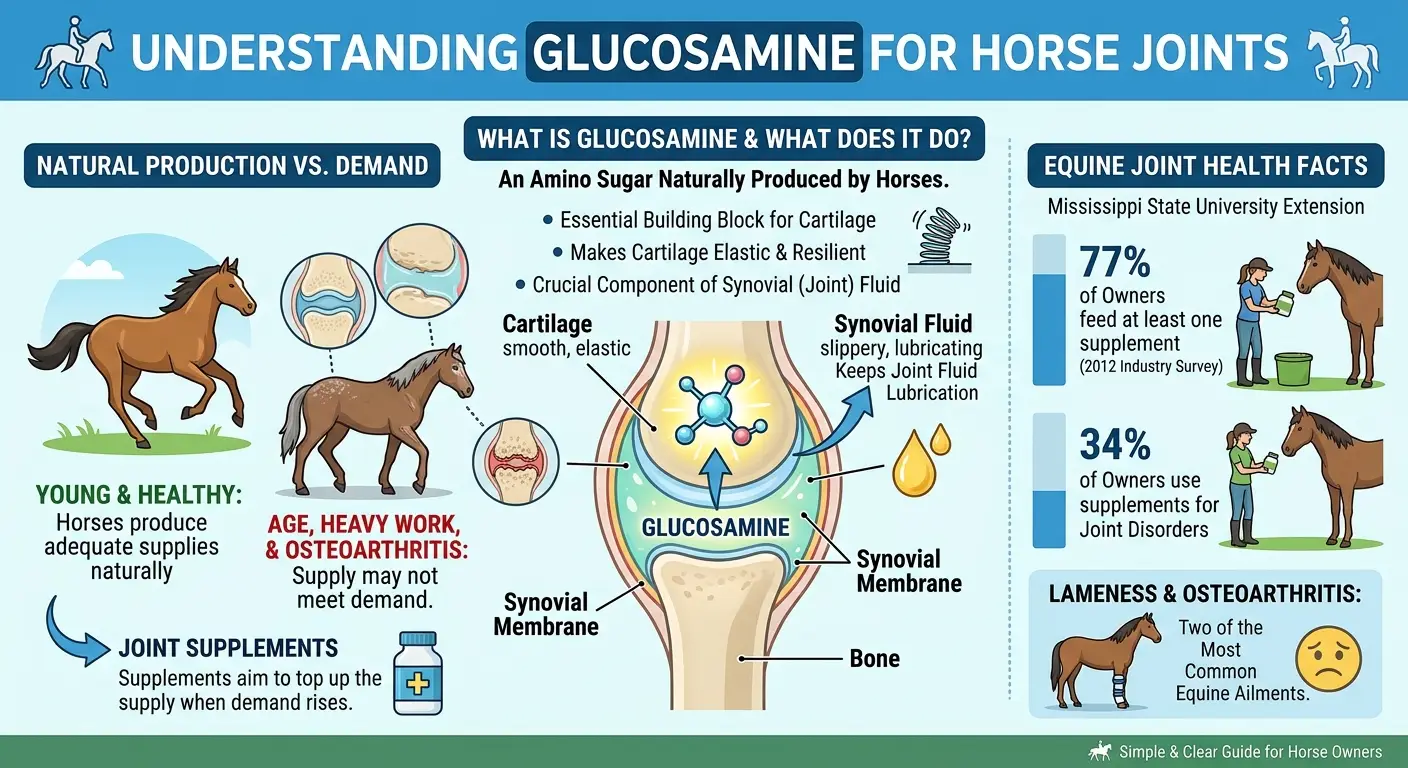
Glucosamine is an amino sugar that horses make naturally. It is a building block for cartilage and synovial (joint) fluid, helping form the molecules that keep cartilage elastic and joint fluid slippery. Supplements aim to top up that supply when demand rises.
Horses produce enough when they are young and healthy. Age, heavy work, and existing osteoarthritis can change that picture, which is why joint supplements are so popular.
A 2012 industry survey cited by Mississippi State University Extension found 77% of owners fed at least one supplement, and 34% used them for joint disorders. Mississippi State University Extension also notes that lameness and osteoarthritis are two of the most common equine ailments.
Where Do Glucosamine Dose Recommendations Come From?
Doses come from a mix of pharmacokinetic studies, clinical trials, and manufacturer labels. They overlap, but not perfectly. The chart below shows how far apart they can be.
How published glucosamine doses compare
Daily glucosamine in grams. Each bar spans the low and high figure in that source.
Sources: Oke et al. (2006) as summarised by Mississippi State University Extension; EQUUS; nuvallo; Equine America product label. The gold bar marks the loading phase.
The Montréal research used 20 mg/kg a day, about 10 g for a 500 kg horse. Texas A&M researchers fed young horses for 84 days before a joint challenge.
Kentucky Equine Research summarises that dose as roughly 10 g given twice daily to horses near 400 kg, though other write-ups describe it a little differently. Treat it as an experimental dose in yearlings, not a home recipe.
Meanwhile, one lab survey found that only five of 23 products recommended a daily amount near 10 g. The average recommendation was about half of that.
Loading Dose vs Maintenance Dose for Horses
What is a glucosamine loading dose?
A loading dose is a higher daily amount used at the start to build up levels faster. EQUUS describes 10,000 mg a day for working horses and during the first week or two of treatment. Nuvallo cites 15 to 20 g a day in acute phases or at the start, then a step down after 2 to 4 weeks.
What is a maintenance dose?
A maintenance dose is the lower, steady amount that follows. For weight-based plans, that is 10 to 20 mg/kg a day. On one UK label for a 500 kg horse, the maker lists 12 g of glucosamine HCl for the first 10 days, then half that afterward.
How long should you feed it?
Give it a fair trial. Experts suggest at least 8 to 12 weeks before judging the result, and cartilage-level changes may take 3 to 6 months. Keep a simple diary of stiffness, stride, and willingness to work.
What to expect when you start glucosamine
Timelines vary by source and by horse. Use them as a guide, not a promise.
Loading phase
Many plans start at the higher end for about 2–4 weeks. Some owners report an early change at 10–14 days.
Step down to maintenance
Drop to the lower daily dose and keep it steady. Consistency matters more than extra scoops.
Fair-trial review
Experts suggest at least 8–12 weeks before deciding if it helps. Track movement, stiffness, and work quality.
Long game
Changes tied to cartilage can take 3–6 months, if they show up at all. Review with your vet.
Sources: EQUUS (10–14 days, loading period); nuvallo (2–4 weeks loading, 8–12 weeks trial, 3–6 months cartilage).
Glucosamine HCl vs Glucosamine Sulfate: Which Form Is Better?
Neither wins outright. Glucosamine sulfate absorbed better in one Montréal comparison (9.4% vs 6.1%), while HCl packs more glucosamine into each gram. EQUUS says both forms are effective, so focus on the real glucosamine per daily serving.
Glucosamine HCl vs glucosamine sulfate for horses
Both forms are used in horse supplements. They are not interchangeable gram for gram.
| Feature | Glucosamine HCl | Glucosamine sulfate |
|---|---|---|
| Absorption in a Montréal comparison | About 6.1% | About 9.4% |
| Pure glucosamine in the powder | Around 80–83% | Around 50–60% (2KCl form) |
| Joint fluid levels | Lower in that study | Higher in that study |
| Extra nutrient | None | Supplies sulphur |
| Used in the Texas A&M study | Yes | No |
| Practical effect | Smaller scoop for the same glucosamine | Bigger scoop needed |
Bottom line: either can work. Compare the actual glucosamine per daily serving, not the front-of-pack number. Sources: Meulyzer et al. (2008); Equine America; nuvallo; KER.
The purity gap changes your math. Equine America points out that 12,000 mg of glucosamine HCl supplies about 10,300 mg of actual glucosamine, while 12,000 mg of glucosamine sulfate supplies about 7,200 mg. Read the label carefully, and see the Montréal comparison for the absorption data.
Does Glucosamine Work for Horses? What the Research Shows
Honestly, the evidence is promising but mixed. Here is what we can say with reasonable confidence, and what we cannot.
Why absorption is the main hurdle
Only about 5 to 10% of an oral dose reaches the bloodstream, and less reaches the joint. The good news is that inflamed joints took up roughly four times more glucosamine than healthy ones in Montréal work, so the supply may concentrate where it is needed.
Why oral glucosamine is hard to dose
What happens to a dose from the bucket to the joint. Not to scale.
Sources: Laverty et al. (2005); Meulyzer et al. (2008, 2009) from Université de Montréal; Mississippi State University Extension.
Evidence in favor
In the Texas A&M study of 14 young horses, glucosamine for 84 days was followed by lower inflammation markers (PGE2) and a drop in a cartilage-breakdown marker. A cartilage-building marker rose. The researchers concluded it may reduce joint inflammation and influence cartilage turnover in young horses.
Evidence against, and the caveats
Mississippi State University Extension is more cautious. One study found about 5% bioavailability and concluded that blood and joint levels were too low to change joint cell activity. A 2014 study in aged horses found no stride-length improvement, and gains seen in both groups were credited to more exercise.
Many positive studies lacked a placebo group, used unblinded evaluators, or were company sponsored. A large human trial, the GAIT study, also found no significant long-term pain difference between supplement and placebo groups. The honest summary: it may help some horses, and it is not a cure.
Oral glucosamine for horses: pros and cons
An honest summary of what the evidence supports.
Pros
- Supplies a building block for cartilage and joint fluid
- Lowered inflammation markers in one study of young horses
- Easy to add to a daily feed routine
- Works alongside veterinary joint care
Cons
- Only about 5–10% is absorbed
- Clinical results are mixed across studies
- Quality and label accuracy vary by product
- Needs weeks of steady feeding to judge
Glucosamine Combined With Other Joint Ingredients
Most products pair glucosamine with chondroitin, MSM, or hyaluronic acid. EQUUS notes that ingredients can work at lower levels in combination, but its advice is still to look for a full glucosamine dose plus a realistic chondroitin amount.
The table lists the doses sources cite for each ingredient fed alone.
Other joint ingredients and the doses sources cite
Daily amounts when each ingredient is fed alone. Evidence quality differs by ingredient.
| Ingredient | Dose cited | What to know |
|---|---|---|
| Chondroitin sulfate | 1,250–5,000 mg | EQUUS says glucosamine plus chondroitin tends to beat either alone. |
| Hyaluronic acid (HA) | About 100 mg | Some horses respond to as little as 20 mg inside a combination product. |
| MSM | 20,000 mg in one hock study | Many products contain far less. Check competition rules, as MSM is a threshold substance in some racing rules. |
| Avocado and soy unsaponifiables | At least 1,200 mg | Slow acting. May protect cartilage rather than ease pain. |
| Hydrolyzed collagen | Up to 40,000 mg | High doses are needed, so cost adds up. |
| Manganese | 25 mg or less | Most diets already supply plenty. More is not better. |
Source: EQUUS Horse Joint Supplements Guide (adapted from EquiSearch, updated 2019). It is more optimistic than recent university reviews, so treat these as reference points, not guarantees.
Some blended formulas also add omega-3 fatty acids. If you are building a plan yourself, our camelina oil dosage for horses guide covers plant-based omega-3 dosing. Avoid stacking several products that each contain glucosamine, since the amounts add up.
Is Glucosamine Safe for Horses? Side Effects and Cautions
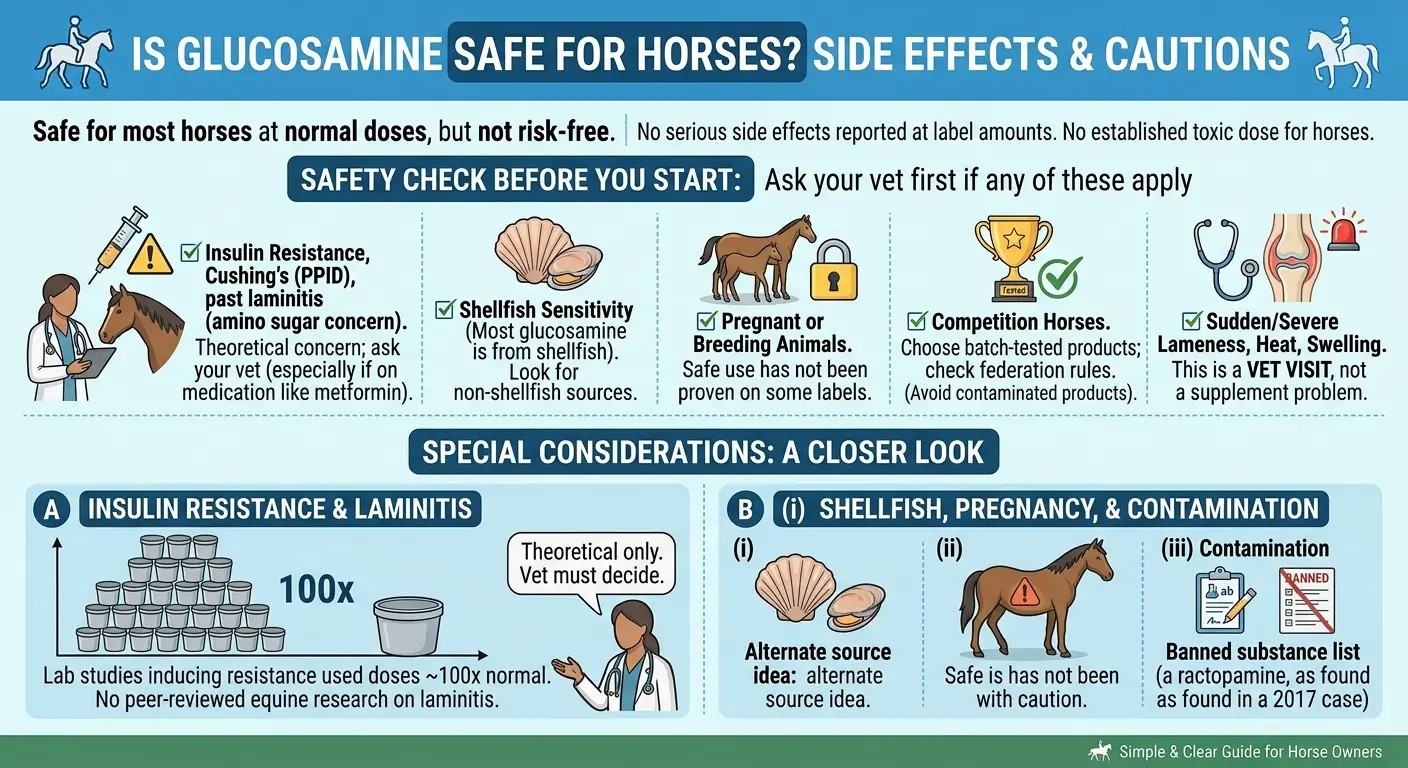
Safe for most horses at normal doses, but not risk-free. We found no established toxic dose for horses, and no serious side effects reported at label amounts in the sources reviewed. The real risks are allergy, special health conditions, and poor product quality.
Safety check before you start
Ask your vet first if any of these apply.
- Insulin resistance, Cushing’s (PPID), or past laminitis. Glucosamine is an amino sugar, and a theoretical concern exists. We found no peer-reviewed horse data showing harm, but let your vet decide.
- Shellfish sensitivity. Most glucosamine comes from shellfish shells. Look for a non-shellfish source if this is a concern.
- Pregnant or breeding animals. Some labels state that safe use has not been proven.
- Competition horses. Contaminated supplements have caused positive drug tests. Choose batch-tested products and check current federation rules.
- Sudden or severe lameness, heat, or swelling. That is a vet visit, not a supplement problem.
Insulin resistance and laminitis
Because glucosamine is an amino sugar, owners worry about insulin resistance. An EQUUS veterinary column explained that lab studies inducing insulin resistance used doses about 100 times normal, and found no peer-reviewed horse research on glucosamine and laminitis.
Even so, ask your vet first, especially if your horse takes medication such as metformin (see our metformin dosage for horses guide).
Shellfish, pregnancy and contamination
Most glucosamine is made from shellfish shells, though non-shellfish forms exist. Some labels state that use in pregnant or breeding animals has not been proven.
Supplements can also be contaminated, and Mississippi State University Extension lists real cases, including a 2017 incident where horses tested positive after eating a supplement with unlisted ractopamine.
Which Horses May Benefit Most From Glucosamine?
- Older horses with stiffness or diagnosed osteoarthritis.
- Athletic horses in regular, demanding work.
- Young performance horses. Kentucky Equine Research points to the potential of starting before joint trauma.
- Horses recovering from injury, as part of a plan your vet approves.
Common Glucosamine Dosing Mistakes
- Judging results after two weeks instead of 8 to 12.
- Reading the powder weight as the glucosamine weight.
- Treating HCl and sulfate as equal, gram for gram.
- Using several joint products that each contain glucosamine.
- Letting the horse sort the powder out and leave it in the bucket.
- Skipping a lameness exam because a supplement is “handling it.”
How to Get Your Horse to Eat the Full Dose
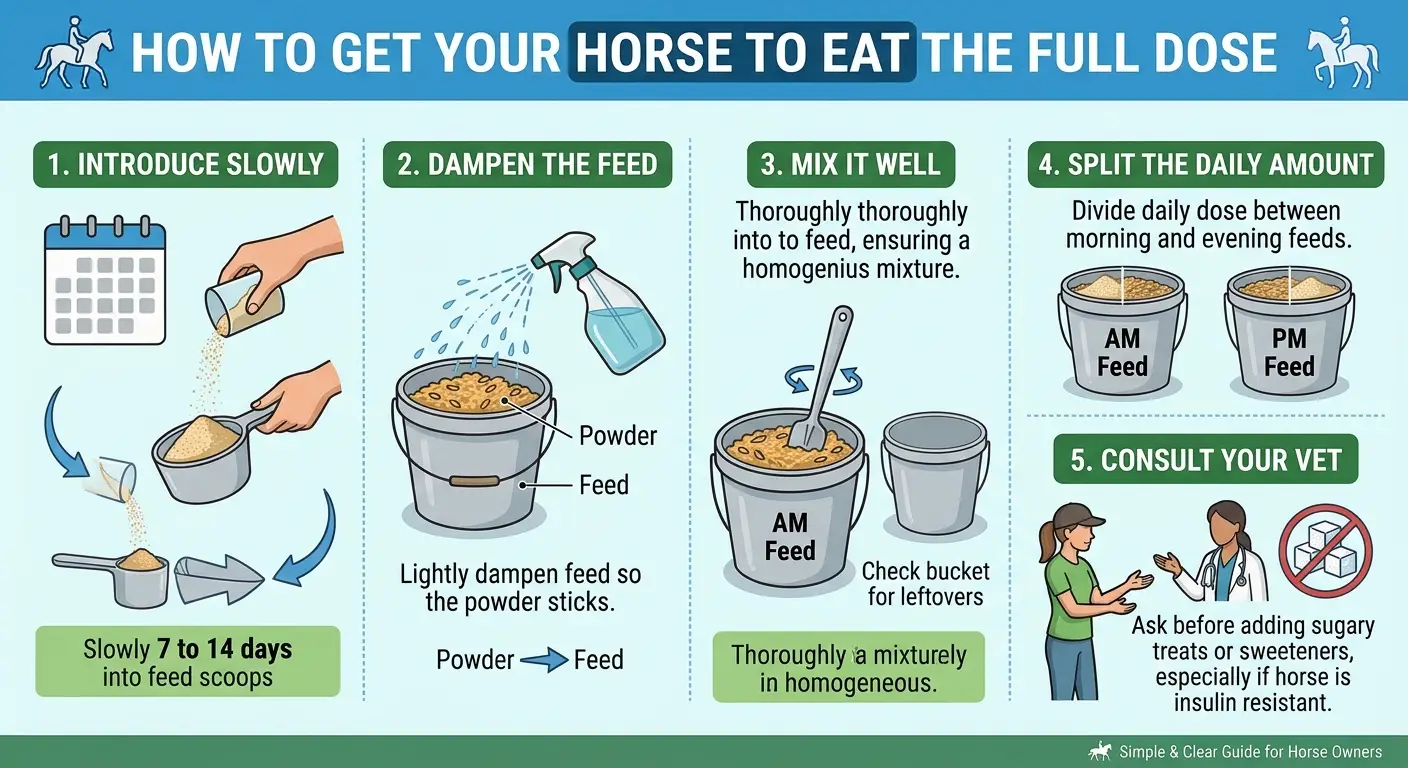
A dose only counts if it is eaten. Powders can be dusty, change the feel of the feed, and get sorted out by picky eaters. Try these steps:
- Introduce the supplement slowly over 7 to 14 days.
- Dampen the feed lightly so the powder sticks.
- Mix it well, and check the bucket for leftovers each time.
- Split the daily amount between morning and evening feeds.
- Ask your vet before adding sugary treats or sweeteners if your horse is insulin resistant.
Glucosamine vs Prescription Joint Treatments
Glucosamine is a slow, supportive supplement. Prescription options work differently and are chosen by your vet. For example, see our Adequan dosage for horses, Equioxx dosage for horses (also covered in our firocoxib dosage for horses guide), and bute dosage for horses pages, or our devil’s claw dosage for horses guide for a herbal option.
Glucosamine compared with other joint options
A plain-language overview. Your vet chooses what fits your horse.
| Option | What it is | Regulation | Typical role |
|---|---|---|---|
| Oral glucosamine | Dietary supplement, cartilage building block | No FDA approval needed to sell | Slow-building daily support |
| Adequan | Injectable joint product given under veterinary direction | FDA-approved veterinary drug | Vet-led joint management |
| Equioxx (firocoxib) | NSAID for osteoarthritis pain | FDA-approved veterinary drug | Pain and inflammation control |
| Bute | NSAID painkiller | Veterinary drug | Short-term pain relief under vet guidance |
| Devil’s claw | Herbal anti-inflammatory | Supplement, check competition rules | Add-on for stiffness |
When to Call Your Vet Before Dosing
Call first if your horse is lame, metabolic, pregnant, or a competition horse. A lame horse needs a diagnosis, since joint pain is only one possible cause.
Should you call the vet before dosing?
Work down the list from the top.
Final Checklist: Dosing Glucosamine Safely
- Weigh your horse and calculate 10 to 20 mg/kg a day.
- Choose a product with a clear glucosamine amount, a named maker, and lot tracking.
- Compare HCl and sulfate using actual glucosamine, not powder weight.
- Start with the standard dose, or a short loading phase only with vet approval.
- Feed steadily for 8 to 12 weeks and keep notes.
- Review with your vet, then continue, adjust, or stop.
Your next step is simple: pull out the label on your current supplement and run its numbers through the calculator above. If it comes up short, that is worth a conversation with your vet.
FAQs
How much glucosamine should I give my horse daily?
Most sources suggest 10 to 20 mg of glucosamine per kilogram of body weight per day. That is 5 to 10 grams for a 500 kg (1,100 lb) horse. EQUUS cites 6,000 to 10,000 mg a day, with the higher end for working horses. Check how much glucosamine your product actually supplies per serving.
What is the glucosamine dosage for a 1,000 lb horse?
A 1,000 lb horse weighs about 454 kg. At 10 to 20 mg per kg, that is roughly 4.5 to 9 grams of glucosamine a day. EQUUS recommends 6,000 to 10,000 mg daily, and the higher end is usually used for horses in work. A vet can fine-tune the number.
What is a loading dose of glucosamine for horses?
A loading dose is a higher daily amount given for the first one to four weeks, then reduced to a maintenance dose. Sources describe about 10 g a day for an average horse in the first week or two, and up to 15 to 20 g a day for larger horses in short phases. Ask your vet before loading.
How long does glucosamine take to work in horses?
Some owners notice a change in 10 to 14 days, but most experts suggest a fair trial of at least 8 to 12 weeks. Cartilage-related changes may take 3 to 6 months, if they appear. Keep the dose steady and note stiffness, stride, and work quality weekly.
Is glucosamine HCl or sulfate better for horses?
Both are used. In a Montréal comparison, sulfate showed higher absorption (about 9.4% vs 6.1%), while HCl is more concentrated, at about 80 to 83% glucosamine versus roughly 50 to 60% for the sulfate 2KCl form. Compare actual glucosamine per daily serving, not the form name alone.
Can you give a horse too much glucosamine?
We found no established toxic dose for horses in the sources reviewed, and most guidance tops out near 20 g a day. A veterinary column on SmartPak’s site mentions safety studies of one commercial product at up to five times its maintenance dose for 84 days with no adverse effects. That finding is product-specific, so stay within the label and ask your vet.
Can I give my horse human glucosamine?
The compound is the same, but horse supplements are far more concentrated, so a human product may mean many capsules a day. Human products can also contain additives your horse does not need. Check the glucosamine per capsule, the form, and any extras, and talk to your vet first.
Can horses with insulin resistance take glucosamine?
Possibly, but ask your vet first. Glucosamine is an amino sugar, and a theoretical link to insulin resistance exists. An EQUUS veterinary column found no peer-reviewed horse research on glucosamine and laminitis. If your horse is on metformin or a strict low-sugar plan, your vet should approve any new supplement.
Can glucosamine cause side effects in horses?
The sources reviewed did not report serious side effects at normal doses. Possible concerns include allergy in shellfish-sensitive animals, a theoretical issue for insulin-resistant horses, and contaminated or mislabeled products. Stop the supplement and call your vet if you see hives, swelling, colic signs, or a worsening limp.
Does glucosamine actually work for horses?
The evidence is mixed. A Texas A&M study in 14 young horses found lower inflammation markers and higher cartilage-building markers after 84 days. Other studies found no clear benefit, and only about 5 to 10% of an oral dose is absorbed. It may help some horses, but it is not a proven cure.
Should I give glucosamine and chondroitin together?
EQUUS reports that combinations of glucosamine and chondroitin tend to work better than either alone, with chondroitin at 1,250 to 5,000 mg a day. Many products include chondroitin at lower amounts, so check the label. A combination does not remove the need for a full glucosamine dose.
Can young horses take glucosamine?
Research has used it in yearlings, and Kentucky Equine Research notes interest in protecting young athletes’ joints before injury. Dose is still weight-based and should be guided by your vet, since growing horses have special nutritional needs. Do not use it to cover up lameness or a developmental problem.
Is glucosamine allowed in horse competition?
We did not find glucosamine listed as banned in the sources reviewed. The bigger risk is contamination: Mississippi State University Extension describes a 2017 case where unlisted ractopamine in a supplement caused positive tests. Choose batch-tested products and check your federation’s current rules.
Should I split the daily dose or give it once?
The Texas A&M study, as summarized by KER, gave glucosamine twice daily. We found no head-to-head data showing once a day is worse. Splitting the dose into morning and evening feeds can also help ensure your horse eats it all. Whichever you choose, keep it steady.
How do I know if a glucosamine supplement is good quality?
Use the ACCLAIM check: a recognizable name, clinical experience, full contents, realistic label claims, clear administration directions, identification such as a lot number, and manufacturer details. A 2006 lab study found over half of 23 products had less glucosamine than claimed, so quality matters.
Do ponies and miniature horses need a different glucosamine dose?
The weight-based range is the same: 10 to 20 mg per kg. A 200 kg pony would need about 2 to 4 grams a day, and a 100 kg miniature about 1 to 2 grams. Always use an accurate weight tape or scale, and check product labels written for full-size horses.
How long should a horse stay on glucosamine?
There is no published maximum duration in the sources reviewed. Many owners feed it long term for aging or working horses. Review progress at 8 to 12 weeks with your vet, and stop or change the plan if you see no clear benefit.
What is the difference between glucosamine and Adequan?
Glucosamine is a feed supplement, while Adequan is an injectable veterinary drug given under a vet’s direction. They are different products with different regulation. Your vet may use them separately or together, depending on your horse’s joint problem.
Sources and Further Reading
- Mississippi State University Extension: Equine Joint Supplementation, Does It Really Work?
- Kentucky Equine Research: Equine Joint Supplements, Merits of Glucosamine
- EQUUS: Horse Joint Supplements Guide
- Leatherwood et al. (2016), Journal of Animal Science: oral glucosamine in young horses
- Meulyzer et al. (2008), Osteoarthritis and Cartilage: glucosamine sulfate vs hydrochloride
- Meulyzer et al. (2009): joint inflammation and glucosamine levels
- Laverty et al. (2005), Arthritis and Rheumatism: synovial fluid levels of oral glucosamine
- Oke et al. (2006), Equine Veterinary Journal: glucosamine in commercial equine supplements
- Clegg et al. (2006), New England Journal of Medicine: GAIT trial
- Nuvallo: glucosamine dosage and feeding overview
- NPC Health: glucosamine supplement research summary
- Equine America: label example for a glucosamine HCl powder
Disclaimer: This article is for general education only. It is not veterinary advice, and doses should be confirmed with a licensed veterinarian who knows your horse.