Red Cell Dosage for Horses: Label-Based Chart, Free Calculator and the Iron Safety Rules Most Owners Never Hear
Written & Reviewed By: Medshorse Team
Last Updated: October 2026
If you’ve ever stood in the feed room with the purple Red Cell jug in one hand and a dosing syringe in the other, you’ve asked the question every owner asks: how much should I actually give? The short answer is on the label.
Red Cell dosage for horses is 2 fluid ounces (60 mL) a day for horses in training and 1 fluid ounce (30 mL) a day for horses not in training.
That’s the easy part. The harder question, and the one most dosage pages skip, is whether your horse needs extra iron in the first place. Most horses already take in several times their daily iron requirement from hay and feed.
This guide gives you the label dose, a chart, a calculator and the iron math, so you can decide with your vet instead of guessing.
How this guide was built: the dose and ingredients come from the Horse Health Products label as published on Drugs.com. We compared it with the Farnam Europe, FS Animal Health and Vet Products Online listings, then checked iron limits against NRC 2007 figures. Where evidence is thin, we say so. Label details were reviewed in October 2026.
Disclaimer: This article is for general education and is not veterinary advice. Product names mentioned, including Red Cell Dosage, belong to their respective owners, and MedsHorse is not affiliated with them. Always follow your veterinarian’s instructions and the current product label.
Red Cell Dosage for Horses: The Quick Answer
Feed 2 fl oz (60 mL) daily to a horse in training and 1 fl oz (30 mL) daily to a horse not in training, either mixed into the feed ration or given orally with a dosing syringe. The label does not change the dose for body weight, age or breed.
- Horses in training: 2 fl oz (60 mL) a day.
- Horses not in training: 1 fl oz (30 mL) a day.
- Not weight-based. The label gives one dose per workload level, not per pound.
- Iron per ounce: 300 mg. Two ounces deliver 600 mg.
- Most diets already supply 2,000+ mg of iron a day, against an NRC requirement of about 400 mg for a 1,100 lb horse.
- Selenium cap: total supplemental selenium should not exceed 0.3 ppm of the complete ration.
- No maximum duration on the label. Agree a review date with your vet before you start.
What Is Red Cell for Horses?
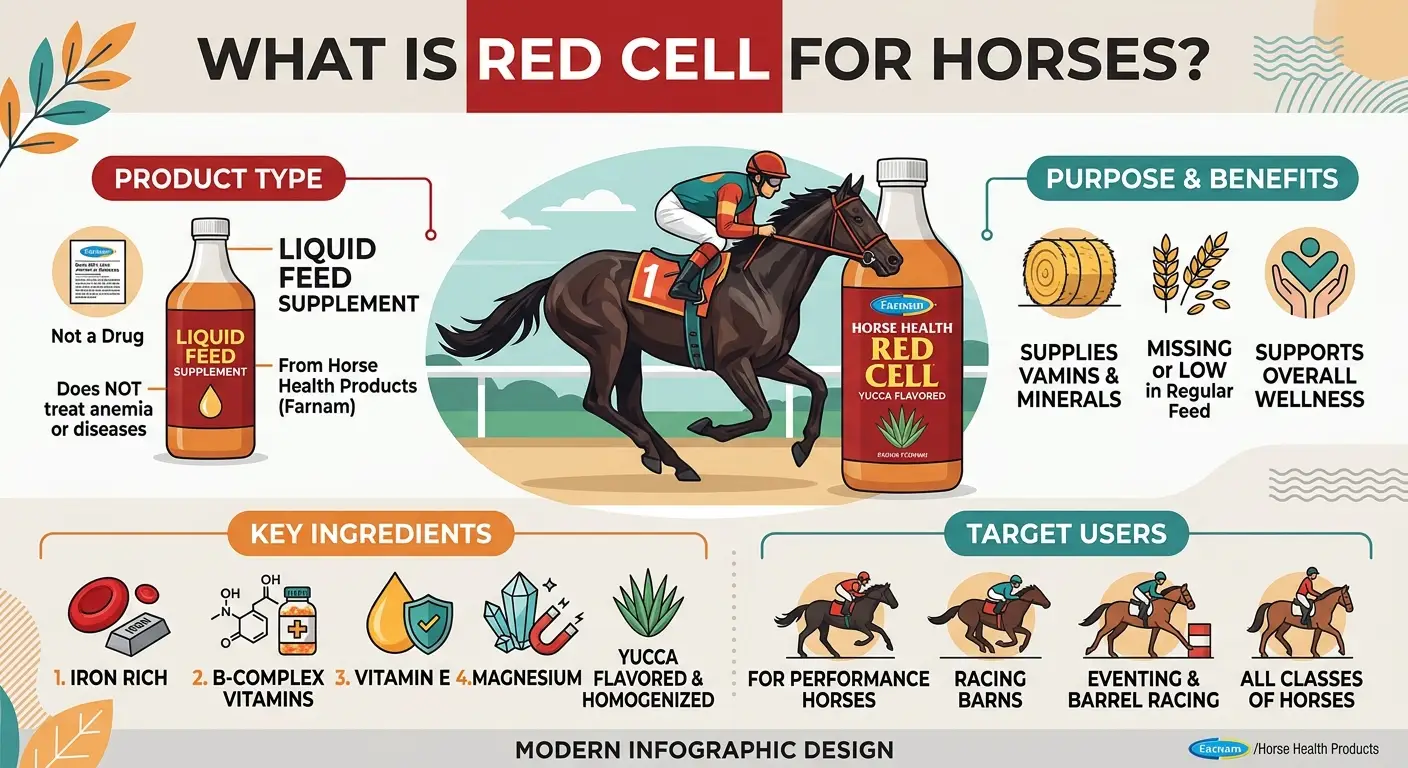
Red Cell is a liquid vitamin-iron-mineral feed supplement from Horse Health Products, a division of Farnam. The label describes it as yucca flavored, iron rich and homogenized, with B-complex vitamins, vitamin E and magnesium.
It is made to supply vitamins and minerals that may be missing or low in a horse’s regular feed, and it is labeled for all classes of horses.
It is a feed supplement, not a drug. The label makes no claim to treat anemia or any disease. Its maker markets it as an industry standard for performance horses, which explains why you see it in racing, eventing and barrel-racing barns.
Red Cell Dosage Chart for Horses
This chart translates the US label into milliliters, tablespoons, iron per dose and how long each bottle lasts.
Give once daily, mixed into the feed ration or squirted into the mouth with a dosing syringe. Shake well first. Days per bottle are simple division of bottle volume by daily dose.
How Many mL and Tablespoons Is a Red Cell Dose?
| Label dose | Milliliters | Tablespoons | Teaspoons | Iron |
|---|---|---|---|---|
| 1 fl oz (not in training) | 30 mL | 2 tbsp | 6 tsp | 300 mg |
| 2 fl oz (in training) | 60 mL | 4 tbsp | 12 tsp | 600 mg |
What Counts as “In Training”?
The label doesn’t define it. Most owners read it as a horse in regular, structured work, such as racing, competition prep or consistent hard riding. A trail horse that works lightly on weekends sits in a gray area. If you aren’t sure which dose fits, ask your vet rather than defaulting to the higher one.
Does Weight Change the Red Cell Dose?
No, and that matters. A 500 lb pony and a 1,500 lb warmblood get the same label dose, so the iron load per pound is very different. The chart below compares each dose with the NRC maintenance iron figure for different body weights.
| Horse weight | NRC maintenance iron (0.8 mg per kg body weight) | 1 fl oz (300 mg) as % of that | 2 fl oz (600 mg) as % of that |
|---|---|---|---|
| 500 lb (227 kg) Small pony | 181 mg | 165% | 331% |
| 700 lb (318 kg) Pony or cob | 254 mg | 118% | 236% |
| 900 lb (408 kg) Light horse | 327 mg | 92% | 184% |
| 1,100 lb (499 kg) Average horse | 399 mg | 75% | 150% |
| 1,300 lb (590 kg) Warmblood | 472 mg | 64% | 127% |
| 1,500 lb (680 kg) Large warmblood or light draft | 544 mg | 55% | 110% |
NRC 2007 sets maintenance at 40 mg iron per kg of dry matter, roughly 0.8 mg per kg of body weight for a horse eating about 2% of its weight daily. These percentages show the iron added by Red Cell on top of what hay, feed and water already supply.
Red Cell Dosage Calculator for Horses
Enter your horse’s weight, workload, bottle size and the iron level in your hay. The calculator shows the label dose, the iron it adds, an estimated total against the maximum tolerable level, the selenium share and how many days the bottle lasts.
Red Cell® Dosage Calculator for Horses
Daily dose and total supplement needed, based on training status.
Choose a training status and press Calculate Dose to see the recommended amount.
How to feed: mix into the daily feed ration or give orally with a dose syringe. Shake well before using.
Important: intake of supplemental selenium should not exceed 0.3 ppm on a complete ration basis. Store in a cool, dry place, keep from freezing, and close the container after each use.
© medshorse.com
How to Give Red Cell to a Horse
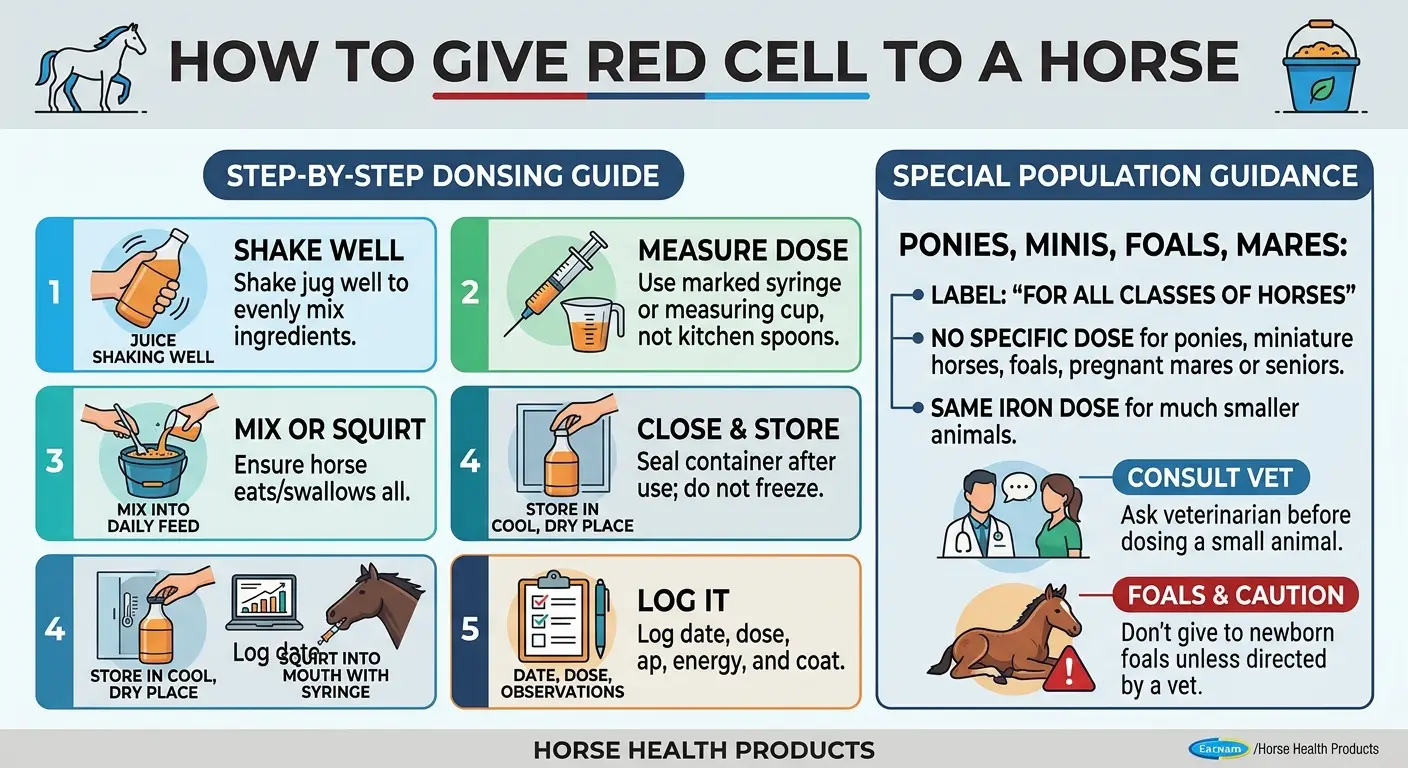
- Shake the jug well. The label says to shake before using, so the ingredients stay evenly mixed.
- Measure the dose. Use a marked dosing syringe or measuring cup. Kitchen spoons vary too much.
- Mix it into the daily feed or squirt it into the mouth with the syringe. Make sure the horse eats or swallows all of it.
- Close the container after every use and store it in a cool, dry place. Don’t let it freeze.
- Log it. Write down the date, dose and any change in appetite, energy or coat so you and your vet can review the plan.
Ponies, Minis, Foals and Mares
The label gives no special dose for ponies, miniature horses, foals, pregnant mares or seniors. It simply says it is for all classes of horses. Since a pony eats far less than a horse but would still receive the same 300 or 600 mg of iron, ask your vet before dosing a small animal.
Foals need extra caution. Veterinary reports describe serious iron toxicity in newborn foals after oral iron products. Don’t give Red Cell to a newborn foal unless your vet directs it.
What Is Inside Red Cell? Ingredients and Guaranteed Analysis
Iron is the headline, but Red Cell is a broad vitamin and mineral blend. The US ingredient statement lists ferric ammonium citrate as the iron source, along with choline chloride, magnesium sulfate, potassium chloride, B-vitamins, vitamin E, zinc, manganese, selenium, kelp extract and yucca schidigera extract.
Double every figure for the 2 fl oz in-training dose. The label also lists a small amount of calcium (6 to 10 mg per ounce). Formulas differ by country, so always read the panel on your own bottle.
Check your own bottle. Formulas aren’t identical worldwide. The Farnam Europe panel lists copper (36 mg), cobalt (2 mg) and 25,000 IU of vitamin A per 30 mL, and its ingredient list names ferric sulfate.
The US label lists vitamin A at 7,000 IU per ounce and no copper in its guaranteed analysis. European labels also warn against feeding it to copper-sensitive animals such as sheep.
A few overlaps are worth knowing. If you already feed a separate magnesium product, review our magnesium dosage for horses guide so you don’t double up. Red Cell holds just 0.02 mg of biotin per ounce, so for hoof support see our biotin dosage for horses guide.
And because the label lists kelp extract and potassium iodide, check our kelp dosage for horses guide if you feed kelp too.
When Red Cell May Make Sense
- Your vet confirms low iron stores or anemia with bloodwork and includes Red Cell in the plan.
- A diet analysis shows a genuine gap, for example a horse on very little forage and unfortified feed.
- Your vet or an equine nutritionist recommends a broad vitamin and mineral boost for a hard-working horse after reviewing the whole diet.
Who Should Skip Red Cell?
- Horses with known iron overload, liver disease, insulin resistance or PPID unless the vet approves it.
- Newborn foals and any horse where the vet has not confirmed a need.
- Horses eating iron-rich hay or drinking high-iron well water.
- Horses already on other iron, selenium or vitamin A, D or E products, until the totals are added up.
- Sheep and other copper-sensitive animals, as noted on European labels.
Yes: follow your vet’s plan. Red Cell may or may not be the right tool. Ask about dose and duration.
No or not sure: go to Step 2.
Yes: do not start Red Cell without your vet’s approval.
No: go to Step 3.
No: test first. Many diets already exceed the requirement several times over.
Yes: go to Step 4.
Yes: use the label dose for your horse’s workload, set a review date, and log results.
No: you probably do not need extra iron. Revisit if the picture changes.
If your horse is insulin resistant, talk with your vet about the whole plan. Our metformin dosage for horses guide explains one medication used in these cases, and the iron question belongs in the same conversation.
Red Cell Side Effects and Risks
Iron Overload
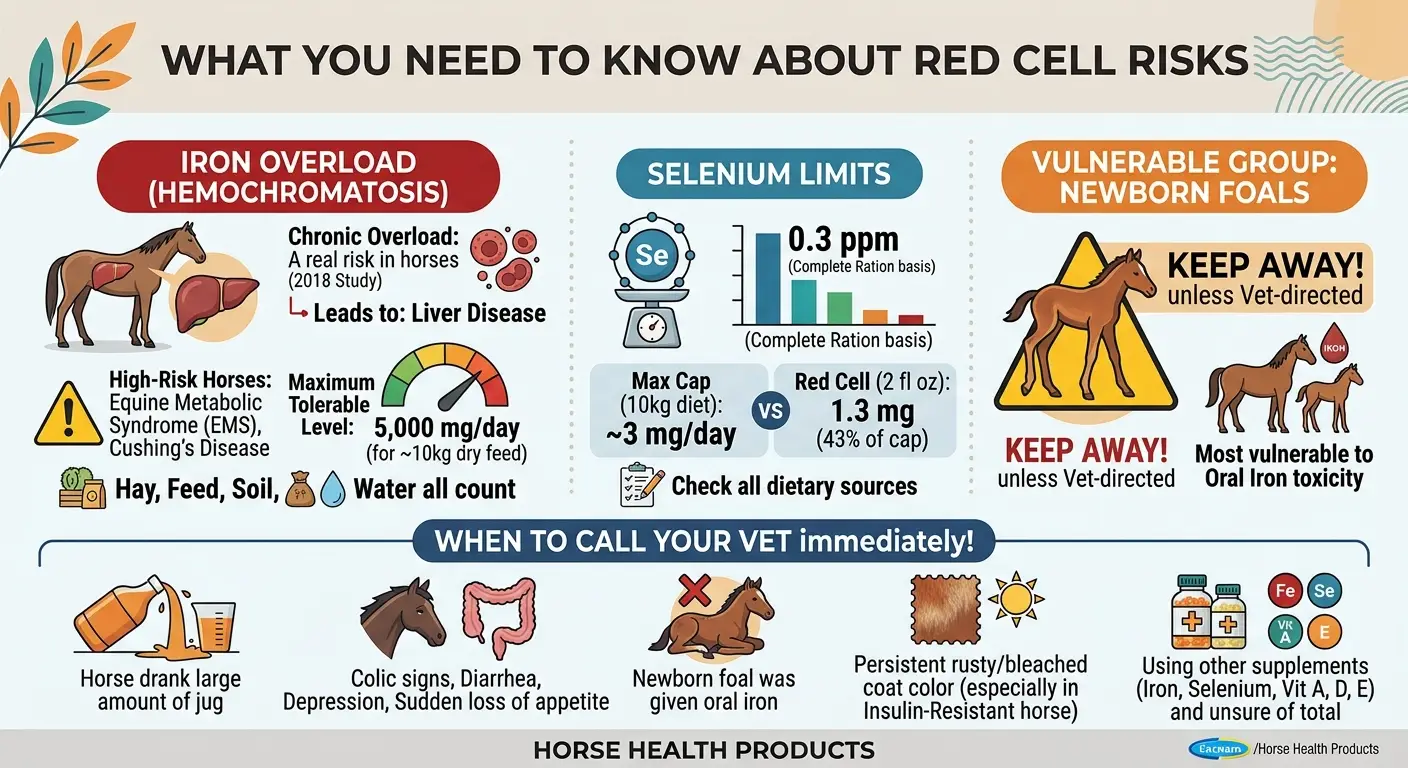
Chronic iron overload (hemochromatosis) is real in horses. A 2018 study by Theelen and colleagues in Equine Veterinary Journal described chronic iron overload with liver disease in 21 horses and one donkey.
Mad Barn also notes that overload is commonly found in horses with equine metabolic syndrome and Cushing’s disease and may worsen those conditions. Whether iron causes the metabolic problems is still debated, so treat it as a reason for caution, not a proven link.
The maximum tolerable level is about 500 mg of iron per kg of total dry matter, or roughly 5,000 mg a day for a horse eating 10 kg. Hay, feed, soil and water all count toward that number.
Selenium Limits
The label warns that supplemental selenium should not exceed 0.3 ppm on a complete ration basis. One fluid ounce carries 0.65 mg of selenium. For a horse eating 10 kg of dry matter, 0.3 ppm works out to about 3 mg a day, so 2 fl oz of Red Cell uses about 43% of that cap before you count anything else in the diet.
Newborn Foals
Newborn foals are the most vulnerable group for oral iron. Keep Red Cell away from them unless a vet specifically instructs otherwise.
- Your horse drinks a large amount of the jug by accident.
- Colic signs, diarrhea, depression or sudden loss of appetite after starting Red Cell.
- A newborn foal has been given any oral iron product.
- Persistent rusty or bleached coat, mane or tail color, especially in an insulin-resistant horse.
- Your horse is on other iron, selenium or vitamin A, D or E products and you are unsure of the total.
How Long Can You Feed Red Cell?
The label sets no maximum duration. That leaves the decision with you and your vet. Before you start, get a baseline: ask about a complete blood count and an iron panel, and test your hay.
Agree on a review date, then recheck. If bloodwork shows normal iron and your hay is already iron rich, stopping is a reasonable outcome.
Pair the check-in with your yearly wellness visit. Our guide to the core horse vaccines is a handy reminder of when that visit usually happens.
Red Cell vs. Other Options
| Option | What it is | Best for | Watch-outs |
|---|---|---|---|
| Red Cell | Liquid iron, B-vitamin and mineral supplement | Horses where a vet or nutritionist wants an iron and vitamin boost | Adds iron most diets already cover; one dose for all sizes |
| Vitamin and mineral ration balancer | Low-intake pelleted feed that fills forage gaps | Easy keepers and horses on hay-only diets | Check iron and selenium so totals don’t stack |
| B-complex supplement without iron | Vitamins with no added iron | Horses where iron isn’t needed but B-vitamins are | Ask whether B-vitamins are truly lacking |
| Vet-directed iron therapy | Treatment based on diagnosed deficiency | Confirmed iron deficiency or anemia | Needs a diagnosis and monitoring |
- Simple label dose with two workload levels
- Liquid form mixes into feed or goes in by syringe
- Combines iron, B-vitamins, vitamin E, magnesium and trace minerals
- Yucca flavor helps acceptance
- Widely available in 32 oz, 1 gallon and 5 gallon sizes
- Adds iron most horses do not need
- One dose for every size of horse
- No maximum duration or foal dose on the label
- Overlaps with fortified feeds, balancers and other supplements
- We found no independent controlled trials on Red Cell itself
Common Red Cell Mistakes
- Dosing by weight. The label doesn’t scale by weight, and guessing a pony dose isn’t safe.
- Ignoring hay and water iron. Test them before adding more.
- Stacking products. Iron, selenium and vitamins A, D and E all add up across the diet.
- Skipping the shake. The label says to shake well before use.
- Treating a dull coat as anemia. Many conditions look alike. Only bloodwork tells you.
- Never reviewing. A supplement started “for a few weeks” can quietly run for years.
Expert Tips for Using Red Cell Safely
- Test your hay and ask your water source for an iron reading.
- Ask your vet for a baseline iron panel before you start and a recheck afterward.
- Use a marked dosing syringe so every dose is exact.
- Keep a one-page log with the date, dose, other supplements and any change in your horse.
- If you compete, check your governing body’s rules and keep the label and batch number.
FAQs
How much Red Cell should I give my horse per day?
The label says 2 fluid ounces (60 mL) a day for horses in training and 1 fluid ounce (30 mL) a day for horses not in training. Mix it into the daily feed or give it by mouth with a dosing syringe.
Is Red Cell dosage based on horse weight?
No. The label gives one dose for horses in training and one for horses not in training, with no adjustment for body weight. That is why it is worth asking your vet whether the dose suits a very small or very large horse.
How many mL and tablespoons is a Red Cell dose?
One fluid ounce is about 30 mL, or 2 tablespoons, or 6 teaspoons. Two fluid ounces is about 60 mL, 4 tablespoons or 12 teaspoons. A marked dosing syringe is more accurate than kitchen spoons.
How long does a bottle of Red Cell last?
At the 2 fl oz in-training dose, a 32 fl oz bottle lasts 16 days and a 1 gallon jug lasts 64 days. At the 1 fl oz not-in-training dose, those figures double to 32 days and 128 days.
Can I give Red Cell to a pony or miniature horse?
The label says it is for all classes of horses but gives no separate pony or miniature dose. Because the same amount of iron is a much bigger load for a small body, ask your vet before feeding it to a pony or miniature.
Can foals take Red Cell?
The label gives no foal dose. Veterinary reports describe serious iron toxicity in newborn foals after oral iron products, so do not give Red Cell to a newborn foal unless your vet tells you to.
Can pregnant or lactating mares have Red Cell?
The label lists all classes of horses, and NRC iron needs are a little higher for lactating mares at 50 mg per kg of diet dry matter. Even so, most mares already get well above that from forage, so confirm the need with your vet first.
Does Red Cell improve performance or boost red blood cells?
Iron is needed to make hemoglobin, but healthy horses usually eat far more iron than they require. We found no independent controlled trials showing that Red Cell improves performance. Suspected anemia needs bloodwork, not guesswork.
How long can a horse stay on Red Cell?
The label sets no maximum length of use. Set a review date with your vet before you start, recheck bloodwork, and stop if your horse does not need it.
Can Red Cell cause iron overload in horses?
It can contribute if the diet already supplies plenty of iron. Chronic iron overload with liver disease has been reported in horses. The maximum tolerable level is about 500 mg of iron per kg of dry matter, and hay, feed and water all count toward it.
Is Red Cell safe for insulin-resistant or Cushing’s horses?
Talk to your vet first. Iron overload is often found in horses with equine metabolic syndrome and PPID, though research has not shown that dietary iron causes insulin resistance. Because the picture is unsettled, many vets prefer to avoid added iron in these horses.
Can I give Red Cell with other supplements?
Yes, but add up the totals. Check iron, selenium and vitamins A, D and E across your feed, balancer and every supplement. Total supplemental selenium should not exceed 0.3 ppm of the complete ration.
What are the signs of too much iron in horses?
Chronic overload may show as a bleached or rusty coat, mane and tail, and it is linked to liver problems and metabolic disease. Acute problems after a large accidental intake need an immediate vet call. Bloodwork confirms iron status.
Is Red Cell allowed in horse competition?
Red Cell is a feed supplement, but one retailer warns that supplements for sport horses can conflict with national equestrian rules. Check your governing body before competing and keep the label and batch number.
How should I store Red Cell?
Keep it in a cool, dry place, shake it well before each use, protect it from freezing and close the container after every dose. European labels add that it should not be fed to copper-sensitive animals such as sheep.
Final Thoughts and Next Steps
Red Cell is simple to dose: 2 fl oz (60 mL) a day in training, 1 fl oz (30 mL) a day when not in training. The real decision comes before the first scoop. Most horses already get far more iron than they need, and iron overload is a documented problem, so extra iron should answer a real gap.
Your next steps: test your hay, talk to your vet about bloodwork, run the numbers in the calculator above, and set a review date if you decide to go ahead. This guide is educational and does not replace veterinary advice.
Sources and Further Reading
- Drugs.com: Red Cell for Animal Use (Horse Health Products label)
- Farnam Europe: Red Cell product page and guaranteed analysis
- FS Animal Health: Red Cell 3.8 L
- Vet Products Online: Red Cell 1 L
- Mad Barn Feed Bank: Red Cell nutritional analysis
- Mad Barn: High iron in horses
- Animals (MDPI), 2022: Dietary iron intake survey in racehorses
- National Research Council: Nutrient Requirements of Horses, 6th revised edition (2007)
- Theelen MJP et al. (2018). Chronic iron overload causing haemochromatosis and hepatopathy in 21 horses and one donkey. Equine Veterinary Journal.
Disclaimer: This article is for general education and is not veterinary advice. Always follow the label on your own product and consult a licensed veterinarian before starting, changing or stopping any supplement.