Morphine Dosage for Horses: Dosage Chart, Calculator, Side Effects & Safety Guide
Written & Reviewed By: Medshorse Team
Last Updated: October 2026
Morphine is one of the strongest pain relievers a vet can use in a horse. It is also a drug where more is not better. Published research links doses only a few times higher than the usual range to pacing, head tossing, and a slowed gut.
This guide covers the dose ranges reported in veterinary sources, how routes differ, the risks, and what to ask your vet. It is educational only. Morphine is a controlled narcotic (Schedule II in the US) and should only be given by or under the direction of a veterinarian.
Disclaimer: For educational purposes only, not veterinary advice. Morphine is a controlled drug that only a licensed vet should give. Dose ranges come from published sources and are not a prescription. Always follow your vet’s instructions.
- Drug class: Opioid analgesic (mu-opioid agonist)
- Legal status: Controlled narcotic, vet-only (Schedule II in the US)
- IV dose in a vet anesthesia handbook: 0.1 to 0.2 mg/kg, never more than 200 mg per horse
- Listed duration (IV): up to about 2.5 hours
- Main risks: Excitement, slowed gut movement, colic
- Competition: FEI Controlled Medication. Also covered by USEF rules.
What Is Morphine for Horses?
Morphine for horses is an opioid pain medication that vets use for moderate to severe pain. It binds to opioid receptors in the nervous system to dull pain signals. Vets may use it around surgery, for joint pain, or for pain in the hind end through an epidural.
It is not a barn-aisle drug like bute or Banamine. Those are NSAIDs that target inflammation. Morphine works on the nervous system instead.
Why Horses React Differently to Morphine
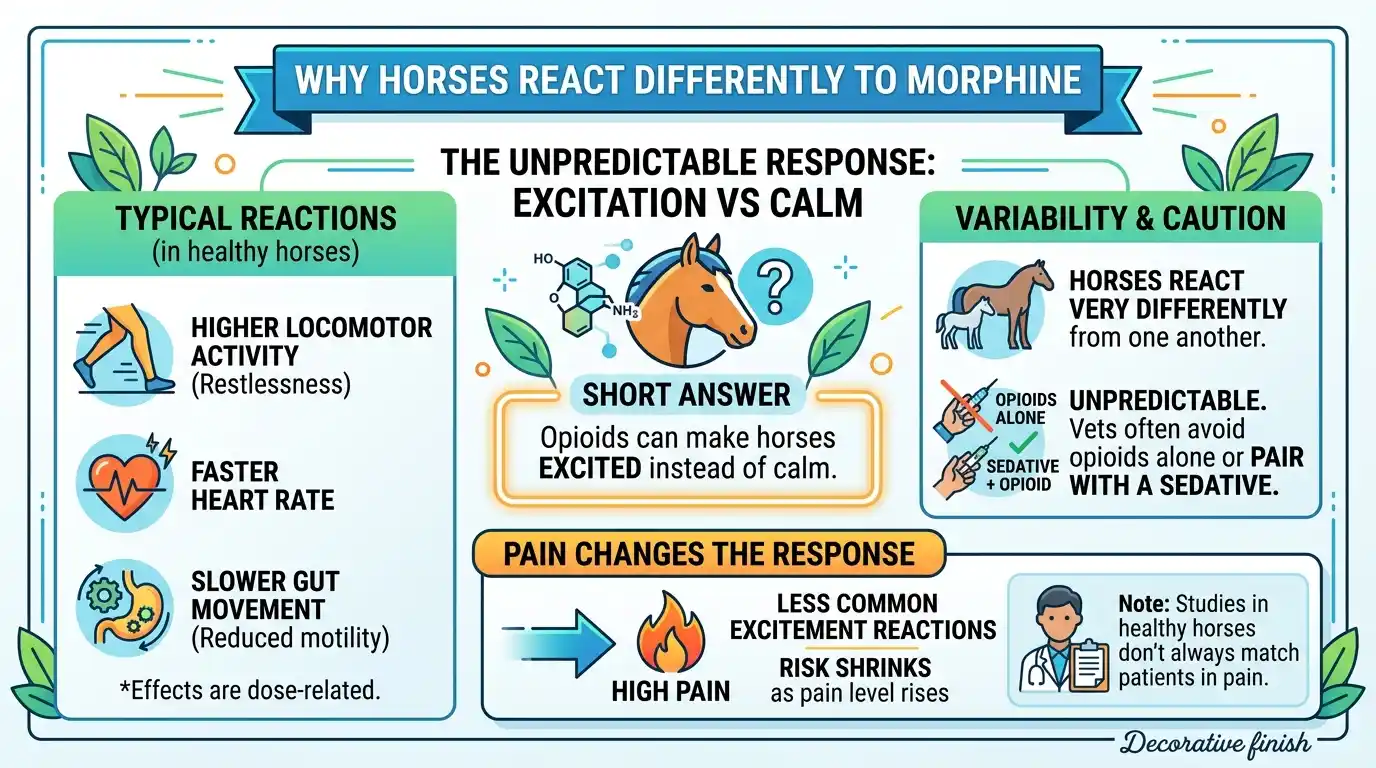
Short answer: Opioids can make horses excited instead of calm. Research on horses describes dose-related restlessness, higher locomotor activity, and a faster heart rate, along with slower gut movement.
Horses also react very differently from one another. That unpredictability is why many vets avoid opioids alone or pair them with a sedative.
Pain changes the response
A 2022 study in Animals notes that these excitement reactions appear less common in horses that are in pain than in pain-free horses. The risk seems to shrink as the level of pain rises. This is one reason doses tested in healthy research horses do not always match what happens in clinical patients.
When Do Vets Use Morphine in Horses?
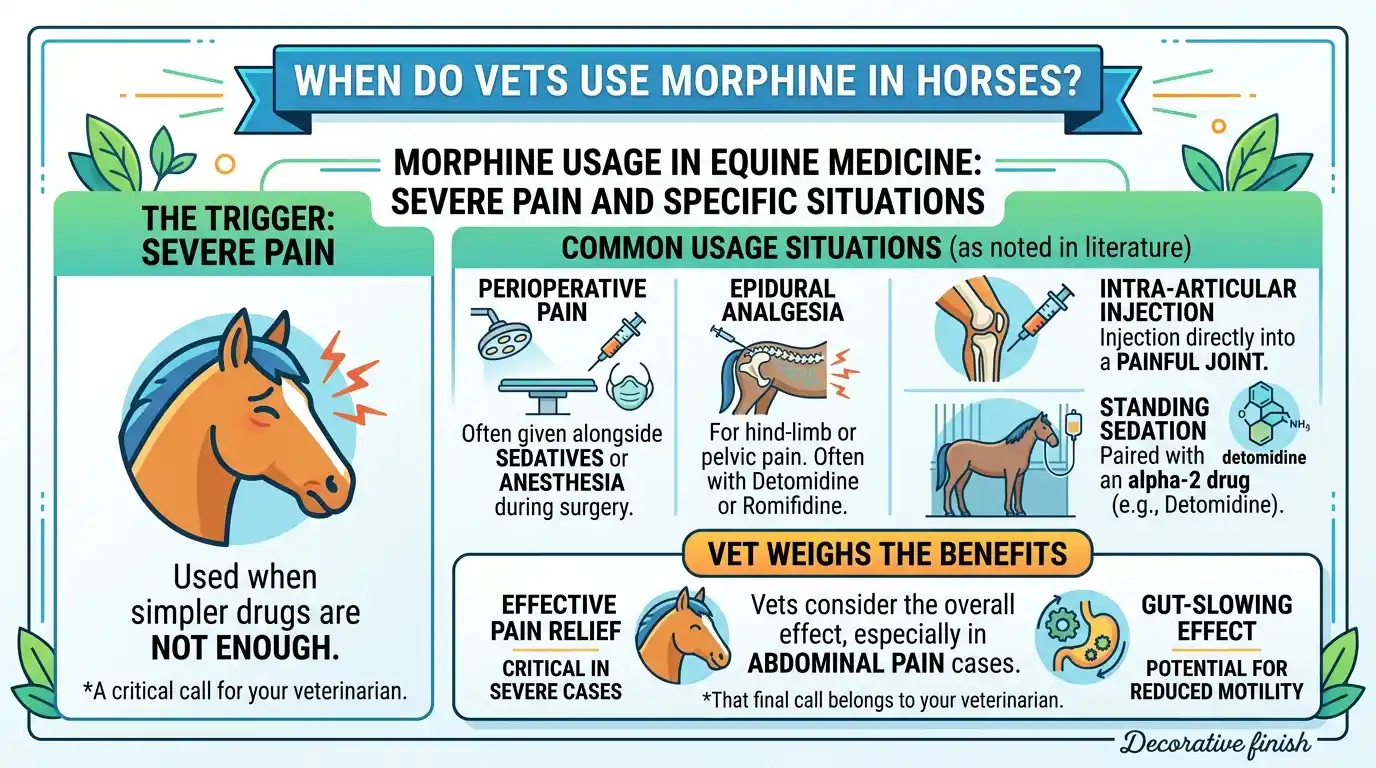
Vets use morphine when pain is severe and simpler drugs are not enough. Common situations in the literature include:
- Perioperative pain, often given along with sedatives or anesthesia.
- Epidural analgesia for hind-limb or pelvic pain, often with detomidine or romifidine.
- Intra-articular injection into a painful joint.
- Standing sedation, where morphine is paired with an alpha-2 drug such as detomidine.
For abdominal pain, vets weigh the benefits against the gut-slowing effect. That call belongs to your veterinarian.
Morphine Dosage for Horses: Published Dose Ranges by Route
Short answer: A Kansas State University anesthesia handbook lists 0.1 to 0.2 mg/kg IV for analgesia, using a 25 mg/mL solution, with a cap of 200 mg per horse. Research studies have used 0.05 to 0.2 mg/kg IV. Epidural and joint doses differ by route and study. Your vet sets the real dose.
| Route / Use | Published Dose | Source and Notes |
|---|---|---|
| IV analgesia (hospital) | 0.1 to 0.2 mg/kg, max 200 mg per horse | K-State anesthesia handbook (rev. 2021). 25 mg/mL. Up to about 2.5 hours. |
| IV, low research doses | 0.05 and 0.1 mg/kg (as morphine sulfate) | Figueiredo 2012, AJVR. Six healthy horses. Minimal, short-lived effects. No pain relief detected in that test. |
| IV, research | 0.2 mg/kg | Knych 2024, Frontiers. Agitation in 4 of 6 horses; cleared within 30 minutes. |
| IV for standing sedation | 0.1 mg/kg after acepromazine and detomidine | Potter 2015. Small pilot study (4 horses on morphine). |
| IV infusion (CRI), research | 0.05 mg/kg bolus, then 0.03 mg/kg/hour with dexmedetomidine | Delli-Rocili 2020, Veterinary Surgery abstract. Standing laparoscopy research. |
| IM, research | 0.05 and 0.1 mg/kg | Figueiredo 2012, AJVR. Gut sounds dropped for about 60 minutes at both doses. |
| Epidural | 0.1 to 0.2 mg/kg, combined with detomidine or romifidine | Natalini 2021, Rowland 2018, Goodrich 2002, Sysel 1996 (abstracts). Spread depends on fluid volume. |
| Oral, research only | 0.8 mg/kg every 12 hours | Knych 2024, Frontiers. Six healthy horses. Authors say more safety work is needed first. |
These are published figures for education, not prescriptions. Many came from small studies in healthy horses. Always follow your veterinarian’s written instructions.
Check the salt form on the label
Studies report morphine as sulfate, hydrochloride, or base, and the amounts are not identical. The 2012 AJVR study notes that morphine sulfate is about 75.2% morphine, so “0.1 mg/kg morphine sulfate” delivered about 0.075 mg/kg of morphine itself. Always confirm which form and concentration your vet is using.
What the epidural and joint data really show
Epidural studies used morphine with an alpha-2 sedative-analgesic, not morphine alone. A 2023 study also found that the volume of fluid injected changes how far the pain relief spreads. For joints, studies used induced inflammation in healthy horses, so results may not match a horse with naturally occurring arthritis.
Oral morphine is still experimental
In the 2024 Frontiers study, oral dosing gave similar pain-threshold effects to IV with less excitement. Bioavailability was only about 36%, one horse showed mild colic signs, and the authors state that more study is needed before clinical use.
Morphine Dosage Chart for Horses by Weight
Short answer: At the handbook concentration of 25 mg/mL, a 500 kg horse at 0.1 mg/kg works out to 50 mg, or 2.0 mL. At 0.2 mg/kg it is 100 mg, or 4.0 mL. This is arithmetic only. It is not a dosing instruction.
| Horse Weight | 0.05 mg/kg (low research dose) | 0.1 mg/kg | 0.2 mg/kg (top of handbook range) |
|---|---|---|---|
| 300 kg (660 lb) | 15 mg (0.6 mL) | 30 mg (1.2 mL) | 60 mg (2.4 mL) |
| 400 kg (880 lb) | 20 mg (0.8 mL) | 40 mg (1.6 mL) | 80 mg (3.2 mL) |
| 450 kg (990 lb) | 22.5 mg (0.9 mL) | 45 mg (1.8 mL) | 90 mg (3.6 mL) |
| 500 kg (1,100 lb) | 25 mg (1.0 mL) | 50 mg (2.0 mL) | 100 mg (4.0 mL) |
| 550 kg (1,210 lb) | 27.5 mg (1.1 mL) | 55 mg (2.2 mL) | 110 mg (4.4 mL) |
| 600 kg (1,320 lb) | 30 mg (1.2 mL) | 60 mg (2.4 mL) | 120 mg (4.8 mL) |
Volumes assume 25 mg/mL. At 10 mg/mL, multiply each volume by 2.5. At 20 mg/mL, multiply by 1.25. Handbook cap: 200 mg per horse.
Morphine Dose Calculator for Horses
Use this tool only to double-check the math on a dose your vet has already prescribed. It does not recommend a dose.
Morphine Dosage Calculator for Horses
Enter the horse’s weight and dose level to calculate the amount to draw up.
Duration of effect: up to 2.5 hours. Not to exceed 200 mg in any horse. This tool is for veterinary reference only. Always confirm doses with a licensed veterinarian.
© medshorse.com
Why Higher Doses Are Dangerous
Short answer: The gap between a useful dose and a problem dose is not huge. Research describes more locomotor activity above about 0.3 mg/kg IV, and colic signs and collapse at much higher doses.
These are research findings, not target doses. Never use them to guess a dose.
Side Effects of Morphine in Horses
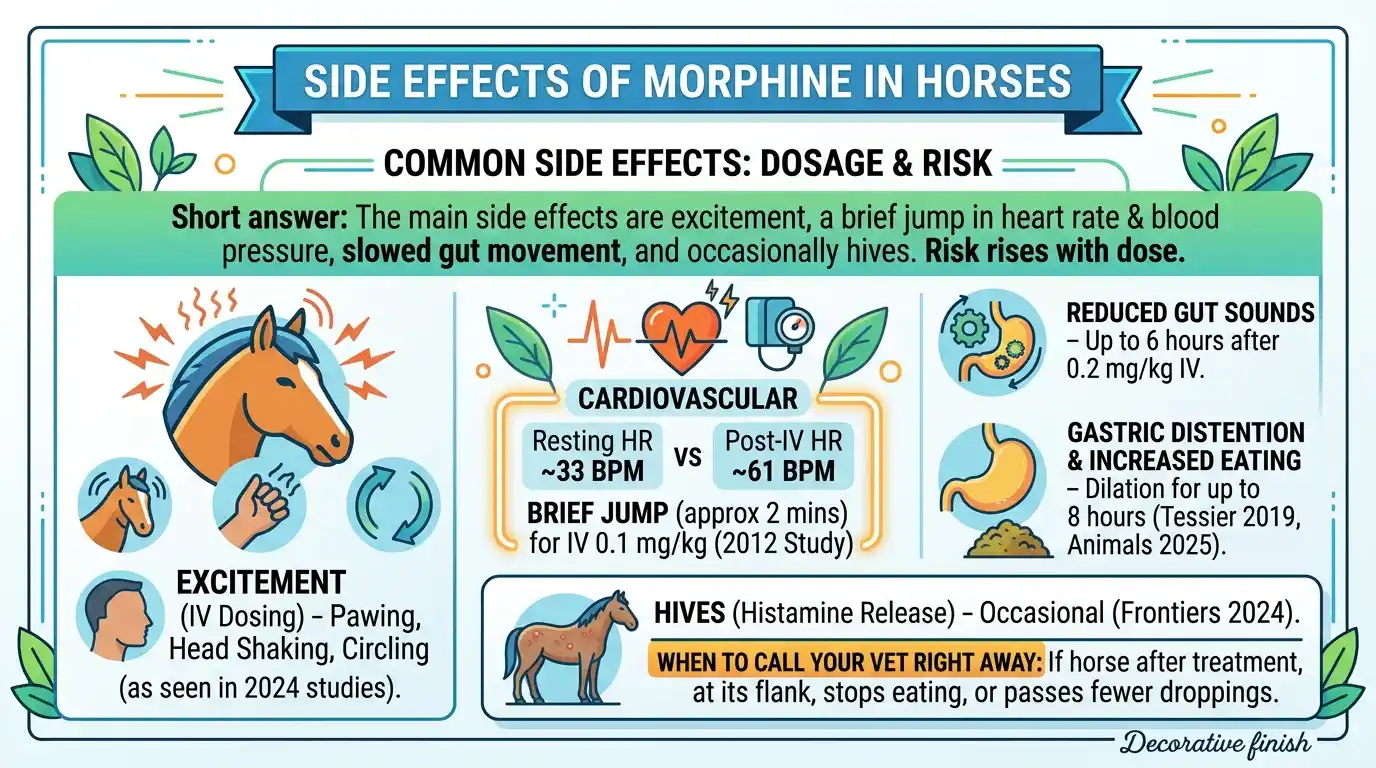
Short answer: The main side effects are excitement, a brief jump in heart rate and blood pressure, slowed gut movement, and occasionally hives. Risk rises with dose.
- Excitement: Head shaking, pawing, and circling after IV dosing in several horses in the 2024 study.
- Cardiovascular spike: In the 2012 study, heart rate rose from about 33 to about 61 beats per minute for around two minutes after IV dosing at 0.1 mg/kg.
- Slowed gut sounds: Reduced for up to 6 hours after 0.2 mg/kg IV in one study.
- Gastric distention and increased eating: Reported in healthy horses given systemic morphine (Tessier 2019). A 2025 study in Animals also found stomach dilation lasting up to eight hours in horses given morphine without surgery.
- Hives: One horse developed hives, likely from histamine release (Frontiers 2024).
Call your vet right away if your horse paws, rolls, looks at its flank, stops eating, or passes fewer droppings after treatment.
Does Morphine Cause Colic in Horses?
Short answer: It can raise the risk because it slows the gut, but the evidence is mixed. Some large retrospective studies found no increase at lower doses, while one found about a four-fold higher colic risk.
The 2012 AJVR paper summarizes the split. A study of horses given 0.1 to 0.17 mg/kg IV found no extra gut discomfort. A large study at 0.1 to 0.15 mg/kg IV found no higher post-anesthesia colic risk. But a study of orthopedic surgery patients given 0.08 to 0.3 mg/kg IV found a four-fold higher colic risk than horses given no opioid. A 2024 retrospective review describes earlier findings as inconclusive.
For your horse, the practical point is simple. Watch manure output and appetite closely after any opioid.
Is Morphine Safe for Horses?
When a veterinarian picks the dose, route, and monitoring, morphine can be an effective tool. It is not safe as a do-it-yourself drug. Wrong dose, wrong route, and slowed gut function are real dangers.
Extra caution applies to horses with a history of colic or impaction. Tell your vet about every drug your horse has had, including acepromazine and sedatives like Dormosedan or Rompun.
Can You Combine Morphine With a Sedative?
Short answer: Yes. Vets often pair morphine with a sedative to reduce excitement. Acepromazine and alpha-2 drugs like detomidine are the combinations that appear most in the studies.
The 2022 Animals study found that adding acepromazine (0.02 mg/kg) to morphine (0.2 mg/kg) reduced gait changes seen with acepromazine alone and limited locomotor effects. An older horse study found that acepromazine and naloxone blocked or lessened movement caused by morphine.
One trade-off: alpha-2 drugs sedate more but can add unsteadiness. The 2022 authors suggest acepromazine may be a better match for horses that are already ataxic. Your vet weighs that choice.
Morphine vs Other Pain Relief for Horses
| Drug | Class | Verified Detail |
|---|---|---|
| Morphine | Opioid | 0.1 to 0.2 mg/kg IV, up to about 2.5 hours (K-State) |
| Butorphanol | Opioid | 0.01 to 0.05 mg/kg IV, about 30 to 40 minutes (K-State) |
| Methadone | Opioid | 0.05 to 0.1 mg/kg IV, similar to morphine, up to about 4 hours (K-State) |
| Bute | NSAID | Targets inflammation. See the Bute guide for dosing. |
| Banamine | NSAID | Targets inflammation and visceral pain. See the Banamine guide. |
| Methocarbamol | Muscle relaxant | Eases muscle spasm. See the Methocarbamol guide. |
Can You Compete a Horse After Morphine?
Short answer: Not without careful planning. Morphine is a Controlled Medication on the FEI list and falls under USEF drug rules. I could not find a universal clearance time, so none is given here.
The FEI moved morphine from Banned to Controlled Medication in 2013. It still counts as a prohibited substance in competition. Morphine can also occur naturally. FEI cases have involved morphine traced to feed or hay, and poppy seeds in feed are a known source.
Ask your vet for timing based on the dose, route, and your governing body’s current rules. Check the official FEI and USEF lists before every event.
Common Mistakes to Avoid
- Assuming an opioid means calm. In horses it can mean the opposite.
- Using a human or small-animal dose. The K-State small-animal and horse tables differ.
- Ignoring the salt form (sulfate, hydrochloride, base) on the label.
- Adding other pain drugs without asking your vet.
- Overlooking low manure output after treatment.
- Forgetting competition rules and natural sources of morphine in feed.
Questions to Ask Your Vet
- Why morphine instead of an NSAID, butorphanol, or methadone?
- Which route and dose will you use, and in which salt form?
- Will my horse get a sedative with it?
- How should I track manure, appetite, and heart rate afterward?
- What is the competition timing guidance for my governing body?
Key Takeaways
- Morphine for horses is a vet-only controlled opioid for moderate to severe pain.
- A vet handbook lists 0.1 to 0.2 mg/kg IV, with a 200 mg cap per horse.
- Epidural and joint doses come from small studies and differ by route.
- Excitement and slowed gut movement are the main risks.
- Watch manure and appetite closely after treatment.
- It is a Controlled Medication under FEI rules, so check your rules.
FAQs
Can you give a horse morphine?
Yes, but only under veterinary direction. Morphine is a controlled narcotic (Schedule II in the US), and horses need careful dosing and monitoring because of excitement and gut slowdown.
How much morphine can you give a horse?
A veterinary anesthesia handbook lists 0.1 to 0.2 mg/kg IV with a cap of 200 mg per horse, and research studies have used 0.05 to 0.2 mg/kg IV. Your vet sets the actual dose for your horse.
What is the epidural dose of morphine for horses?
Published studies have used about 0.1 to 0.2 mg/kg, usually combined with detomidine or romifidine and given by a vet near the spinal cord. How far the pain relief spreads depends on the fluid volume used.
Why does morphine excite horses?
Opioids can cause dose-related excitement in horses, such as pacing, head shaking, and a faster heart rate. It appears less likely in horses that are in pain, and vets often add a sedative such as acepromazine.
Does morphine cause colic in horses?
It can raise the risk because it slows gut movement. Studies are mixed: some found no increase at lower doses and one found about a four-fold higher risk. Watch manure output and appetite after treatment.
How long does morphine last in horses?
A veterinary handbook lists up to about 2.5 hours of effect after an IV dose of 0.1 to 0.2 mg/kg. In one research study, gut sounds stayed reduced for up to 6 hours after 0.2 mg/kg IV.
Can morphine be injected into a horse’s joint?
Yes. Vets have studied intra-articular morphine for joint pain, with doses of 0.05 mg/kg, 40 mg, and 120 mg reported in different experimental studies. A vet must give it using sterile technique.
Can horses take morphine by mouth?
Only in research so far. One study gave 0.8 mg/kg by mouth every 12 hours to six healthy horses with less excitement than IV dosing, but the authors say more safety work is needed before clinical use.
What is the difference between morphine and butorphanol in horses?
Both are opioids. A vet handbook lists butorphanol at 0.01 to 0.05 mg/kg IV for about 30 to 40 minutes, while morphine is listed at 0.1 to 0.2 mg/kg IV for up to about 2.5 hours.
Is morphine allowed in horse competition?
Morphine is a Controlled Medication on the FEI list and is covered by USEF drug rules. It can also occur naturally in feed or hay, so check current rules and ask your vet about timing.
What signs should I watch for after my horse gets morphine?
Watch for pacing, head shaking, sweating, hives, fewer droppings, poor appetite, and colic signs such as pawing or rolling. Call your vet right away if you see them.
Can morphine be reversed in horses?
Naloxone blocked or reduced opioid-driven movement in a classic horse study, and vets can use opioid antagonists in emergencies. Reversal decisions and doses belong to your veterinarian.
Conclusion
Morphine can give a horse real relief when pain is severe, but the margin for error is thin. The right route, dose, sedation plan, and aftercare make the difference between helpful and harmful.
If your horse is in pain, call your vet first. For everyday pain management, compare options like Bute, Banamine, and Methocarbamol, and always work from your vet’s plan.
Sources and Further Reading
- Kansas State University Veterinary Health Center: Anesthetic Drugs and Dosages Commonly Used in Horses (rev. 2021)
- Knych et al. 2024, Frontiers in Veterinary Science: Oral morphine in horses
- Figueiredo, Muir & Sams 2012, AJVR: Effects of morphine sulfate in conscious healthy horses
- López-Sanromán et al. 2022, Animals: Morphine with or without acepromazine in horses
- Mad Barn Equine Research Database: Morphine topic page (study abstracts for epidural, intra-articular, and CRI doses)
- FEI Equine Prohibited Substances List and Database
- USEF Guidelines and Rules for Drugs and Medications