Learn About Sweet Itch in Horses: Causes, Treatment & Prevention
If your horse is rubbing its mane and tail against every fence post, gate, and tree in the paddock every spring and summer, you’re not imagining it, and you’re not doing anything wrong. Sweet itch is one of the most common allergic skin conditions in horses, and it can turn a calm, easy-going horse into one that seems miserable for months at a time.
The good news: sweet itch is well understood, well studied, and while it can’t be cured it can usually be managed well enough that your horse is comfortable, has a full coat, and stays sound for work.
This guide walks through exactly what causes it, how to confirm that’s really what you’re dealing with, which treatments have actual evidence behind them, and how to build a prevention routine that holds up through midge season.
What Is Sweet Itch in Horses?
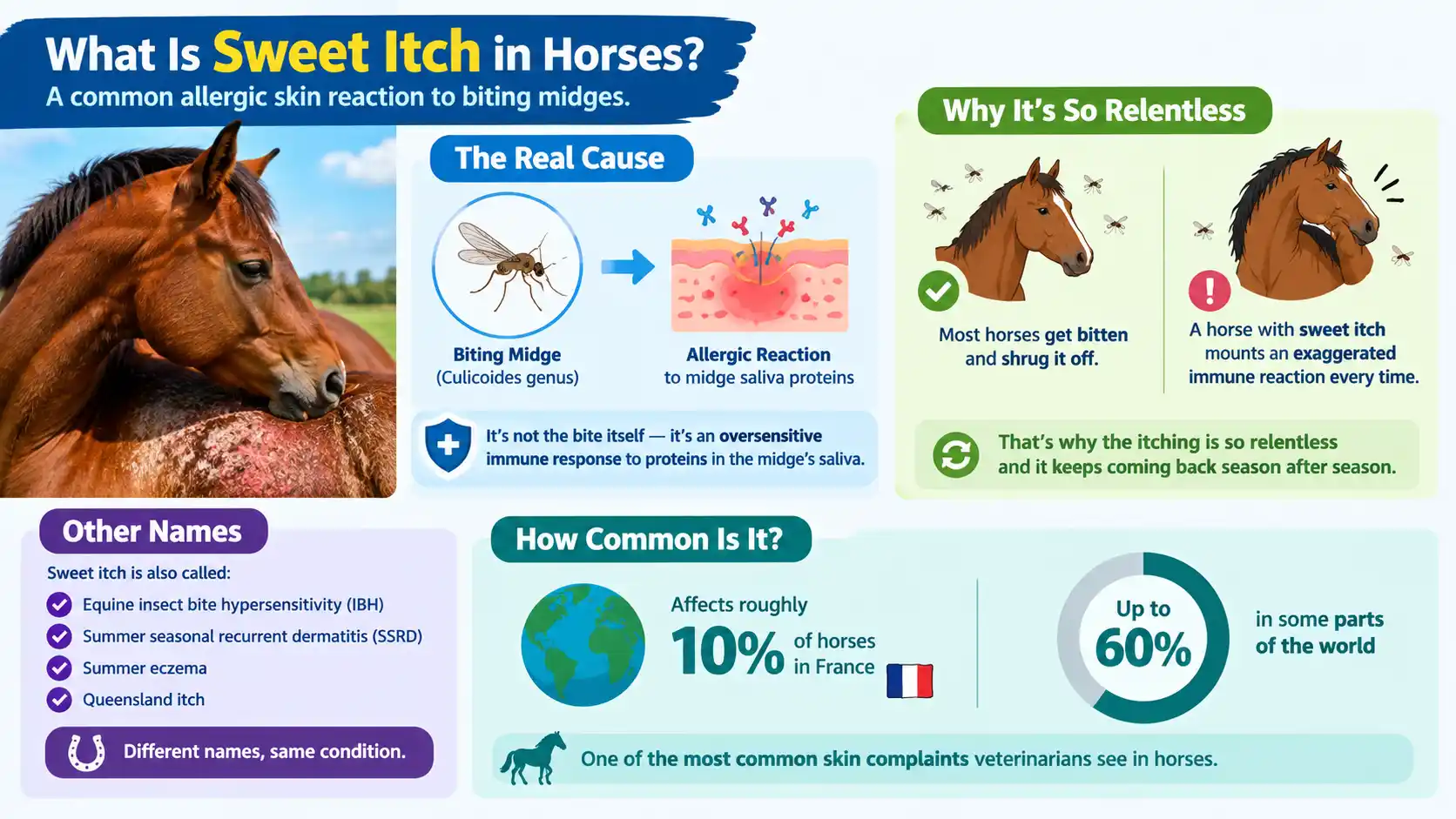
Sweet itch is an allergic skin reaction to the saliva of biting midges, most commonly from the Culicoides genus. It’s also called equine insect bite hypersensitivity (IBH), summer seasonal recurrent dermatitis (SSRD), summer eczema, or Queensland itch. Different names, same condition.
It isn’t the bite itself that causes the problem it’s an oversensitive immune response to proteins in the midge’s saliva. Most horses get bitten and shrug it off. A horse with sweet itch mounts an exaggerated immune reaction every time, which is why the itching is so relentless and why it keeps coming back season after season.
Estimates vary by region, but insect bite hypersensitivity is thought to affect roughly around 10% of horses in France, and prevalence has been reported as high as 60% in some parts of the world, making it one of the most common skin complaints veterinarians see in horses.
What Causes Sweet Itch?
1. Culicoides Midges (and Other Biting Insects)
The core trigger is hypersensitivity to Culicoides midge saliva, though horses can also react to other biting insects, including stable flies, mosquitoes, black flies, horn flies, and tabanids (horse flies).
Culicoides midges breed in standing water, mud, and wet manure or bedding, and they’re most active in warmer temperatures, which is why symptoms cluster in the warmer months.
2. An Overactive Immune Response
Horses with sweet itch actually develop two overlapping types of allergic reaction to the same bite. One is an immediate reaction (Type 1), which is why some horses develop hives, and the other is a delayed reaction (Type 4), causing itch in specific areas 24 to 48 hours after the bite many affected horses have both.
That combination is part of why the itching can seem to flare up even when you haven’t seen a single midge on your horse.
3. Genetics and Breed Predisposition
Sweet itch has a real genetic component.
Breeds such as the Belgian Warmblood, Icelandic horses, and native ponies like the Exmoor are documented at increased risk, and genome-wide studies have identified genomic regions associated with insect bite hypersensitivity in Shetland ponies, Icelandic horses, and Exmoor ponies, with confirmed polygenic (multi-gene) inheritance rather than a single “sweet itch gene.”
Interestingly, the condition is genuinely rare in Thoroughbreds, though no breed is fully exempt.
4. Early-Life Exposure
Foals born in an environment with Culicoides midges tend to build some natural tolerance.
Icelandic horses illustrate this in reverse: because the responsible midges aren’t present in Iceland, native Icelandic horses don’t develop Culicoides-associated IBH but when they’re exported to continental Europe, as many as 50% or more develop the condition within two years, since they missed that early-life exposure window entirely.
5. Environment
Culicoides need moisture to breed, so horses turned out near ponds, streams, marshy ground, or muck heaps are exposed to far more midges than horses on high, open, breezy ground.
Sweet Itch Symptoms: What to Look For
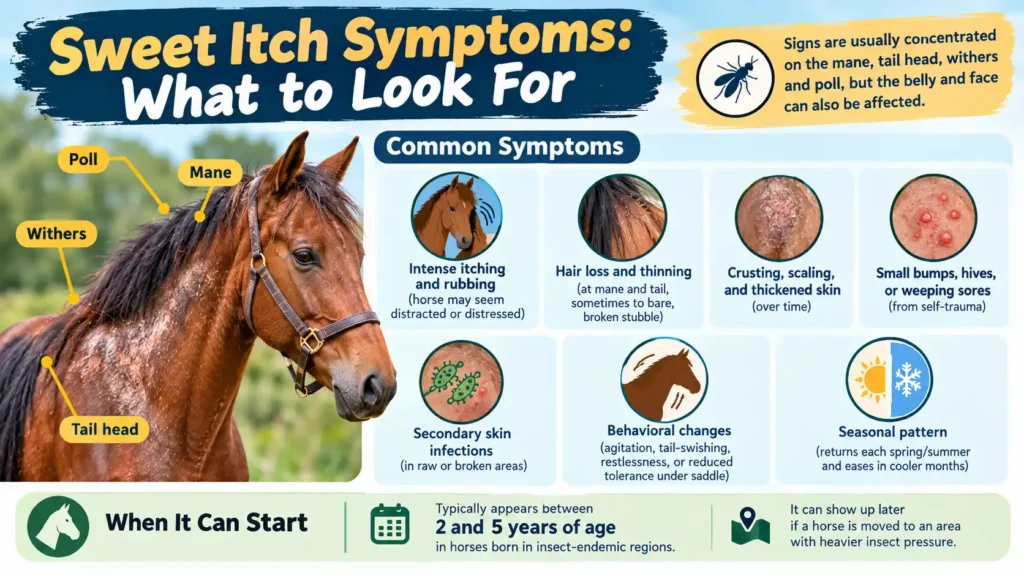
The signs are usually concentrated wherever midges prefer to feed typically the mane, tail head, withers, and poll, though the belly and face can also be affected depending on the insect species involved.
Onset typically happens in horses between 2 and 5 years of age in horses born in insect-endemic regions, though it can appear later if a horse is moved somewhere with heavier insect pressure.
Horse Sweet Itch vs. Look-Alike Conditions
Owners often confuse sweet itch with rain rot, lice, pinworms, or ringworm treating the wrong one wastes time while the real problem continues. Here’s a quick way to tell them apart:
| Condition | Pattern | Key Clue |
|---|---|---|
| Sweet itch | Mane, tail, withers; seasonal | Rubbed-out hair + relentless itching, returns yearly |
| Rain rot (dermatophilosis) | Back, rump, hindquarters | Painful crusty scabs, worse in wet weather, not itchy |
| Lice | Whole body, worse in winter coat | Visible nits/lice, dull coat, more common in poor-condition horses |
| Pinworms | Tail head only | Itching mainly at the tail base, eggs visible around anus |
| Ringworm | Circular patches, anywhere | Round, hairless lesions, can spread to other horses/humans |
If you’re not sure which one you’re dealing with, a vet exam (sometimes with a skin scrape or tape test) settles it quickly and prevents months of the wrong treatment.
How Is Sweet Itch Diagnosed in Horses?
There’s no single blood test that proves sweet itch on its own. Vets typically diagnose it based on:
Getting an accurate diagnosis matters because it determines whether immunotherapy is even a realistic option for your horse.
- Constant rubbing, broken mane/tail hair
- Raw, crusted skin at withers or tail head
- Restless, distracted under saddle
- Flare-ups every spring/summer
- Intact, regrowing mane and tail hair
- Healed, calm skin at trouble spots
- Normal temperament and focus at work
- Fewer, milder flare-ups each season
How Can Horse Sweet Itch Be Treated?
There’s no cure treatment focuses on symptom relief through preventing insect exposure, fly masks, insect repellents, and shelter during peak insect activity, alongside allergen-specific immunotherapy in some cases.
In practice, most horses do best on a layered approach: barrier prevention plus targeted medical treatment during flare-ups.
Medical Treatments
1 Corticosteroids
These are the most effective option for breaking a severe flare-up, reducing inflammation and itching quickly.
They come with real trade-offs, though corticosteroid treatment doesn’t cure the condition, only relieves the itching, and can carry serious side effects such as inducing laminitis and increased infection risk, so they’re typically reserved for short courses under veterinary supervision rather than long-term daily use.
If your vet prescribes this route, our dexamethasone dosage guide for horses breaks down typical dosing and safety considerations.
2. Antihistamines
Antihistamines are part of standard symptomatic therapy for insect bite hypersensitivity, and they work best started before the season ramps up rather than after a flare-up is already underway, since they’re better at preventing histamine-driven itching than reversing it.
Two commonly used options are covered in our cetirizine dosage guide for horses and Benadryl (diphenhydramine) dosage guide for horses always confirm dosing with your vet before starting either.
Topical treatments
Medicated shampoos, creams, and sprays containing antihistamines, corticosteroids, or soothing/antimicrobial ingredients can calm irritated skin and reduce the risk of secondary infection in already-broken skin.
1. Allergen-specific immunotherapy (“allergy shots”)
This is the closest thing to a long-term fix. After intradermal testing identifies the specific allergens involved, a custom vaccine gradually desensitizes the horse’s immune system.
It works well for Type 1 (immediate) hypersensitivity but doesn’t help with Type 4 (delayed) hypersensitivity and since most affected horses have a mix of both, results are genuinely variable. It also requires ongoing veterinary involvement and isn’t universally available.
2. Nutritional support
Omega-3 fatty acids have real research behind them: in a Guelph University study, horses fed 500 grams of flax meal daily for six weeks showed significantly reduced allergic skin reactions to Culicoides extract injections compared to controls. It’s not a fast fix omega-3 supplementation won’t provide rapid relief and works better as a season-long strategy but it’s a low-risk addition to almost any management plan.
Some owners also use calming/anti-inflammatory adjuncts; if you’re exploring options like CBD, see our CBD guide for horses for what’s currently known about safe use in horses.
Treatment Comparison at a Glance
| Treatment | Speed of Relief | Best Used For | Key Caution |
|---|---|---|---|
| Corticosteroids | Fast | Breaking a severe active flare-up | Laminitis risk with long-term use |
| Antihistamines | Moderate, preventive | Reducing itch before season starts | Less effective once flare-up is severe |
| Medicated shampoo/cream | Fast, topical only | Soothing skin, preventing infection | Doesn’t address the allergy itself |
| Immunotherapy | Slow (months) | Long-term reduction in reactions | Requires testing; inconsistent results |
| Omega-3 supplementation | Slow (weeks) | Season-long symptom support | Not a substitute for medical treatment |
How to Prevent Sweet Itch: A Season-by-Season Plan
Because there’s no cure, prevention is where most of the real progress happens. The goal is simple: minimize how many midges ever reach your horse’s skin.
Before the Season Starts
- Start omega-3 supplementation several weeks ahead, since it takes time to build up benefit
- Have fly sheets, fly masks, and belly bands cleaned and checked for wear
- Book intradermal testing with your vet if you’re considering immunotherapy this year
During Peak Season
Ongoing Habits
- Confirm the diagnosis and rule out look-alikes
- Start barrier prevention: fly sheets, masks, repellents, fans
- Adjust the environment: avoid standing water, manage manure/bedding
- Add nutritional support: omega-3 fatty acids
- Use antihistamines preventively before flare-ups build
- Reserve corticosteroids for vet-supervised flare-up control
- Consider intradermal testing and immunotherapy for long-term cases
Common Mistakes Owners Make With Sweet Itch
Key Takeaways
FAQs
What is sweet itch in horses?
Sweet itch is an allergic skin reaction to the saliva of biting midges, most often Culicoides species, causing intense itching, hair loss, and skin damage, usually concentrated at the mane, tail, and withers.
What causes sweet itch?
It’s caused by an oversensitive immune response to proteins in midge saliva. Genetics, breed, environment (standing water and wet ground), and lack of early-life exposure to the allergen all influence risk.
Can sweet itch be cured?
No. It’s an allergic condition, not an infectious disease, so it cannot spread from one horse to another.
What does sweet itch look like?
Typically, patchy hair loss and broken stubble at the mane and tail head, crusted or thickened skin, small bumps or sores from rubbing, and sometimes raw, weeping patches from self-trauma.
When does sweet itch season start?
It follows midge activity, which ramps up as temperatures warm in spring, peaks in summer, and eases in autumn though timing shifts by region and climate.
Which horse breeds are most prone to sweet itch?
Icelandic horses, Belgian Warmbloods, and native ponies like the Exmoor are documented at higher risk, though the condition can occur in any breed except that it’s notably rare in Thoroughbreds.
Why do Icelandic horses get sweet itch so often after being exported?
Because Culicoides midges don’t exist in Iceland, native Icelandic horses never build early-life tolerance, so many develop the condition within two years of moving somewhere the midges are present.
Can you ride a horse with sweet itch?
Generally yes, as long as tack doesn’t rub already-irritated skin and the horse isn’t in acute distress. Many horses continue normal work once symptoms are under control.
Can sweet itch lead to skin infections?
Yes. Constant rubbing breaks the skin, and open, weeping areas are vulnerable to secondary bacterial infection, which may need separate treatment.
- Full-coverage fly sheet + fly mask
- Pyrethroid/permethrin-based repellent
- Barn fans
- Omega-3 supplement (flaxseed-based)
- Vet-prescribed antihistamine and/or corticosteroid
- Medicated shampoo for flare-ups
- Confirm diagnosis with a vet
- Start omega-3 supplementation before season
- Fit fly sheet/mask, apply repellent daily
- Stable at dawn and dusk
- Avoid turnout near standing water
- Add antihistamines preventively
- Use corticosteroids only for vet-supervised flare-ups
- Discuss immunotherapy for long-term cases
References
- British Horse Society Sweet Itch: https://www.bhs.org.uk/horse-care-and-welfare/health-care-management/horse-health/equine-diseases/sweet-itch/
- MDPI Animals journal Insect Bite Hypersensitivity in Horses (peer-reviewed review): https://doi.org/10.3390/ani13152514
- The Horse Sweet Itch: Itching for a Cure (veterinary dermatologist interviews): https://thehorse.com/157859/sweet-itch-itching-for-a-cure/
- Acta Veterinaria Scandinavica Icelandic horse IBH study: https://actavetscand.biomedcentral.com/track/pdf/10.1186/s13028-018-0425-1