Dormosedan Dosage For Horses: Calculator, Chart & Safe Dosing Guide
Dormosedan® Dosage Calculator For Horses
Expected Duration: –
© medshorse.com
Getting a Dormosedan dose wrong isn't a small mistake. Too little, and your horse stays anxious through a procedure that needs it still. Too much, and you're pushing into territory the drug's own safety data flags as risky. In this guide, we are going to deconstruct the precise dosing of Dormosedan (detomidine hydrochloride) in horses, its meaning, and where the actual risks lie all in the FDA-approved label and manufacturer dosing instructions, not speculation.
This article is informational and is not a substitute of veterinary judgment. Dormosedan Injectable Dosage For Horses is a prescription drug that is federally restricted. All dosages must be verified with a licensed veterinarian who has performed an examination of the horse.
Quick Answer: Dormosedan Dosage at a Glance
Dormosedan for horses Sterile Solution is administered at 20 or 40 mcg of detomidine hydrochloride/kg of body weight that amounts to 0.2 or 0.4 mL/100 kg (220 lb) horse. The lighter sedation or shorter procedure is done at the lower dose; the deeper, longer and analgesia at the higher dose. It may be administered IV or IM in sedation, IV alone in analgesia and IV plus analgesia.
| Purpose | Route | Dose | Onset | Duration |
| Sedation | IV | 20 mcg/kg | 2–4 min | 30–90 min |
| Sedation | IV | 40 mcg/kg | 2–4 min | ~90 min–2 hrs |
| Sedation | IM | 20 or 40 mcg/kg | 3–5 min | Same as above |
| Analgesia | IV only | 20 mcg/kg | 2–4 min | 30–45 min |
| Analgesia | IV only | 40 mcg/kg | 2–4 min | 45–75 min |
What Is Dormosedan?
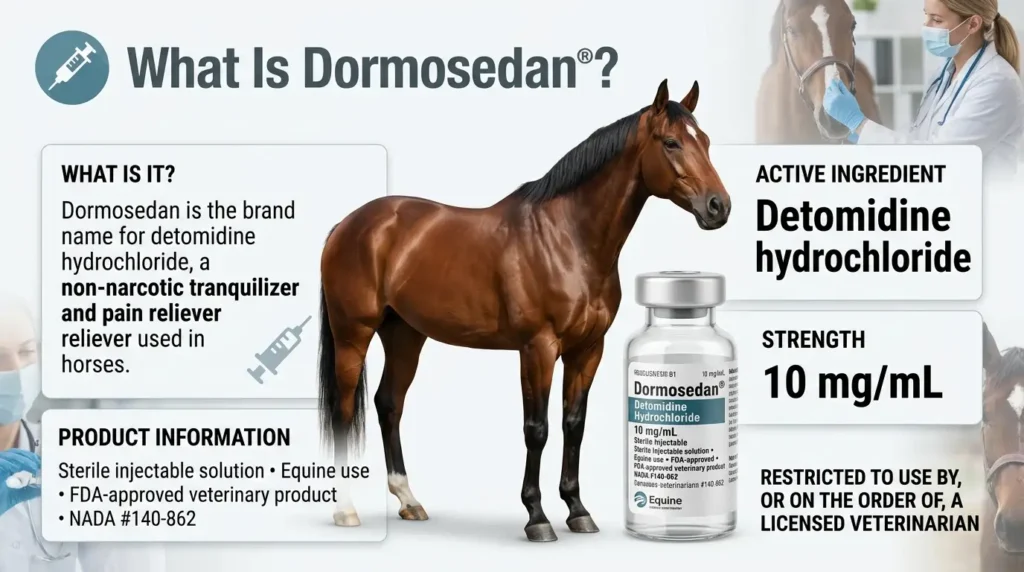
Detomidine hydrochloride, which is a sterile injectable solution, is the brand name of Dormosedan, a product that is produced by Zoetis and is only used in horses. It is a non-narcotic tranquilizer and pain reliever, and has enjoyed a long history of use in equine medicine, having been available in the market about thirty years, and is one of the oldest standing-sedation medications of its kind.
Active Ingredient and Concentration
Dormosedan Sterile Solution is 10 mg of detomidine hydrochloride in 1 ml of water-injection base that includes methylparaben as a preservative and sodium chloride. That 10 mg/mL is the figure all dosing calculations are constructed around - it is what 20 mcg/kg of a 100 kg horse is, exactly 0.2 mL.
Detomidine for horses is a white, water-soluble crystalline substance. It's approved by the FDA under NADA #140-862 and is restricted by federal law to use by, or on the order of, a licensed veterinarian.
How Dormosedan Works in the Body
Detomidine hrse medication is a man-made alpha-2 adrenoreceptor agonist. In simple language, it attaches itself to receptors in the central nervous system which reduces arousal and pain transmissions. The outcome is dose dependent sedation and analgesia (pain relief) especially in surface and internal (visceral) pain.
Physically, a sedated horse normally exhibits a lowered head, decreased response to sound and movement and a short duration of instability after which it gets into a firm and wide position. The heart rate decreases significantly and blood pressure increases first and then returns to normalcy. The initial two minutes are characterized by slowing of respiration but within a few minutes, it becomes normal.
What Is Dormosedan Used For in Horses?

Approved Indications
Dormosedan dosage for horses is indicated to be used as a sedative and pain killer to render minor surgical and diagnostic procedures bearable in adult horses, as well as in yearlings.
Common Procedures Where Vets Use It
Practically, the veterinarians pick Dormosedan when:
- Soothing squirrelly or jumpy horses to ride.
- Abdominal pain (colic) during diagnosis.
- Bronchoscopy and bronchoalveolar lavage.
- Nasogastric intubation
- Non-reproductive rectal palpation
- Suturing skin lacerations
- The procedure of castration, in which it is also used as a component of the local anesthetic regimen.
- Standing dentistry, minor standing surgery, shockwave therapy, and regenerative treatments.
It is not marked as a breeding product in horses - little information is available on its action in breeding stallions and mares, so is not a product of choice in that group.
Dormosedan Dosage Chart For Horses By Weight
This chart uses the label's 10 mg/mL concentration. Volumes are rounded to two decimal places.
| Horse Weight | Weight (lb) | 20 mcg/kg dose (mL) | 40 mcg/kg dose (mL) |
| 200 kg | ~440 lb | 0.40 mL | 0.80 mL |
| 300 kg | ~660 lb | 0.60 mL | 1.20 mL |
| 400 kg | ~880 lb | 0.80 mL | 1.60 mL |
| 450 kg | ~990 lb | 0.90 mL | 1.80 mL |
| 500 kg | ~1,100 lb | 1.00 mL | 2.00 mL |
| 550 kg | ~1,210 lb | 1.10 mL | 2.20 mL |
| 600 kg | ~1,320 lb | 1.20 mL | 2.40 mL |
| 700 kg | ~1,540 lb | 1.40 mL | 2.80 mL |
Simple guideline based on the manufacturer dosing recommendations: in a typical 1,100 lb horse, that would be approximately 1 to 2 mL total, either IV or IM, based on the intensity of the required sedation. This is in agreement with the chart above.
How to Calculate Dormosedan Dosage Manually
The formula of all numbers above:
Dose (mL) = (Body weight in kg × Dose rate in mcg/kg) ÷ 10,000The 10,000 is obtained by dividing the concentration (10mg/mL) by the mcg/ml (10,000mg/10,000mcg).
Example worked: A 40 mcg/kg dose of a 450 kg horse at 40 m height:
450 × 40 = 18,000 mcg → 18,000 ÷ 10,000 = 1.8 mL
When you just have the weight of the horse in pounds, first find: kg = lb / 2.2.
Dormosedan IV vs. IM Administration
| Factor | IV (Intravenous) | IM (Intramuscular) |
| Approved for sedation | Yes | Yes |
| Approved for analgesia | Yes | No — IV only |
| Onset | 2–4 minutes | 3–5 minutes |
| Precision | Faster, more titratable | Slightly slower onset, useful when IV access is difficult |
| Typical setting | Clinic, hospital, controlled environment | Field settings, fractious horses where IV access is unsafe |
The label is specific on this point: analgesia and combined sedation/analgesia dosing has only been established for IV use. IM is an option for sedation alone.
Onset and Duration of Sedation and Analgesia
- Sedation, 20 mcg/kg: onset in 2–4 minutes (IV) or 3–5 minutes (IM); lasts 30–90 minutes.
- Sedation, 40 mcg/kg: onset window is the same; duration is about 90 minutes to 2 hours.
- Analgesia, 2 0 mcg/kg (IV): effect onset in 245 minutes; effect duration 3045 minutes.
- Analgesia, 40 mcg/kg (IV): onset in 2-4 minutes; duration 45-75 minutes.
Allowing the horse to stand calmly some 5 minutes prior to injection, and 10-15 minutes after, is likely to enhance the working rate of the drug - a fact expressly spelled out in the handling instructions of the manufacturer.
Dormosedan vs. Xylazine: How Do They Compare?
The other commonly used alpha-2 agonist in equine practice is xylazine, thus it is an easy point of comparison.
| Factor | Dormosedan (detomidine) | Xylazine |
| Drug class | Alpha-2 adrenoreceptor agonist | Alpha-2 adrenoreceptor agonist |
| Relative potency | Manufacturer dosing materials place detomidine's sedative/analgesic potency at roughly 80–100 times that of xylazine | Baseline reference |
| Duration | Longer — up to ~2 hours at the high dose | Shorter, typically well under an hour |
| Receptor selectivity | More selective for alpha-2 receptors | Can also act on alpha-1 and non-alpha-2 sites, which manufacturer materials associate with more variable neurologic effects |
| Best fit | Longer procedures, deeper or more predictable sedation | Quick procedures needing brief sedation |
No drug substitutes the other on all counts - the correct option will be determined by the duration of the procedure, temperament of the horse, and the guidelines of the veterinarian attending.
Side Effects of Dormosedan in Horses
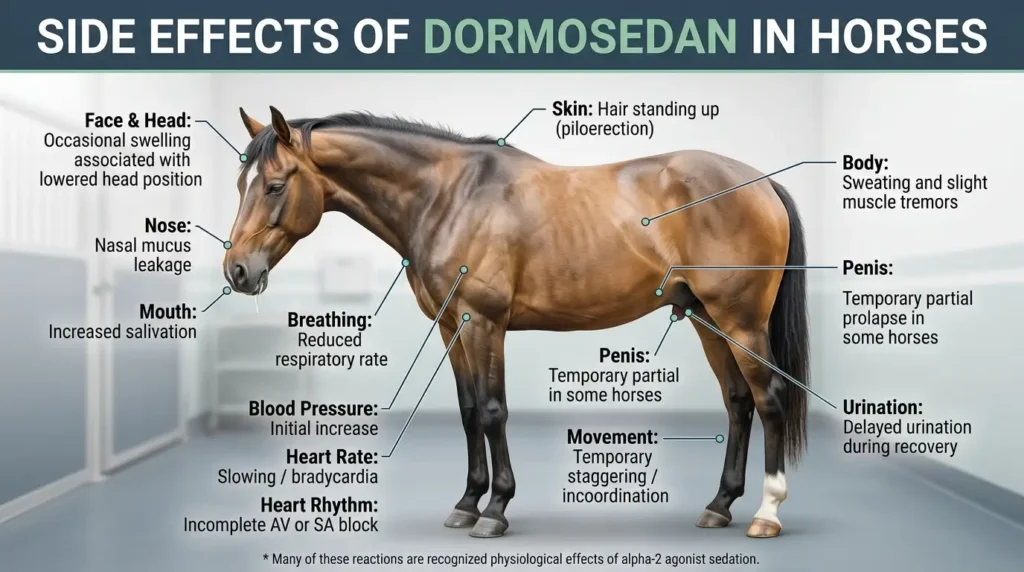
Majority of them are normal physiological reactions to an alpha-2 agonist and not indications that something is amiss, although they should be noted by the owners:
- High blood pressure and then slowing of the heart rate (bradycardia), which begins approximately one minute after injection - this is a normal baroreceptor reaction to the initial elevation of blood pressure, not a pathological issue.
- Piloerection (hair standing up), sweating, salivation and slight muscle tremors.
- Some horses have partial and transient penile prolapse.
- Incomplete AV or SA block, and low heart and respiratory rate.
- Delayed urinating, usually at 45-60 minutes of recovery.
- Staggering (or incoordination) during the initial 3-5 minutes, until the horse gains solid footing.
- Naresal mucus leakage and facial or head swelling occasionally due to the lowered head position during sedation - the head should be kept a little higher and this usually prevents it.
Serious Adverse Reactions and Warnings
Serious reactions, although rare, have been reported such as anaphylactic-like reactions: hives, skin plaques, difficulty breathing, upper airway swelling, trembling, collapse and, in rare instances, death.
Epinephrine should not be used to treat a response to Dormosedan - the label cautiously states that epinephrine may enhance (increase the action) of alpha-2 agonists. Serious reactions require symptomatic medical care and not epinephrine. Mild reactions have mostly subsided on their own without treatment.
Like any alpha-2 agonist, there are isolated instances of paradoxical excitation (the reverse of sedation).
Contraindications: When Not to Use Dormosedan
Dormosedan for horses dosage should not be used in horses with:
- AV (atrioventricular) or SA (sinoatrial) heart block.
- Severe coronary insufficiency
- Cerebrovascular disease
- Respiratory disease
- Chronic renal failure
Nor should it be used concomitantly with IV potentiated sulfonamides in a sedated or anesthetized horse as this has been associated with potentially fatal heart rhythm disturbances.
Since not a lot of safety data exists on breeding animals, Dormosedan is not advised when using stallions or mares to breed.
Precautions Before and After Giving Dormosedan
- Use with caution in those horses that are in, or approaching endotoxic or traumatic shock.
- Be careful with horses that have a well-developed liver or kidney disease.
- Should not be used in horses during heat, cold, fatigue or when they are exposed to stresses of high altitude and sedated horses should not be exposed to extreme temperatures.
- Not even the most apparently deep-sedated horses will not respond to sudden stimuli, so handlers must remain alert and observe the usual safety precautions, no matter how much the horse seems to be asleep.
- To reduce the risk of choke and aspiration, withhold food and water until the sedative effect has passed.
- When taking Dormosedan in the case of abdominal pain, it needs to be administered in addition to and not in place of a complete physical examination and diagnostic testing to determine the true cause of the pain.
Drug Interactions
- Other tranquilizers, painkillers, or anesthetics: Dormosedan is a strong alpha-2 agonist, and when used with other CNS-depressant medications, it can have additive - unpredictable - effects. Much care is necessary.
- IV potentiated sulfonamides: not recommended in sedated or anesthetized horses since it may cause severe dysrhythmias (see Contraindications).
- Epinephrine: is contraindicated in case of adverse reaction to Dormosedan, because it may increase alpha-2 agonist effects.
- Atropine: the label states that IV atropine at 0.02 mg/kg may inhibit the momentary cardiac conduction changes (partial AV/SA block) occasionally observed with detomidine - a point that would be of interest to the vets in how they handle the cardiac effects of the drug, not an owner-administered intervention.
Always inform the veterinarian who attends of all the medications, supplements, and recent treatments before sedation.
Overdose: What Happens If a Horse Gets Too Much?
The safety studies conducted by the manufacturer showed that horses could withstand doses up to 200 mcg/kg -10 times the low label dose, and 5 times the high dose -without the dire results that occurred in higher levels of the experiment. But, in individual safety testing, 400 mcg/kg daily over 3 days resulted in microscopic foci of myocardial damage (myocardial necrosis) in 1 of 8 horses dosed.
This isn't a home-management scenario. In case of the suspicion of overdose, a veterinarian should be contacted at once to provide some supportive treatment.
Storage, Handling, and How Dormosedan Is Supplied
- Storage: Room temperature, 59 o C-86 o C (15 o C-30 o C), light-sensitive.
- Supply quantities: 5 mL and 20 mL multidose vials.
- Status of prescription: Federal law places restrictions on the use of Dormosedan to be used only by, or under the direction of, a licensed veterinarian.
- Do not use in the horse that is to be fed on by humans.
Human Safety Warning
Dormosedan Injectable dosage for horses is well absorbed when accidentally absorbed orally, and should therefore be taken care to avoid this. It is not irritating to the eyes and skin during normal testing, and is not well absorbed through intact skin, although exposure must be avoided anyway- wash the affected skin or eyes with water in case of contact with it.
It is recommended that handlers observe general precautions when handling loaded syringes to avoid self-injection of drug as it is a drug with strong physiological effects in small doses.
Dormosedan Injectable vs. Dormosedan Gel
Dormosedan Gel is also produced by Zoetis and it is an oral, sublingual (under-the-tongue) version of detomidine that is a milder standing sedative, self-administered to a horse by its owner prior to regular care such as farrier work, clipping, and loading onto a trailer.
It cannot be used to replace the injectable solution - the gel is dosed with a different weight-based syringe system, has a different onset window (sedation usually builds up over a period of about 40 minutes), and is not designed to achieve the deep levels of sedation and analgesia the injectable can in surgical and diagnostic procedures.
The gel is not the alternative when a procedure requires injectable level of sedation or pain control.
Myth vs. Fact
Myth: More Dormosedan, translates to a quieter horse with no drawback.
Fact: Increased doses prolong the sedation and increase analgesia, however they do not increase safety in a linear manner - overdose evidence indicates actual cardiac risks with extreme, repeated doses.
Myth: "Dormosedan medication works the same IV or IM.
Fact: IM is not labeled as sedative and its onset is slower, and analgesic dosing is determined only in the IV form.
Myth: When a horse does not behave, epinephrine will get him going.
Fact: Epinephrine may exacerbate an alpha-2 agonist response and should be avoided, reactions should be treated symptomatically by a veterinarian.
Myth: There is no difference between Dormosedan Gel and injectable.
Fact: The same active ingredient, different route, different dosing system, and different depth of effect they are not interchangeable.
You May Also Like to Read:
- Benadryl Dosage For Horses: Calculator, Chart & Safe Guide
- Uniprim Dosage For Horses: Calculator, Chart & Safe Guide
FAQs
What is Dormosedan used for in horses?
Dormosedan dose is administered to calm and give pain relief to horses during minor surgical and diagnostic procedures - procedures such as castrations, dental, would repair, colic workup, and standing procedures that require a horse to remain quiet and calm.
How long does Dormosedan sedation last in a horse?
Sedation has a typical duration of 30-90 minutes at a dose of 20 mcg/kg. It has a duration of about 90 minutes to 2 hours at a dosage of 40 mcg/kg.
What is the rate of activity of Dormosedan?
The effect of IV administration is in 2-4 minutes. IM delivery is a bit more time-consuming, 3-5 minutes.
Is it possible to administer Dormosedan IM rather than IV?
Yes, for sedation. Nevertheless, only the IV administration has been proved to have analgesic and combined sedation/analgesia dosing.
Is Dormosedan safe for horses?
It has a long history of safety in decades of use, but it is a strong medication with actual contraindications - heart conduction problems, severe heart failure, cerebrovascular or respiratory disease, and chronic kidney disease are some of the reasons a veterinarian will not use it. It should always be given under veterinary direction.
What are the side effects of Dormosedan?
Hypertension with ensuing bradycardia, sweating, piloerection, slight muscle tremors, incoordination in initial few minutes, delayed urination during recovery, and infrequent nasal discharge or slight head swelling.
Are pregnant or breeding horses safe to use Dormosedan?
It's not recommended. In breeding stallions and mares, there is limited data on its effects, limited to uncontrolled clinical reports.
What will happen to a horse that eats too much Dormosedan?
Repeated high dose exposure (400 mcg/kg/day 3 days) has led to heart muscle damage in some horses in safety trials but the highest dose used has been up to 200 mcg/kg/day without any effects being noted except in the case of extreme experimental treatments. Possible overdose should be taken to a doctor.
Will a horse drink or eat after Dormosedan?
No. Food and water must be refused until the sedative has been worn off, to diminish the chances of choking.
Is Dormosedan the same as xylazine?
No. They are both alpha-2 agonists, but detomidine (Dormosedan) is much stronger and longer-acting, according to manufacturer dosing recommendations, whereas xylazine is usually faster, and has a shorter action.
What's the difference between Dormosedan Injectable and Dormosedan Gel?
The injectable is given IV or IM by a veterinarian for deeper sedation and analgesia during procedures. The gel is an oral, sublingual preparation designed to produce mild standing sedation and which can be self-administered by the owners to deal with the routine handling conditions, having a different dosing schedule and time of onset.
What is the storage of Dormosedan?
At controlled room temperature (59-86F) in darkness.
Final Thoughts
The dosing math of Dormosedan Injectable for horses is actually not that complex, the 10 mg per mL, 20 or 40 mcg per kg, and so on, and then all other dosing parameters are derivatives of these numbers, onset, duration, route, etc. What really needs to be judged is all that surrounds the number: is this horse a candidate with its heart and health history, is IV or IM the right decision, and what happens when things go bad.
Such a verdict is that of a veterinarian that has examined the horse, each time. Enter the calculator and chart above to go through the math quicker, but not the professional conversation.