
Acepromazine Dosage For Horses: Calculator, Chart & Safe Guide
Your vet just prescribed acepromazine, or “ace,” for your horse – and now you’re standing at the barn with a vial, a syringe, and a body-weight tape, trying to work out the right amount. That’s exactly what this guide is for.
Acepromazine Dosage For Horses is one of the oldest and most commonly used of the sedatives used in equine practice. It is also one of the most forgiving drugs to get a little wrong and the correct dose is dependent on body weight, desired level of sedation and route of injection. Do it right and you will have a horse that is calm and controllable. Wrong and you risk wasting the appointment or putting your horse at risk unnecessarily.
Below you will find the FDA recommended dose, a complete weight-based dose chart, an interactive calculator and answers to questions about what acepromazine does, why it is used, what it does not do and what to look out for following administration.
The information included in this article is educational and should not take the place of veterinary advice from your treating veterinarian. Acepromazine for horses is a federally controlled, prescription only veterinary medication. Don’t give it or change a dose without your veterinarian’s directions.
Acepromazine Dosage Calculator For Horses
Reference dosing tool for acepromazine maleate injection
Horses onlyCalculated Dosage
- The dosage should be individualized according to the degree of tranquilization required.
- As a general rule, the required dose in mg per lb of body weight decreases as the horse’s weight increases — the calculated range is a starting reference, not a fixed prescription.
- This guideline applies to IV, IM, or SC injection of acepromazine maleate.
Disclaimer: This calculator is for informational and reference purposes only and does not replace professional veterinary guidance. Always confirm dosing, route, and suitability for the individual animal with a licensed veterinarian before administration.
What Is Acepromazine?
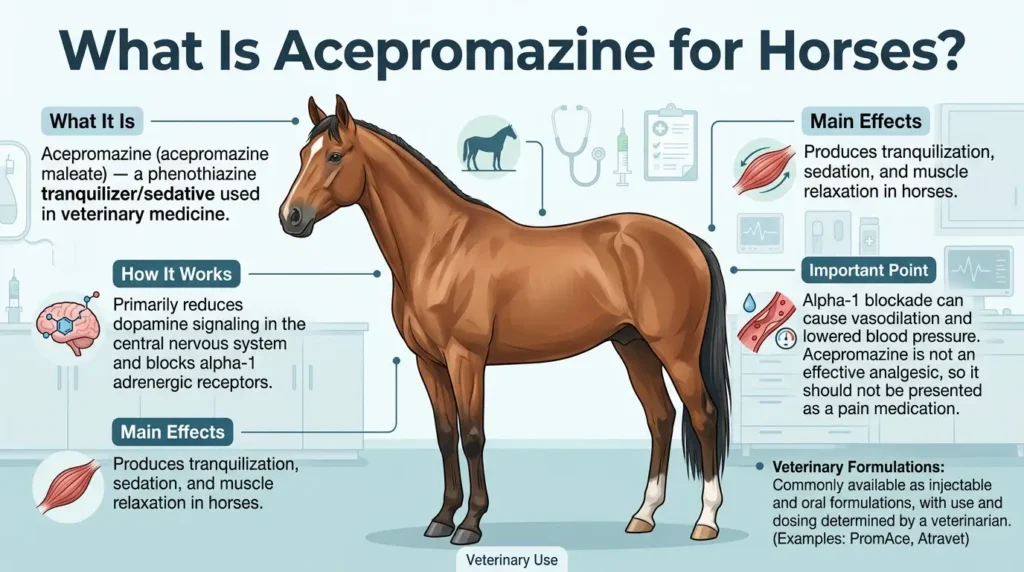
Acepromazine maleate for horses is a tranquilizer that belongs to the phenothiazine family of drugs that is approved for use in horses, dogs and cats. It was first developed as an antipsychotic in humans but was discontinued, and it continues to be a key sedative in veterinary medicine due to its effectiveness and low level of toxicity in comparison to dosage.
Pharmacologically, acepromazine inhibits dopamine transmission in the central nervous system, resulting in sedation and muscle relaxation, but it is not a very effective pain reliever. It also acts as an antagonist of alpha-1 adrenergic receptors, which causes blood vessels to dilate (vasodilation) and can lead to a decrease in blood pressure, a fact that will come in handy later on when discussing precautions.
It is marketed under veterinary names like PromAce and Atravet, and as a tablet (marked for dogs but prescribed off-label for horses by a veterinarian) and injectable solution (10 mg/mL) for horses.
What Is Acepromazine Used for in Horses?
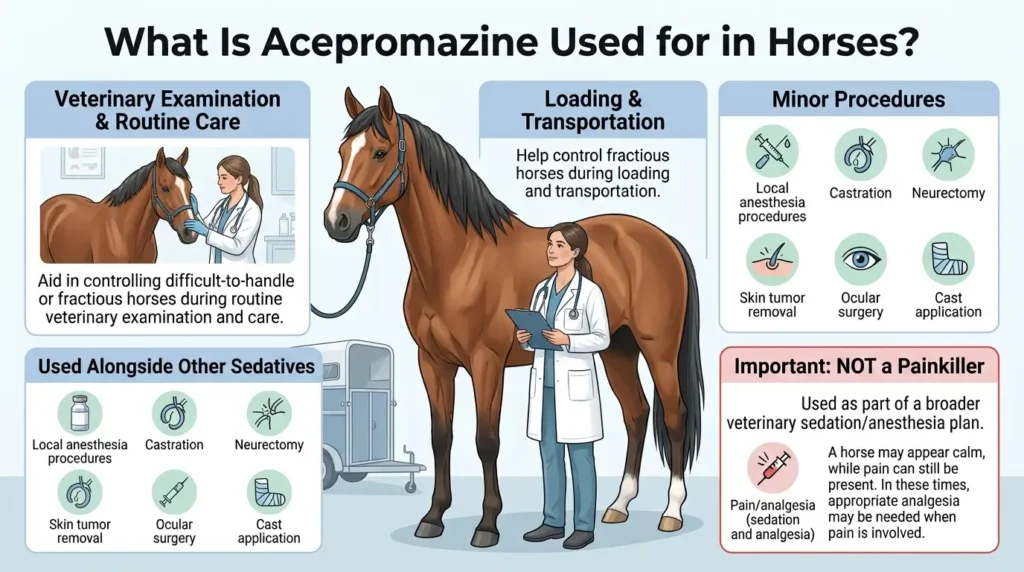
The label approved by the FDA in horses states that injectable acepromazine (ACE for horses) is used as an aid in the control of fractious (difficult to handle) horses during:
- Examination and routine vet care
- Loading and transportation
- Minor local anesthesia procedures such as firing, castrations, neurectomy, skin tumor removal, ocular surgery and cast application.
In the day to day application of acepromazine (ACE Dosage for Horses) , it is used in a combination with other sedative drugs; for instance, acepromazine is often administered to calm an anxious horse before using another sedative, or to decrease the amount of general anesthetic used during a procedure.
One thing acepromazine is not: a painkiller. if your horse is not feeling it, then Ace will make him appear calm, but will not be treating any pain involved and it is common for vets to prescribe an analgesic in conjunction with Ace if there is an element of pain.
Acepromazine Dosage Chart for Horses By Weight
Dosage is adjusted according to the degree of sedation desired – according to the label, the amount needed per lb of body weight will be less the heavier the horse. The normal range Acepromazine for Horses is:
2 to 4 mg of acepromazine per 100 lb of body weight, given IV, IM, or SC.Here’s how that translates across typical horse weights:
| Body Weight | Low-End Dose (2 mg/100 lb) | High-End Dose (4 mg/100 lb) | Volume at 10 mg/mL (low–high) |
| 400 lb (pony/foal) | 8 mg | 16 mg | 0.8–1.6 mL |
| 700 lb | 14 mg | 28 mg | 1.4–2.8 mL |
| 1,000 lb (average light horse) | 20 mg | 40 mg | 2.0–4.0 mL |
| 1,200 lb | 24 mg | 48 mg | 2.4–4.8 mL |
| 1,500 lb (draft-type) | 30 mg | 60 mg | 3.0–6.0 mL |
| 2,000 lb (large draft) | 40 mg | 80 mg | 4.0–8.0 mL |
Volumes are listed in the typical injectable formulation of 10 mg/mL. Always verify the concentration on the specific vial provided and before injecting always verify the exact dose and volume with your veterinarian.
How Is Acepromazine Given to Horses?
Acepromazine can be administered three ways:
- Intravenous (IV) (fastest onset, but slow injection is required). Accidental injection in an artery rather than a vein (intracarotid injection) is a serious possibility in horses and can result in disorientation, seizures or death, therefore IV injections should be administered by a veterinarian or experienced handler under close supervision.
- Intramuscular (IM) most commonly used for owner/handler administration when approved by a vet.
- Subcutaneous (SC) or under the skin, and is usually used, also with somewhat slower effect than IM.
No matter which way one takes, patience is key. It is recommended that the full effect of the label dose be allowed at least 15 minutes to occur after an IV dose, with some equine specific sources stating that the practical window prior to assessing the full effect of the dose is more likely to be 15-30 minutes after an IM/SC dose.
Do not “top up” the dose if the horse does not appear sedated, watch first and if in doubt, please contact your veterinarian.
How Long Does Acepromazine Take to Work – and How Long Does It Last?
Time of onset varies by route of administration and dosage but is usually within 15-30 minutes of injection. Sedation typically lasts for 1 to 4 hours, depending on dosage administered, the horse, and whether used with other sedatives.
Given this type of variability, schedule any activity which involves acepromazine with a generous margin of error on either side; trailering, a farrier visit, a procedure.
Side Effects of Acepromazine in Horses
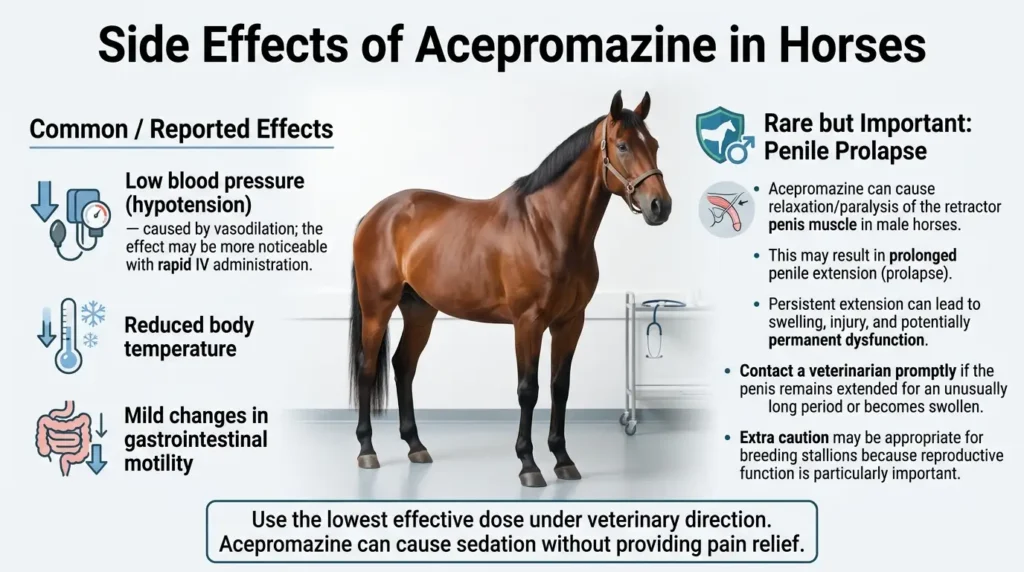
Acepromazine dosage for horses is well tolerated by most horses. The following effects are reported from the FDA label and the veterinary pharmacology literature:
- Vasodilating effect of the drug leads to low blood pressure (hypotension) which can be more noticeable if given at a fast rate via IV.
- Reduced body temperature
- Slight alterations in gut transit.
- The most clinically significant, but rare, side effect is penile prolapse in male horses.
Penile Prolapse: What Owners Should Know
Acepromazine medication has been reported to cause paralysis of the retractor penis muscle in male horses, which results in a more prolonged extension (prolapse) of the penis than sedation-induced, short-term, non-permanent relaxation. It is a real risk to be aware of, but it can also often be misinterpreted, so here is the balanced view:
- The label already states that the dose should be kept to a minimum and alerts to the risk prior to considering dosing any horse male or not.
- Recent veterinary literature (a retrospective study and a survey of practitioners) places the risk of permanent penile dysfunction at less than one in 10,000 and as a result, many veterinary practitioners today routinely use acepromazine in geldings and stallions.
- If the penis stays down for a long time it can swell and get injured, and make the temporary (reversible) effect permanent. Contact your vet immediately if a male horse’s penis does not retract a few hours after being sedated or if it is swollen.
- Generally, the extra care is warranted in breeding stallions as the cost of risk to reproductive function is greater.
Contraindications & Precautions
Acepromazine horse dosage is not necessarily right for all horses. Consult your veterinarian before using in horses with:
- Cardiovascular disease or any disease which can cause low blood pressure.
- Liver disease (acepromazine is processed in the liver)
- Anemia
- Very young/old age
- Dehydration, shock, or debilitation — tranquilizers will enhance the other CNS depressant effects
- Organophosphate poisoning — acepromazine should never be used to treat tremors of organophosphate poisoning, should not be given in combination with organophosphate dewormers or flea/tick products.
The label also states that it should not be used in horses for human food or for the treatment of hypotension that occurs following acepromazine administration because it paradoxically can exacerbate this blood pressure drop; in this emergency situation you should use norepinephrine or phenylephrine – this is something which should be left to the veterinary profession.
Drug Interactions
Phenothiazines affect more than one receptor type, and acepromazine dose does have the potential for interaction. Never give your veterinarian a partial list of medications and supplements before acepromazine is administered. Reactions to watch for are:
| Drug/Class | Interaction Concern |
| Organophosphate dewormers/insecticides | Acepromazine can potentiate their toxicity; avoid combining |
| Procaine (local anesthetic) | Acepromazine may enhance procaine’s activity |
| CNS depressants (barbiturates, opioids, anesthetics) | Additive sedation/depression |
| Epinephrine | Contraindicated for treating acepromazine-induced hypotension — can worsen it |
| Propranolol | Blood levels of both drugs may rise when combined |
| Quinidine | Potential for additional cardiac effects |
| Phenytoin | Acepromazine may slow its metabolism |
| Metoclopramide | May increase metoclopramide side effects |
| Acetaminophen | May increase risk of low body temperature |
This list is of known interactions reported in veterinary pharmacology books, and it is by no means complete; always tell your veterinarian about any drugs your horse is taking, including those that might appear unrelated.
Is Acepromazine Safe for Horses?
Acepromazine dosage for horses is a well-tolerated drug in horses, with a low order of toxicity per dose as demonstrated by acute toxicity studies when used at labeled doses in an appropriate patient under veterinary supervision. The word “safe” is used in the context of safe when used properly, not risk free in all horses.
Your vet will make that decision—whether it’s your horse’s heart, liver, hydration status or reproductive status—if ace is not the right choice for this day.
What to Monitor After Dosing
- Degree of sedation and response
- Heart rate and rhythm (the vet might look for signs of low blood pressure)
- In male horses: penile retraction; and protection of the penis from injury if it is still dropped
- General effects of drugs wearing off, particularly before the horse is returned to normal turn out or activity.
Overdose: What Happens If a Horse Gets Too Much?
Literature does not contain a large amount of information about overdose of acepromazine in horses. If studied in any species (dogs and cats), the signs of overdose are extreme sedation, poor co-ordination, inability to rise, seizures and profound hypotension.
Management is supportive veterinary care while the drug is metabolized. If you think your horse has overdosed, which is an unusually severe reaction, collapse or has seizure-like activity, it is a veterinary emergency and you should call right away rather than waiting.
Is Acepromazine Legal in Horse Competitions?
No – not on show day. Acepromazine is:
- Banned in competition (FEI rules) on the FEI’s Equine Prohibited Substances List.
- It is a Category II (shorter-acting sedative/tranquilizer) prohibited substance (see USEF Chapter 4 Drugs and Medications) and is subject to a mandatory withdrawal period prior to competition; while a seven-day withdrawal period is often referenced when dealing with shorter-acting sedative/tranquilizer drugs, horses metabolize them individually and detection periods are not absolute.
- No excuse for routine uses such as clipping, shipping or teeth floating immediately prior to a show — USEF specifically states the following in its exceptions to therapeutic use:
In conclusion, if your horse is scheduled for a show, sanctioned event, or FEI competition, inform your veterinarian of the date before he/she grabs acepromazine, and never dose “just in case” close to a show without checking your organization’s rule book (rules and withdrawal guidance change periodically).
Myth vs. Fact
| Myth | Fact |
| “Ace is a painkiller.” | It’s a sedative/tranquilizer with no meaningful analgesic effect. |
| “More ace always means a calmer horse.” | Response plateaus and risk (hypotension, prolonged sedation) rises with dose; the label calls for individualized, minimum-effective dosing. |
| “It’s never safe to use in male horses.” | Serious, permanent complications are rare in modern data, though the risk is real enough to warrant caution and monitoring. |
| “If my horse isn’t sedated after 5 minutes, I should give more.” | Full effect can take 15–30 minutes; redosing too soon risks over-sedation. |
| “It’s fine to use before a schooling show if I stop a day or two before.” | Detection windows commonly cited are around a week for short-acting sedatists like acepromazine; always check current rules rather than assuming. |
You May Also Like to Read:
- Equioxx Dosage For Horses: Calculator, Chart & Safe Guide
- Cetirizine Dosage For Horses: Calculator, Chart & Safe Guide
FAQs
What does acepromazine dosage do for horses?
It is used for sedating fractious or nervous horses during handling, examination, transportation and for minor procedures and is also used in pre-anesthetic or standing sedation.
How is acepromazine given to a horse?
Through an injection into a vein, muscle or under the skin. IV doses must be given slowly.
What is the onset of aced for a horse?
The duration of effect is usually 15-30 minutes, depending on the route and the dose; full effect may take at least 15 minutes after an IV dose.
What is the duration of the effect of acepromazine on a horse?
Sedation typically only lasts for approximately one to four hours depending on the individual horse and dose.
Does acepromazine relieve pain in horses?
No. It calms and relaxes the horse, but it does not have a pain relieving effect as such.
Is acepromazine safe for horses?
Yes, as it’s been used for a long time and is non-toxic at the recommended doses as long as prescribed by a veterinarian who has assessed the horse’s health.
What does Acepromazine do to horses?
Decreased BP, decreased body temp, minor changes in GI motility, and, uncommonly, penile prolapse in male horses.
Is Acepromazine suitable for use in stallions/geldings?
Yes, but with an awareness of the (rare) risks of penile prolapse; many vets use its routinely in male horses and monitor them after that, and with extra caution when used in breeding stallions.
Are there possible side effects to over-dosing a horse on acepromazine?
There is no specific documentation of overdosing in horses, but from other species, one would expect profound sedation, low blood pressure, poor coordination or worse. If there is any possibility of an overdose, this is an emergency; contact your veterinarian.
Does acepromazine interact with other drugs?
Yes, including organophosphate parasiticides, procaine, other CNS depressants and several cardiac and GI drugs. Always list all medications your horse takes before giving it to him/her.
Is acepromazine allowed in horse competitions?
No – it is against FEI regulations and is a Category II prohibited substance under USEF rules, and requires a withdrawal period prior to competition.
In what way is acepromazine stored?
This product may be stored at controlled room temperature per the FDA label (68-77° F with excursions between 59-86° F) protected from freezing.
Key Takeaways
- The IV/IM/subcutaneous dosage recommended by the FDA for horses is 2-4 mg of acepromazine for every 100 lb of body weight.
- The dosage is reduced for larger horses (mg/lb requirement decreases with weight).
- IV injections should be administered slowly, and may take 15 minutes or more (some sources say as long as 30 minutes) to be fully effective.
- Acepromazine is a sedative and tranquilizer – it does not relieve pain.
- In male horses the most severe, but uncommon, adverse reaction is penile prolapse and failure to retract it.
- Acepromazine should not be used near competition as it is a FEI prohibited substance and a USEF category II substance.
Final Thoughts
Acepromazine Dosage For Horses is a dependable, a well-studied, and an effective equine sedative at the labeled dose of 2 to 4 mg/100 lb. While the calculation is simple, accuracy is important as factors such as body weight, route and level of sedation required by each individual horse on a particular day influence the correct dosage.
It’s simple: check with your veterinarian, double check the calculations using the calculator above, monitor your horse carefully after he or she has been given a dose (particularly male horses), and know competition regulations well in advance of the day. Acepromazine is a product that can be used to make veterinary care and handling safer for both horse and human – when used correctly, as directed by the label and your veterinarian.
The information in this article is intended for general information only and should not replace specific veterinary advice. Check with your veterinarian before giving any medication—including acepromazine—to your horse.